

Volume 12, Issue 2 (9-2026)
J Sport Biomech 2026, 12(2): 286-300 |
Back to browse issues page




Download citation:
BibTeX | RIS | EndNote | Medlars | ProCite | Reference Manager | RefWorks
Send citation to:


BibTeX | RIS | EndNote | Medlars | ProCite | Reference Manager | RefWorks
Send citation to:
Omidi H, Sabzevari Rad R, Ghorbani M. Changes in Lower Limb Strength and Neuromuscular Control during One Year of Military Training in Officer Cadets. J Sport Biomech 2026; 12 (2) :286-300
URL: http://biomechanics.iauh.ac.ir/article-1-452-en.html
URL: http://biomechanics.iauh.ac.ir/article-1-452-en.html


1- Department of Physical Education and Sport Sciences, Faculty of Command and management, Imam Ali Military' University, Tehran, Iran.
2- Department of Sport Injuries and Corrective Exercise, Faculty of Physical Education and Sport Sciences, University of Guilan, Rasht, Iran.
2- Department of Sport Injuries and Corrective Exercise, Faculty of Physical Education and Sport Sciences, University of Guilan, Rasht, Iran.
Full-Text [PDF 1963 kb]
(502 Downloads)
| Abstract (HTML) (1663 Views)
Full-Text: (658 Views)
Extended Abstract
1. Introduction
Military readiness is among the most critical requirements of any country, as an army lacking adequate readiness cannot effectively defend its borders. Human resources play a central role in achieving this readiness; consequently, the assessment and development of physical fitness have long been shared priorities within armed forces (1). Enhanced physical fitness improves resilience to both physical and psychological stresses encountered in combat, enabling military personnel to perform operational tasks effectively and maintain optimal performance under demanding conditions (3,4). The development of physical characteristics such as strength, balance, and endurance is essential for improving the functional capacity and practical military skills of service members, thereby contributing to successful professional and combat operations (4). Previous studies have demonstrated that military training positively influences soldiers’ physical fitness. A systematic review reported that military training enhances physical fitness, operational readiness, and resilience in harsh environments (9). Additionally, military training has been shown to increase muscular strength (10), improve balance (11), and enhance resilience during operational tasks (12). Despite these findings, a notable challenge in the field of military physical fitness research is the limited attention paid to neuromuscular factors—particularly balance and proprioception—following military and athletic training (13). For example, Ghorbani et al. reported that military training may increase the risk of musculoskeletal injuries by inducing alterations in landing biomechanics, including muscular asymmetry and impaired proprioception (14).
Another important limitation of previous research is that, due to the time-consuming nature of longitudinal investigations, many studies have focused primarily on short-term training interventions lasting 6 to 8 weeks and examined outcomes such as strength, endurance, balance, and proprioception (17). Consequently, the comprehensive and real-world effects of long-term military training programs on these neuromuscular components remain insufficiently explored. Given that muscular strength, muscular endurance, and balance are fundamental pillars for effective performance in military duties and operations (4,18), targeted attention to these components within officer cadet training programs is essential. Therefore, the present study aimed to evaluate the direct and practical effects of a routine military training program by examining changes in lower-limb neuromuscular indices, with a particular focus on strength, balance, and proprioception.
2. Methods
This study employed a longitudinal, prospective observational design with pre-test and post-test measurements. The statistical population consisted of officer cadets enrolled at Imam Ali University. Sample size was determined using G*Power software based on previous studies, assuming a significance level of 0.05 and a statistical power of 0.80, which yielded a required sample size of 30 participants (19). To account for potential attrition due to withdrawal or incomplete participation, 35 cadets were initially recruited. Ultimately, data from 30 participants who completed all assessments without significant attrition were included in the final analysis. Baseline data on selected muscle strength, dynamic balance, and lower-limb proprioception were collected upon the cadets’ entry to Imam Ali University. Following the pre-test assessments, participants completed a standard, routine military training program for a duration of one year. The training program comprised sprint and endurance running, field maneuvers involving rapid directional changes, obstacle jumping, load carriage (e.g., military backpacks), and bodyweight resistance exercises. After the one-year training period, all measurements were repeated using the same assessment protocols.
3. Results
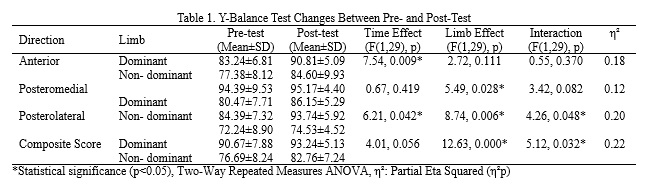
The results of the repeated measures analysis of variance in Table 1 showed that Y-balance in the anterior direction (η² = 0.18, P = 0.009) and posterolateral direction (η² = 0.20, P = 0.042) significantly improved in the post-test. Additionally, significant differences were observed between the dominant and non-dominant limbs in the posteromedial direction (P = 0.028), posterolateral direction (P = 0.006), and total score (P < 0.001 in the pre-test and P = 0.032 in the post-test). A significant interaction effect was observed only in the posterolateral direction (P = 0.048), indicating a greater improvement in the dominant limb compared to the non-dominant limb.
1. Introduction
Military readiness is among the most critical requirements of any country, as an army lacking adequate readiness cannot effectively defend its borders. Human resources play a central role in achieving this readiness; consequently, the assessment and development of physical fitness have long been shared priorities within armed forces (1). Enhanced physical fitness improves resilience to both physical and psychological stresses encountered in combat, enabling military personnel to perform operational tasks effectively and maintain optimal performance under demanding conditions (3,4). The development of physical characteristics such as strength, balance, and endurance is essential for improving the functional capacity and practical military skills of service members, thereby contributing to successful professional and combat operations (4). Previous studies have demonstrated that military training positively influences soldiers’ physical fitness. A systematic review reported that military training enhances physical fitness, operational readiness, and resilience in harsh environments (9). Additionally, military training has been shown to increase muscular strength (10), improve balance (11), and enhance resilience during operational tasks (12). Despite these findings, a notable challenge in the field of military physical fitness research is the limited attention paid to neuromuscular factors—particularly balance and proprioception—following military and athletic training (13). For example, Ghorbani et al. reported that military training may increase the risk of musculoskeletal injuries by inducing alterations in landing biomechanics, including muscular asymmetry and impaired proprioception (14).
Another important limitation of previous research is that, due to the time-consuming nature of longitudinal investigations, many studies have focused primarily on short-term training interventions lasting 6 to 8 weeks and examined outcomes such as strength, endurance, balance, and proprioception (17). Consequently, the comprehensive and real-world effects of long-term military training programs on these neuromuscular components remain insufficiently explored. Given that muscular strength, muscular endurance, and balance are fundamental pillars for effective performance in military duties and operations (4,18), targeted attention to these components within officer cadet training programs is essential. Therefore, the present study aimed to evaluate the direct and practical effects of a routine military training program by examining changes in lower-limb neuromuscular indices, with a particular focus on strength, balance, and proprioception.
2. Methods
This study employed a longitudinal, prospective observational design with pre-test and post-test measurements. The statistical population consisted of officer cadets enrolled at Imam Ali University. Sample size was determined using G*Power software based on previous studies, assuming a significance level of 0.05 and a statistical power of 0.80, which yielded a required sample size of 30 participants (19). To account for potential attrition due to withdrawal or incomplete participation, 35 cadets were initially recruited. Ultimately, data from 30 participants who completed all assessments without significant attrition were included in the final analysis. Baseline data on selected muscle strength, dynamic balance, and lower-limb proprioception were collected upon the cadets’ entry to Imam Ali University. Following the pre-test assessments, participants completed a standard, routine military training program for a duration of one year. The training program comprised sprint and endurance running, field maneuvers involving rapid directional changes, obstacle jumping, load carriage (e.g., military backpacks), and bodyweight resistance exercises. After the one-year training period, all measurements were repeated using the same assessment protocols.
3. Results
The results of the repeated measures analysis of variance in Table 1 showed that Y-balance in the anterior direction (η² = 0.18, P = 0.009) and posterolateral direction (η² = 0.20, P = 0.042) significantly improved in the post-test. Additionally, significant differences were observed between the dominant and non-dominant limbs in the posteromedial direction (P = 0.028), posterolateral direction (P = 0.006), and total score (P < 0.001 in the pre-test and P = 0.032 in the post-test). A significant interaction effect was observed only in the posterolateral direction (P = 0.048), indicating a greater improvement in the dominant limb compared to the non-dominant limb.
4. Discussion
The results of this study demonstrate the positive and significant impact of one year of military training on enhancing key neuromuscular performance indicators, including dynamic balance, proprioceptive accuracy, and muscular strength, in military cadets. The observed improvements, particularly in the dominant limb, highlight the importance of intensive and diverse military training in inducing superior neuromuscular adaptations. These findings can serve as a foundation for designing optimized training programs for military and athletic populations.
Ethical Considerations
Compliance with ethical guidelines
This study was conducted in accordance with the 2013 Helsinki Declaration. Participants provided informed consent after being informed of the research objectives. Data confidentiality and the right to withdraw were upheld.
Funding
This research did not receive any financial support from government, private, or non-profit organizations.
Authors' contributions
All authors contributed equally to preparing the article.
Conflicts of interest
The authors declare that they have no conflict of interest associated with this study.
The results of this study demonstrate the positive and significant impact of one year of military training on enhancing key neuromuscular performance indicators, including dynamic balance, proprioceptive accuracy, and muscular strength, in military cadets. The observed improvements, particularly in the dominant limb, highlight the importance of intensive and diverse military training in inducing superior neuromuscular adaptations. These findings can serve as a foundation for designing optimized training programs for military and athletic populations.
Ethical Considerations
Compliance with ethical guidelines
This study was conducted in accordance with the 2013 Helsinki Declaration. Participants provided informed consent after being informed of the research objectives. Data confidentiality and the right to withdraw were upheld.
Funding
This research did not receive any financial support from government, private, or non-profit organizations.
Authors' contributions
All authors contributed equally to preparing the article.
Conflicts of interest
The authors declare that they have no conflict of interest associated with this study.
Type of Study: Research |
Subject:
Special
Received: 2025/10/8 | Accepted: 2026/01/21 | Published: 2026/01/31
Received: 2025/10/8 | Accepted: 2026/01/21 | Published: 2026/01/31
References
1. Frehner C, Senn H. Juvenile obesity and fitness for military service. Schweizerische Medizinische Wochenschrift. 1988;118(40):1427-36.
2. Giles GE, Hasselquist L, Caruso CM, Eddy MD. Load carriage and physical exertion influence cognitive control in military scenarios. Medicine & Science in Sports & Exercise. 2019;51(12):2540-6. [DOI:10.1249/MSS.0000000000002085]
3. Pihlainen K, Santtila M, Vasankari T, Häkkinen K, Kyröläinen H. Evaluation of occupational physical load during 6-month international crisis management operation. International Journal of Occupational Medicine and Environmental Health. 2017;31(2):185-97. [DOI:10.13075/ijomeh.1896.01048]
4. Vaara JP, Groeller H, Drain J, Kyröläinen H, Pihlainen K, Ojanen T, et al. Physical training considerations for optimizing performance in essential military tasks. European Journal of Sport Science. 2022;22(1):43-57. [DOI:10.1080/17461391.2021.1930193]
5. Banka A, Bussmann M. Uncomfortable neighbors: NATO, Russia and the shifting logic of military exercises in the Baltics. Defence Studies. 2023;23(1):1-24. [DOI:10.1080/14702436.2022.2089657]
6. Ager AL, Roy J-S, Gamache F, Hébert LJ. The effectiveness of an upper extremity neuromuscular training program on the shoulder function of military members with a rotator cuff tendinopathy: a pilot randomized controlled trial. Military Medicine. 2019;184(5-6):e385-e93. [DOI:10.1093/milmed/usy294]
7. Gepner Y, Hoffman J, Hoffman M, Zelicha H, Cohen H, Ostfeld I. Association between circulating inflammatory markers and marksmanship following intense military training. BMJ Military Health. 2019;165(6):391-4. [DOI:10.1136/jramc-2018-001084]
8. Martin K, Périard J, Rattray B, Pyne DB. Physiological factors which influence cognitive performance in military personnel. Human Factors. 2020;62(1):93-123. [DOI:10.1177/0018720819841757]
9. Bustamante-Sánchez Á, Tornero-Aguilera JF, Fernández-Elías VE, Hormeño-Holgado AJ, Dalamitros AA, Clemente-Suárez VJ. Effect of stress on autonomic and cardiovascular systems in military population: a systematic review. Cardiology Research and Practice. 2020;2020(1):7986249. [DOI:10.1155/2020/7986249]
10. Radzak KN, Sedory EJ, Hooper M, Kasamatsu TM. Defining athletic training in the military setting: a survey investigation into professional characteristics, preparation, and barriers in clinical practice. Journal of Athletic Training. 2020;55(5):522-31. [DOI:10.4085/1062-6050-213-19]
11. Smith C, Doma K, Heilbronn B, Leicht A. Effect of exercise training programs on physical fitness domains in military personnel: a systematic review and meta-analysis. Military Medicine. 2022;187(9-10):1065-73. [DOI:10.1093/milmed/usac040]
12. Margolis LM, Murphy NE, Martini S, Spitz MG, Thrane I, McGraw SM, et al. Effects of winter military training on energy balance, whole-body protein balance, muscle damage, soreness, and physical performance. Applied Physiology, Nutrition, and Metabolism. 2014;39(12):1395-401. [DOI:10.1139/apnm-2014-0212]
13. Harman EA, Gutekunst DJ, Frykman PN, Nindl BC, Alemany JA, Mello RP, et al. Effects of two different eight-week training programs on military physical performance. The Journal of Strength & Conditioning Research. 2008;22(2):524-34. [DOI:10.1519/JSC.0b013e31816347b6]
14. Omidi H, Sabzevari Rad R, Ghorbani M. Biomechanical changes of the knee during jump-landing tasks: a longitudinal study of military cadets at Imam Ali (AS) University. Journal of Sport Biomechanics. 2026;11(4):424-37. [DOI:10.61882/JSportBiomech.11.4.424]
15. Alvani E, Shirvani H, Shamsoddini A. Neuromuscular exercises on pain intensity, functional disability, proprioception, and balance of military personnel with chronic low back pain. The Journal of the Canadian Chiropractic Association. 2021;65(2):193-206.
16. Orellana KV, Vásquez ML, Rebolledo GM, Muñoz EEG. Efectos de un entrenamiento neuromuscular sobre el equilibrio postural dinámico y propiocepción en basquetbolistas juveniles con inestabilidad funcional de tobillo. Retos: Nuevas Tendencias en Educación Física, Deporte y Recreación. 2022;(44):1104-12. [DOI:10.47197/retos.v44i0.91257]
17. Roshandel Hesari A, Aoshandel Hesari A, Mohagheghi Pirshahid A. The effect of eight weeks training in shallow water on static balance of military with knee injuries. Journal of Sport Biomechanics. 2022;7(4):260-9. [DOI:10.32598/biomechanics.7.4.319.1]
18. de la Motte SJ, Gribbin TC, Lisman P, Murphy K, Deuster PA. Systematic review of the association between physical fitness and musculoskeletal injury risk: Part 2-muscular endurance and muscular strength. The Journal of Strength & Conditioning Research. 2017;31(11):3218-34. [DOI:10.1519/JSC.0000000000002174]
19. Murayama K, Usami S, Sakaki M. Summary-statistics-based power analysis: a new and practical method to determine sample size for mixed-effects modeling. Psychological Methods. 2022;27(6):1014. [DOI:10.1037/met0000330]
20. Rashvand M, Shamlou Kazemi S, Hemati Afif A. Effects of combined exercises and vitamin D supplementation on serum levels of alkaline phosphatase in elderly women. Iranian Journal of Ageing. 2025;19(4):590-603. [DOI:10.32598/sija.2024.3806.1]
21. Ghorbani M, Shamloo Kazemi A, Babakhani F. The effect of fatigue on the time to stability in jumping and landing in football players who have undergone anterior cruciate ligament reconstruction. Journal of Rehabilitation Sciences & Research. 2022;9(4):167-72.
22. Rodríguez-Lorenzo L, Fernandez-del-Olmo M, Sanchez-Molina JA, Martín-Acero R. Role of vertical jumps and anthropometric variables in maximal kicking ball velocities in elite soccer players. Journal of Human Kinetics. 2016;53:143-154. [DOI:10.1515/hukin-2016-0018]
23. Ness BM, Albright J, Ehlers B, Glasoe T, Selby S, Zimney K, et al. The influence of center line width during the crossover hop test. Physical Therapy in Sport. 2020;46:63-9. [DOI:10.1016/j.ptsp.2020.08.005]
24. Rodrigo T, Hislop A, O'Leary SP, Window PJ. The reliability of goniometric measurement of frontal knee alignment in standing in people with knee osteoarthritis: a pilot study. Journal of Musculoskeletal Surgery and Research. 2025;9(2):260-5. [DOI:10.25259/JMSR_502_2024]
25. Negrete R, Simms S, Gross J, Rabello LN, Hixon M, Zeini IM, et al. The test re-test reliability of a novel single leg hop test (T-drill hop test). International Journal of Sports Physical Therapy. 2021;16(3):724-731. [DOI:10.26603/001c.23677]
26. Kendall F, McCreary E, Provance P. Muscles, testing and function. Medicine and Science in Sports and Exercise. 1994;26(8):1070. [DOI:10.1249/00005768-199408000-00023]
27. Pasco JA, Stuart AL, Holloway-Kew KL, Tembo MC, Sui SX, Anderson KB, et al. Lower-limb muscle strength: normative data from an observational population-based study. BMC Musculoskeletal Disorders. 2020;21(1):89. [DOI:10.1186/s12891-020-3098-7]
28. Oliver GD, Plummer HA, Washington JK, Weimar WH, Brambeck A. Effects of game performance on softball pitchers and catchers. The Journal of Strength & Conditioning Research. 2019;33(2):466-73. [DOI:10.1519/JSC.0000000000001848]
29. Navacchia A, Ueno R, Ford KR, DiCesare CA, Myer GD, Hewett TE. EMG-informed musculoskeletal modeling to estimate realistic knee anterior shear force during drop vertical jump in female athletes. Annals of Biomedical Engineering. 2019;47(12):2416-30. [DOI:10.1007/s10439-019-02318-w]
30. Coge M, Neiva HP, Pereira A, Faíl L, Ribeiro B, Esteves D. Effects of 34 weeks of military service on body composition and physical fitness in military cadets of Angola. Journal of Functional Morphology and Kinesiology. 2024;9(3):111. [DOI:10.3390/jfmk9030111]
31. Santtila M, Kyröläinen H, Häkkinen K. Changes in maximal and explosive strength, electromyography, and muscle thickness of lower and upper extremities induced by combined strength and endurance training in soldiers. The Journal of Strength & Conditioning Research. 2009;23(4):1300-8. [DOI:10.1519/JSC.0b013e3181a884bc]
32. Kraemer WJ, Vescovi JD, Volek JS, Nindl BC, Newton RU, Patton JF, et al. Effects of concurrent resistance and aerobic training on load-bearing performance and the Army physical fitness test. Military Medicine. 2004;169(12):994-9. [DOI:10.7205/MILMED.169.12.994]
33. Groeller H, Burley S, Orchard P, Sampson JA, Billing DC, Linnane D. How effective is initial military-specific training in the development of physical performance of soldiers? The Journal of Strength & Conditioning Research. 2015;29:S158-S62. [DOI:10.1519/JSC.0000000000001066]
34. Rosendal L, Langberg H, Skov-Jensen A, Kjær M. Incidence of injury and physical performance adaptations during military training. Clinical Journal of Sport Medicine. 2003;13(3):157-63. [DOI:10.1097/00042752-200305000-00006]
35. Hofstetter M-C, Mäder U, Wyss T. Effects of a 7-week outdoor circuit training program on Swiss Army recruits. The Journal of Strength & Conditioning Research. 2012;26(12):3418-25. [DOI:10.1519/JSC.0b013e318245bebe]
36. Aleksandr R, Serhii R, Viktor R, Aleksandr B, Vitalii K, Vyacheslav A, et al. Research on the organism response of reconnaissance officers on the specific load of military exercises. Journal of Physical Education and Sport. 2016;16(1):132-139.
37. Fyfe JJ, Hamilton DL. Spinal cord-level adaptations to resistance training: the'backbone'of early strength gains? Journal of Physiology. 2019;597(11). [DOI:10.1113/JP277893]
38. Keefe G, Wright C. An intricate balance of muscle damage and protein synthesis: the key players in skeletal muscle hypertrophy following resistance training. The Journal of Physiology. 2016;594(24):7157. [DOI:10.1113/JP273235]
39. Legg SJ, Duggan A. The effects of basic training on aerobic fitness and muscular strength and endurance of British Army recruits. Ergonomics. 1996;39(12):1403-18. [DOI:10.1080/00140139608964560]
40. O'Bryan SJ, Giuliano C, Woessner MN, Vogrin S, Smith C, Duque G, et al. Progressive resistance training for concomitant increases in muscle strength and bone mineral density in older adults: a systematic review and meta-analysis. Sports Medicine. 2022;52(8):1939-60. [DOI:10.1007/s40279-022-01675-2]
41. Morton RW, Murphy KT, McKellar SR, Schoenfeld BJ, Henselmans M, Helms E, et al. A systematic review, meta-analysis and meta-regression of the effect of protein supplementation on resistance training-induced gains in muscle mass and strength in healthy adults. British Journal of Sports Medicine. 2018;52(6):376-84. [DOI:10.1136/bjsports-2017-097608]
42. Yavnai N, Bar-Sela S, Pantanowitz M, Funk S, Waddington G, Simchas L, et al. Incidence of injuries and factors related to injuries in combat soldiers. BMJ Military Health. 2021;167(6):418-23. [DOI:10.1136/jramc-2019-001312]
43. Steinberg N, Bar-Sela S, Moran U, Pantanowitz M, Waddington G, Adams R, et al. Injury prevention exercises for reduced incidence of injuries in combat soldiers. The Journal of Strength & Conditioning Research. 2021;35(11):3128-38. [DOI:10.1519/JSC.0000000000004053]
44. Kounalakis S, Karagiannis A, Kostoulas I. Balance training and shooting performance: the role of load and the unstable surface. Journal of Functional Morphology and Kinesiology. 2024;9(1):17. [DOI:10.3390/jfmk9010017]
45. Thompson KR, Mikesky AE, Bahamonde RE, Burr DB. Effects of physical training on proprioception in older women. J Musculoskelet Neuronal Interact. 2003;3(3):223-31.
46. Lauersen JB, Bertelsen DM, Andersen LB. The effectiveness of exercise interventions to prevent sports injuries: a systematic review and meta-analysis of randomised controlled trials. British Journal of Sports Medicine. 2014;48(11):871-7. [DOI:10.1136/bjsports-2013-092538]
47. Zhang Y, Smeets JB, Brenner E, Verschueren S, Duysens J. Effects of ageing on responses to stepping-target displacements during walking. European Journal of Applied Physiology. 2021;121(1):127-40. [DOI:10.1007/s00421-020-04504-4]
48. Cooper Ci, Moon HY, Van Praag H. On the run for hippocampal plasticity. Cold Spring Harbor Perspectives in Medicine. 2018;8(4):a029736. [DOI:10.1101/cshperspect.a029736]
49. Liang J, Wang H, Zeng Y, Qu Y, Liu Q, Zhao F, et al. Physical exercise promotes brain remodeling by regulating epigenetics, neuroplasticity and neurotrophins. Reviews in the Neurosciences. 2021;32(6):615-29. [DOI:10.1515/revneuro-2020-0099]
50. Huang Z, Zhang Y, Zhou R, Yang L, Pan H. Lactate as potential mediators for exercise-induced positive effects on neuroplasticity and cerebrovascular plasticity. Frontiers in Physiology. 2021;12:656455. [DOI:10.3389/fphys.2021.656455]
51. Mohammadi F, Azma K, Naseh I, Emadifard R, Etemadi Y. Military exercises, knee and ankle joint position sense, and injury in male conscripts: a pilot study. Journal of Athletic Training. 2013;48(6):790-6. [DOI:10.4085/1062-6050-48.3.06]
52. Shakibirad A, Babagoltabar Samakoush H, Jalili R. Comparison of physical performance related to the health of students of Imam Ali University at different levels of education. Military Management Quarterly. 2025;24(96):143-73.
53. Moon D, Jung J. Effect of incorporating short-foot exercises in the balance rehabilitation of flat foot: a randomized controlled trial. Healthcare. 2021;9(10):1358. [DOI:10.3390/healthcare9101358]
| Rights and permissions | |
 |
This work is licensed under a Creative Commons Attribution-NonCommercial 4.0 International License. |

Journal of Sport Biomechanics
Department of Sport Biomechanics, Faculty of Humanities, Islamic Azad University, Hamedan Branch, Prof. Mousivand Blvd, Imam Khomeini Blvd, Hamedan, Iran.
Journal Tel: +98 81 34494042
Website: http://biomechanics.iauh.ac.ir
Email: sportbiomechanics@iauh.ac.ir
