

Volume 12, Issue 3 (11-2026)
J Sport Biomech 2026, 12(3): 372-393 |
Back to browse issues page




Download citation:
BibTeX | RIS | EndNote | Medlars | ProCite | Reference Manager | RefWorks
Send citation to:


BibTeX | RIS | EndNote | Medlars | ProCite | Reference Manager | RefWorks
Send citation to:
Najafpoor S, Fadaei H, Adigozali H, Ghiami Rad A. Effect of a Post-Activation Potentiation-Based Plyometric Warm-Up on Hand and Pelvis Linear Velocity During the Gyaku-Zuki Punch: A Quasi-Experimental Study. J Sport Biomech 2026; 12 (3) :372-393
URL: http://biomechanics.iauh.ac.ir/article-1-485-en.html
URL: http://biomechanics.iauh.ac.ir/article-1-485-en.html


1- Department of Sports Biomechanics, Faculty of Physical Education and Sport Sciences, Kharazmi University, Tehran, Iran.
2- Department of Physiotherapy, Faculty of Rehabilitation Sciences, Tabriz University of Medical Sciences, Tabriz, Iran.
3- Department of Motor Behavior, Faculty of Physical Education and Sport Sciences, University of Tabriz, Tabriz, Iran.
2- Department of Physiotherapy, Faculty of Rehabilitation Sciences, Tabriz University of Medical Sciences, Tabriz, Iran.
3- Department of Motor Behavior, Faculty of Physical Education and Sport Sciences, University of Tabriz, Tabriz, Iran.
Full-Text [PDF 2148 kb]
(876 Downloads)
| Abstract (HTML) (2553 Views)
Full-Text: (1066 Views)
1. Introduction
Karate is one of the most popular martial arts worldwide and is characterized by fast, precise, and coordinated movements of both the upper and lower extremities. Success in this sport depends not only on physical strength and endurance but also on precise neuromuscular coordination (1). In competitive kumite, punches are primarily used to score points and are executed in a controlled and rapid manner to minimize harm to the opponent. Among hand techniques, the gyaku-zuki (reverse punch) is recognized as one of the most effective and frequently used techniques (2). This technique is considered one of the most important striking techniques in karate, and its successful execution requires efficient force transfer from the lower to the upper body. Force generation begins in the legs and is transmitted through the pelvis, trunk, and shoulder before reaching the arm. This sequence represents a classic example of the kinetic chain, in which pelvis rotation contributes to increasing the final hand velocity, a factor of particular importance in short-duration explosive matches (3).
Although karate is generally considered a relatively safe sport, its contact and explosive nature expose athletes to various injuries involving both the upper body, such as the shoulder and elbow, and the lower body, such as the ankle and knee (4). To reduce injury risk, neuromuscular training programs that incorporate flexibility, strength, balance, and plyometric exercises are considered essential (5). Proprioceptive and balance-based interventions have been shown to reduce the risk of anterior cruciate ligament injury in young and novice athletes by as much as 50% (6). Furthermore, regular training programs that include warm-up, cool-down, and targeted stretching are regarded as important components of physical preparation for martial artists (7).
An active warm-up prior to training or competition is commonly performed to increase blood flow, oxygen delivery to muscles, flexibility, and motor coordination. Research has demonstrated that active warm-up protocols provide greater benefits than passive warm-up and may reduce injury incidence in contact sports (8, 9). However, stretching exercises, particularly when performed before explosive activities, may reduce muscle strength and power by 5–10% (10). Consequently, post-activation potentiation (PAP) protocols have gained considerable attention as an alternative strategy for enhancing performance (11, 12). PAP involves maximal or near-maximal contractions, including isometric, dynamic, and plyometric exercises, to facilitate motor unit recruitment, increase muscle power, and improve explosive athletic performance (13). Proposed mechanisms underlying PAP include phosphorylation of myosin regulatory light chains and enhanced neural activation, resulting in improved force production (14).
Plyometric exercises utilize the stretch-shortening cycle to enhance force production capacity, increase contraction velocity, and reduce the time required to generate force throughout the range of motion (15, 16). These characteristics are particularly relevant to karate punching techniques, which require precise neuromuscular coordination and efficient transfer of body-generated torque (17). Previous studies have reported that plyometric exercises can improve reaction time (18). In combat sport athletes, PAP-based plyometric protocols have also been shown to influence punch or kick performance variables, while no significant changes in fatigue rate have been observed (19). Therefore, combining active warm-up procedures with PAP-based plyometric exercises may provide an effective approach for enhancing explosive performance.
Despite growing interest in PAP interventions, limited information is available regarding their effects on the kinematic characteristics of karate punching performance, particularly the contribution of pelvis motion within the kinetic chain. Therefore, the present study aimed to investigate the effects of a PAP-based plyometric warm-up on hand and pelvis linear velocity, reaction time, punch frequency, and fatigue rate during the execution of the gyaku-zuki punch in male karate athletes. The findings may provide useful information for coaches and athletes when designing warm-up strategies for short-duration karate competitions.
2. Methods
This quasi-experimental study employed a pre-test–post-test design to investigate the effects of a plyometric post-activation potentiation (PAP) protocol on gyaku-zuki punch kinematics in male karate athletes. The study was conducted in 2025 at the Biomechanics Laboratory of the Faculty of Rehabilitation Sciences, Tabriz University of Medical Sciences, Tabriz, Iran. Participants completed three sessions, including one familiarization session and two experimental sessions separated by 48–72 hours. The experimental conditions consisted of: (1) a standard warm-up followed by the execution of the gyaku-zuki punch, and (2) a PAP protocol consisting of a standard warm-up combined with three sets of five maximal two-leg tuck jumps, followed by the execution of the gyaku-zuki punch. Kinematic variables, including maximum and mean velocity of the hand and pelvis, reaction time, punch frequency, and fatigue rate, were measured and analyzed using a three-dimensional motion capture system. Based on a G*Power analysis (version 3.1.9.4, Heinrich Heine University Düsseldorf, Germany), assuming an effect size of d = 0.60, a statistical power of 0.80, and α = 0.05, a sample size of 19 participants was required (20).
Nineteen Shotokan karate athletes were recruited through cooperation with the national karate federation and the provincial karate board. Inclusion criteria were male sex, right-handedness confirmed by the Edinburgh Handedness Questionnaire, absence of any medical condition limiting physical activity, engagement in at least 150 minutes of moderate-intensity physical activity per week, and age between 18 and 25 years. Exclusion criteria included any musculoskeletal injury, use of supplements or performance-enhancing substances during the previous six months, and participation in additional organized sports activities outside the study protocol. All participants received a detailed explanation of the study procedures and voluntarily signed an informed consent form before participation. The study protocol was approved by the Ethics Committee of Tabriz University of Medical Sciences (IR.TBZMED.REC.1403.908).
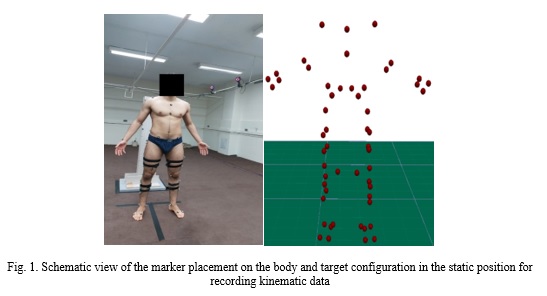
Punch kinematics were recorded using a three-dimensional motion capture system consisting of nine infrared cameras (Kestrel 2200, Motion Analysis Corporation, Santa Rosa, CA, USA) with a sampling frequency of 340 Hz (21). Fifty-six passive reflective markers (14 mm diameter) were attached to prominent anatomical landmarks (Fig. 1). Markers were placed on the first and fifth metatarsophalangeal joints, heels, malleoli, femoral epicondyles, anterior superior iliac spines, iliac crests, acromial processes, jugular notch, xiphoid process, humerus, radius, ulna, and the second and fifth metacarpals. Additional cluster markers were attached to the thighs and shanks (22). The system was calibrated before each testing session, yielding an average calibration error of less than 1 mm. Data collection was performed under controlled laboratory conditions (23 ± 1°C and 42 ± 2% relative humidity). Raw kinematic data were processed using Cortex software (version 7.2.16, Motion Analysis Corporation) and filtered with a fourth-order low-pass Butterworth filter with a cutoff frequency of 12 Hz. A six-degree-of-freedom biomechanical model was constructed in Visual3D software (version 6.01, C-Motion Inc., USA) based on a static calibration trial (19). Joint angles were calculated using the Cardan-Euler rotation sequence (Y-X-Z) according to International Society of Biomechanics (ISB) recommendations (23).
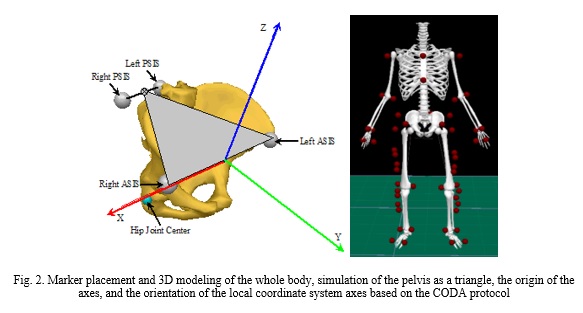
Specific marker sets were used to model different body segments. As shown in Fig. 2, the distal hand segment was defined using the second and fifth metacarpal markers, whereas the proximal segment was defined using the radius and ulna markers (22). Pelvis modeling was performed according to the CODA protocol, in which the pelvis was represented as a triangular structure. The vertices of this triangle consisted of the left and right anterior superior iliac spine markers and a posterior midpoint marker. Iliac crest markers were additionally used to improve tracking accuracy (24).
Karate is one of the most popular martial arts worldwide and is characterized by fast, precise, and coordinated movements of both the upper and lower extremities. Success in this sport depends not only on physical strength and endurance but also on precise neuromuscular coordination (1). In competitive kumite, punches are primarily used to score points and are executed in a controlled and rapid manner to minimize harm to the opponent. Among hand techniques, the gyaku-zuki (reverse punch) is recognized as one of the most effective and frequently used techniques (2). This technique is considered one of the most important striking techniques in karate, and its successful execution requires efficient force transfer from the lower to the upper body. Force generation begins in the legs and is transmitted through the pelvis, trunk, and shoulder before reaching the arm. This sequence represents a classic example of the kinetic chain, in which pelvis rotation contributes to increasing the final hand velocity, a factor of particular importance in short-duration explosive matches (3).
Although karate is generally considered a relatively safe sport, its contact and explosive nature expose athletes to various injuries involving both the upper body, such as the shoulder and elbow, and the lower body, such as the ankle and knee (4). To reduce injury risk, neuromuscular training programs that incorporate flexibility, strength, balance, and plyometric exercises are considered essential (5). Proprioceptive and balance-based interventions have been shown to reduce the risk of anterior cruciate ligament injury in young and novice athletes by as much as 50% (6). Furthermore, regular training programs that include warm-up, cool-down, and targeted stretching are regarded as important components of physical preparation for martial artists (7).
An active warm-up prior to training or competition is commonly performed to increase blood flow, oxygen delivery to muscles, flexibility, and motor coordination. Research has demonstrated that active warm-up protocols provide greater benefits than passive warm-up and may reduce injury incidence in contact sports (8, 9). However, stretching exercises, particularly when performed before explosive activities, may reduce muscle strength and power by 5–10% (10). Consequently, post-activation potentiation (PAP) protocols have gained considerable attention as an alternative strategy for enhancing performance (11, 12). PAP involves maximal or near-maximal contractions, including isometric, dynamic, and plyometric exercises, to facilitate motor unit recruitment, increase muscle power, and improve explosive athletic performance (13). Proposed mechanisms underlying PAP include phosphorylation of myosin regulatory light chains and enhanced neural activation, resulting in improved force production (14).
Plyometric exercises utilize the stretch-shortening cycle to enhance force production capacity, increase contraction velocity, and reduce the time required to generate force throughout the range of motion (15, 16). These characteristics are particularly relevant to karate punching techniques, which require precise neuromuscular coordination and efficient transfer of body-generated torque (17). Previous studies have reported that plyometric exercises can improve reaction time (18). In combat sport athletes, PAP-based plyometric protocols have also been shown to influence punch or kick performance variables, while no significant changes in fatigue rate have been observed (19). Therefore, combining active warm-up procedures with PAP-based plyometric exercises may provide an effective approach for enhancing explosive performance.
Despite growing interest in PAP interventions, limited information is available regarding their effects on the kinematic characteristics of karate punching performance, particularly the contribution of pelvis motion within the kinetic chain. Therefore, the present study aimed to investigate the effects of a PAP-based plyometric warm-up on hand and pelvis linear velocity, reaction time, punch frequency, and fatigue rate during the execution of the gyaku-zuki punch in male karate athletes. The findings may provide useful information for coaches and athletes when designing warm-up strategies for short-duration karate competitions.
2. Methods
This quasi-experimental study employed a pre-test–post-test design to investigate the effects of a plyometric post-activation potentiation (PAP) protocol on gyaku-zuki punch kinematics in male karate athletes. The study was conducted in 2025 at the Biomechanics Laboratory of the Faculty of Rehabilitation Sciences, Tabriz University of Medical Sciences, Tabriz, Iran. Participants completed three sessions, including one familiarization session and two experimental sessions separated by 48–72 hours. The experimental conditions consisted of: (1) a standard warm-up followed by the execution of the gyaku-zuki punch, and (2) a PAP protocol consisting of a standard warm-up combined with three sets of five maximal two-leg tuck jumps, followed by the execution of the gyaku-zuki punch. Kinematic variables, including maximum and mean velocity of the hand and pelvis, reaction time, punch frequency, and fatigue rate, were measured and analyzed using a three-dimensional motion capture system. Based on a G*Power analysis (version 3.1.9.4, Heinrich Heine University Düsseldorf, Germany), assuming an effect size of d = 0.60, a statistical power of 0.80, and α = 0.05, a sample size of 19 participants was required (20).
Nineteen Shotokan karate athletes were recruited through cooperation with the national karate federation and the provincial karate board. Inclusion criteria were male sex, right-handedness confirmed by the Edinburgh Handedness Questionnaire, absence of any medical condition limiting physical activity, engagement in at least 150 minutes of moderate-intensity physical activity per week, and age between 18 and 25 years. Exclusion criteria included any musculoskeletal injury, use of supplements or performance-enhancing substances during the previous six months, and participation in additional organized sports activities outside the study protocol. All participants received a detailed explanation of the study procedures and voluntarily signed an informed consent form before participation. The study protocol was approved by the Ethics Committee of Tabriz University of Medical Sciences (IR.TBZMED.REC.1403.908).
Punch kinematics were recorded using a three-dimensional motion capture system consisting of nine infrared cameras (Kestrel 2200, Motion Analysis Corporation, Santa Rosa, CA, USA) with a sampling frequency of 340 Hz (21). Fifty-six passive reflective markers (14 mm diameter) were attached to prominent anatomical landmarks (Fig. 1). Markers were placed on the first and fifth metatarsophalangeal joints, heels, malleoli, femoral epicondyles, anterior superior iliac spines, iliac crests, acromial processes, jugular notch, xiphoid process, humerus, radius, ulna, and the second and fifth metacarpals. Additional cluster markers were attached to the thighs and shanks (22). The system was calibrated before each testing session, yielding an average calibration error of less than 1 mm. Data collection was performed under controlled laboratory conditions (23 ± 1°C and 42 ± 2% relative humidity). Raw kinematic data were processed using Cortex software (version 7.2.16, Motion Analysis Corporation) and filtered with a fourth-order low-pass Butterworth filter with a cutoff frequency of 12 Hz. A six-degree-of-freedom biomechanical model was constructed in Visual3D software (version 6.01, C-Motion Inc., USA) based on a static calibration trial (19). Joint angles were calculated using the Cardan-Euler rotation sequence (Y-X-Z) according to International Society of Biomechanics (ISB) recommendations (23).
Specific marker sets were used to model different body segments. As shown in Fig. 2, the distal hand segment was defined using the second and fifth metacarpal markers, whereas the proximal segment was defined using the radius and ulna markers (22). Pelvis modeling was performed according to the CODA protocol, in which the pelvis was represented as a triangular structure. The vertices of this triangle consisted of the left and right anterior superior iliac spine markers and a posterior midpoint marker. Iliac crest markers were additionally used to improve tracking accuracy (24).
The onset and termination of each punch were identified from the wrist velocity–time curve using a threshold of three standard deviations above baseline velocity. Reaction time was defined as the interval between the auditory stimulus and the onset of right wrist movement (25, 26). For each punch cycle, mean punch velocity and peak punch velocity were calculated, and the highest value obtained by each participant was selected for analysis. Punch frequency was defined as the number of successful punches performed within a specified time interval. A successful punch was defined as a complete punch cycle in which the elbow reached maximal extension. Fatigue rate (FR) was calculated using the successful punch counts obtained across multiple sets (Equation 1). This index quantifies the decline in performance across successive sets, with higher values indicating greater fatigue accumulation (27).
Equation 1
FR %=(1-(N1+N2+N3+N4+N5)/max〖N×5〗 )×100
Where:
N = number of successful punches in each set
max N = highest number of successful punches recorded among all sets
Participants completed three testing sessions. All sessions were conducted between 8:00 and 10:00 a.m. to correspond with common competition schedules and to minimize potential circadian influences. During the familiarization session, study procedures were explained, informed consent forms were completed, and anthropometric measurements including body mass, height, and body mass index were recorded. To assess baseline upper-body strength and verify participant homogeneity, a one-repetition maximum (1RM) bench press test was administered. The bench press was selected because of its similarity to the muscle activation patterns involved in the gyaku-zuki punch. The 1RM assessment followed the guidelines of the National Strength and Conditioning Association (NSCA). Previous studies have reported reliability coefficients greater than 0.94 for this procedure (28).
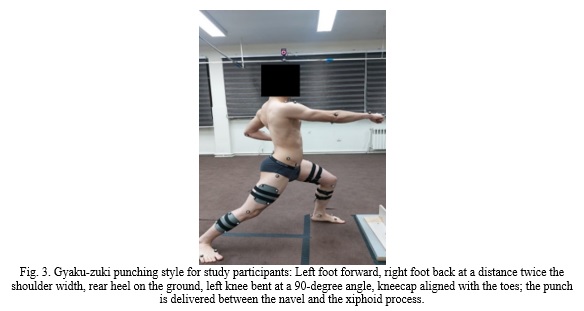
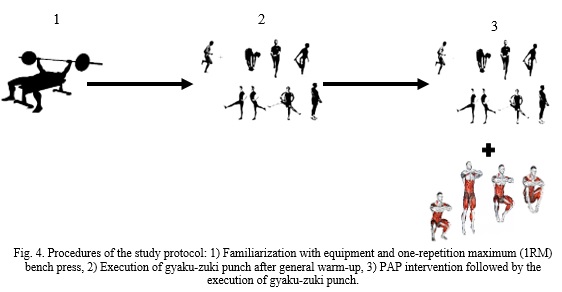
The second session was conducted 48–72 hours later. Participants first completed a standard warm-up consisting of five minutes of light jogging (RPE = 3/10), dynamic stretching exercises, and kumite-specific technical drills (29). Following the warm-up, kinematic data were recorded during gyaku-zuki punch performance. The testing protocol consisted of five 10-second sets of maximal-intensity punching separated by 10-second rest intervals (19). Punching commenced following an auditory signal. Target height was adjusted to shoulder level, and the punching distance was individualized according to each participant’s arm length (24). As illustrated in Fig. 3, participants adopted the zenkutsu-dachi stance, with the feet positioned approximately twice shoulder width apart, 60% of body weight distributed on the front leg and 40% on the rear leg, and the front knee aligned with the toes (30). The punching technique was standardized for all participants and consisted of a straight reverse punch directed between the navel and xiphoid process levels (31).
The third session began with the same standard warm-up procedure followed by the PAP protocol. Participants performed three sets of five maximal tuck jumps with one minute of recovery between sets (Fig. 3). Technical criteria including knee elevation to pelvis height, maintenance of landing position, and proper body alignment during the jumps were monitored throughout the protocol (32). Following completion of the PAP intervention, participants rested for five minutes before repeating the punch testing procedure under identical conditions to those used in the second session. This design allowed direct comparison between baseline performance and performance following the PAP stimulus (Fig. 4).
Equation 1
FR %=(1-(N1+N2+N3+N4+N5)/max〖N×5〗 )×100
Where:
N = number of successful punches in each set
max N = highest number of successful punches recorded among all sets
Participants completed three testing sessions. All sessions were conducted between 8:00 and 10:00 a.m. to correspond with common competition schedules and to minimize potential circadian influences. During the familiarization session, study procedures were explained, informed consent forms were completed, and anthropometric measurements including body mass, height, and body mass index were recorded. To assess baseline upper-body strength and verify participant homogeneity, a one-repetition maximum (1RM) bench press test was administered. The bench press was selected because of its similarity to the muscle activation patterns involved in the gyaku-zuki punch. The 1RM assessment followed the guidelines of the National Strength and Conditioning Association (NSCA). Previous studies have reported reliability coefficients greater than 0.94 for this procedure (28).
The second session was conducted 48–72 hours later. Participants first completed a standard warm-up consisting of five minutes of light jogging (RPE = 3/10), dynamic stretching exercises, and kumite-specific technical drills (29). Following the warm-up, kinematic data were recorded during gyaku-zuki punch performance. The testing protocol consisted of five 10-second sets of maximal-intensity punching separated by 10-second rest intervals (19). Punching commenced following an auditory signal. Target height was adjusted to shoulder level, and the punching distance was individualized according to each participant’s arm length (24). As illustrated in Fig. 3, participants adopted the zenkutsu-dachi stance, with the feet positioned approximately twice shoulder width apart, 60% of body weight distributed on the front leg and 40% on the rear leg, and the front knee aligned with the toes (30). The punching technique was standardized for all participants and consisted of a straight reverse punch directed between the navel and xiphoid process levels (31).
The third session began with the same standard warm-up procedure followed by the PAP protocol. Participants performed three sets of five maximal tuck jumps with one minute of recovery between sets (Fig. 3). Technical criteria including knee elevation to pelvis height, maintenance of landing position, and proper body alignment during the jumps were monitored throughout the protocol (32). Following completion of the PAP intervention, participants rested for five minutes before repeating the punch testing procedure under identical conditions to those used in the second session. This design allowed direct comparison between baseline performance and performance following the PAP stimulus (Fig. 4).
Statistical analyses were performed using SPSS software (version 26.0, IBM Corp., Armonk, NY, USA). Data normality was assessed using the Shapiro–Wilk test. Paired-samples t-tests were used to compare dependent variables before and after the intervention. Pearson correlation coefficients were calculated to examine the relationships between changes in pelvis velocity and corresponding changes in punch velocity and reaction time. Statistical significance was set at p < 0.05.
3. Results
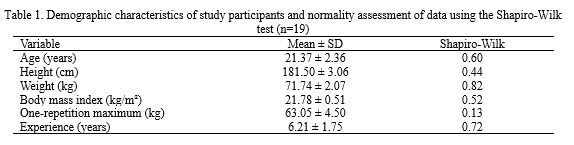
The demographic characteristics of the participants, including age, height, weight, body mass index, 1RM, and training experience, are presented in Table 1.
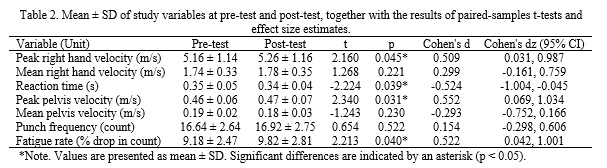
As shown in Table 2, paired-samples t-test results revealed significant differences between the pre-test and post-test conditions for several variables. Fatigue rate increased significantly following the intervention (mean difference = 0.642, p = 0.040). Significant increases were also observed in peak pelvis velocity (mean difference = 0.010 m/s, p = 0.031) and peak hand velocity (mean difference = 0.098 m/s, p = 0.045). In addition, reaction time decreased significantly after the intervention (mean difference = −0.010 s, p = 0.039). No significant differences were found for punch frequency, mean pelvis velocity, or mean hand velocity (p > 0.05). Pearson correlation analysis demonstrated a significant positive correlation between changes in peak pelvis velocity and changes in peak hand velocity (r = 0.537, p = 0.018).
3. Results
The demographic characteristics of the participants, including age, height, weight, body mass index, 1RM, and training experience, are presented in Table 1.
As shown in Table 2, paired-samples t-test results revealed significant differences between the pre-test and post-test conditions for several variables. Fatigue rate increased significantly following the intervention (mean difference = 0.642, p = 0.040). Significant increases were also observed in peak pelvis velocity (mean difference = 0.010 m/s, p = 0.031) and peak hand velocity (mean difference = 0.098 m/s, p = 0.045). In addition, reaction time decreased significantly after the intervention (mean difference = −0.010 s, p = 0.039). No significant differences were found for punch frequency, mean pelvis velocity, or mean hand velocity (p > 0.05). Pearson correlation analysis demonstrated a significant positive correlation between changes in peak pelvis velocity and changes in peak hand velocity (r = 0.537, p = 0.018).
4. Discussion
The findings of this study showed that the use of the PAP technique with a maximal tuck jump protocol significantly increased peak hand and pelvis velocity during the gyaku-zuki punch and improved reaction time compared with traditional warm-up exercises in the participants. Warm-up protocols are different and depend on the situation, but their main goal is to improve athletic performance and reduce the risk of injury. This is achieved through physiological mechanisms such as optimizing oxygen consumption, increasing muscle metabolism, inducing post-activation potentiation, as well as increasing tissue tensile tolerance and improving energy absorption (29). The potential mechanism for improving peak velocity in hand and pelvis movement following this technique can be explained by increased calcium ion sensitivity in myocytes, thereby increasing fast-twitch muscle contraction efficiency. Furthermore, the plyometric nature of the jumping exercise facilitates the recruitment of fast-twitch muscle fibers and accelerates neural activation, ultimately leading to the recruitment of more motor units and improved punching performance (28).
The results of one study showed that a single set of plyometric jumping exercises significantly increased jump height and power. In contrast, a multi-set protocol (three sets of 10 repetitions) with a 15-second interval produced no improvement in jump performance. It seems that the reason for the failure of the multi-set protocol in that study was the short recovery period following the stimulus. The researchers attributed the failure of the multi-set protocol to metabolic fatigue caused by the longer exercise duration (approximately 70 seconds). However, interestingly, in the present study, a multi-set protocol with similar rest intervals led to improvements. A possible explanation for this discrepancy is the lower training volume. Fewer repetitions (5 vs. 10) may prevent fatigue accumulation while still preserving the benefits of neuromuscular activation (33).
According to reports, the peak PAP effect usually occurs 3–4 minutes after plyometric exercises and at least 5 minutes after resistance exercises (34). However, some studies, such as the research by Cui et al. (2024), reported peak performance approximately 12 minutes after the intervention. This inconsistency in findings can be attributed to the high training volume (three sets of squats at 85% of 1RM). High volume likely delays the time course of the peak PAP effect by inducing greater fatigue. Also, differences in execution speed and type of kinetic chain are worth considering. This study used maximum jump speed, whereas evidence suggests that executing the protocol at 80% of maximum speed may yield better results than 90%. This indicates that the intensity of the PAP stimulus does not have a simple linear relationship with the functional response, and there is likely an optimal point for each individual (35).
Many martial arts studies, relying on an individual approach, emphasize the direct involvement of the hands and feet in training protocols to directly improve performance (36–38). In contrast, the present study focused on the pelvis as a vital link between the lower and upper extremities, based on the principle of the kinetic chain and the importance of trunk rotation during punching. However, more direct protocols, such as the study by Aandahl et al. (2015), which used resistance band training (2 sets of 10 repetitions), showed better functional outcomes than the findings of the present study. The mechanism of action of elastic bands is likely the increased force production throughout the entire range of motion. Also, using bands without disrupting punch technique may make force transfer more efficient. These characteristics may explain the better performance of martial artists with the band-based protocol compared with the jumping protocol used in the present study (36).
In the study by Sharma et al. (2018), both strength (squat at 90% of 1RM) and plyometric (countermovement jump) protocols significantly improved jump height and sprint time. The plyometric protocol also led to an increase in peak velocity. Nevertheless, the results showed that plyometrics had a relative superiority (39). A possible explanation is lower fatigue with this method, as strength training may be associated with greater accumulation of metabolites such as lactate and reduced muscle energy levels (40). In contrast, some studies have reported no significant difference between the effects of these two methods. A possible explanation for these discrepancies is insufficient training load or specific characteristics of the protocols used. These discrepancies emphasize the complexity of selecting an optimal protocol and the importance of paying attention to individual factors and the demands of the sport (41, 42).
Contrary to expectations, punch frequency did not change significantly after applying the PAP protocol in this study. This result is consistent with some previous research on combat athletes (19, 43). A possible explanation is the dynamic balance between two physiological phenomena: on one hand, fatigue resulting from acute activity can temporarily reduce neuromuscular function and have an inhibitory effect on the speed of repetitive movements. On the other hand, the PAP mechanism increases the potential for force production. It seems that under these conditions, the positive effects of PAP and the negative effects of fatigue cancel each other out, leaving punch frequency unchanged. Given the use of the plyometric protocol in this study, it appears that this method can be used as a practical, low-risk strategy in specific warm-ups prior to performing karate skills, without negatively affecting the rhythm and frequency of the martial artist’s punches.
Another notable finding of this study was the increase in fatigue rate following the plyometric exercises. Unlike some previous findings in combat sports (19), this result indicates that although punch frequency did not change significantly (p = 0.522), the plyometric protocol imposed a considerable physiological load on the neuromuscular system. This additional load may manifest as a reduced ability to produce maximal power during consecutive repetitions. However, given the nature of karate competitions, which are designed around short-duration, high-intensity actions, the observed increase in fatigue rate may not have a noticeable impact on overall competitive performance. In other words, although plyometric exercises increase fatigue, within the short time frame of karate competitions this effect may not be sufficient to negate the benefits of enhanced neuromuscular activation.
It seems that PAP exercises in a plyometric format, while imposing a significant physiological load on the neuromuscular system and increasing fatigue rate, can also provide important performance advantages such as improved reaction time. This improvement likely arises from two main pathways: first, facilitation of neural signal conduction and motor unit recruitment, leading to increased coordination and efficiency of the neuromuscular system. These observations are consistent with the idea that when a motor response closely resembles previously practiced patterns, its execution speed increases (44). Second, the preferential effect of PAP on type II fast-twitch muscle fibers. In response to plyometric training, these fibers experience biochemical changes such as phosphorylation of myosin regulatory light chains, which increases their sensitivity to calcium and consequently their contraction efficiency (45). Subsequently, more effective utilization of these fibers becomes possible, ultimately leading to a significant improvement in reaction time. In summary, although these exercises come with a cost in the form of fatigue, their benefit—faster reaction time—can be a decisive advantage in competitive karate situations where victory sometimes depends on the speed and accuracy of an explosive movement. Therefore, careful planning and intelligent timing of these exercises in the training routine are of particular importance for maximizing benefits and minimizing the effects of fatigue.
The present study has several limitations that affect the generalizability of the results. First, participants were selected only from male karate athletes; therefore, generalizing the findings to female athletes requires caution. Second, the fatigue rate was calculated based on changes in successful punch performance across repeated sets, and objective physiological indicators such as lactate levels or surface electromyography were not directly measured, which limits a more comprehensive analysis of fatigue. Third, the PAP protocol was implemented in a controlled laboratory setting with a fixed recovery interval (5 minutes), which may differ from the dynamic and variable conditions of an actual competition. Also, due to the lack of a randomized and counterbalanced design for the order of warm-up conditions (traditional and PAP), there is a possibility that factors such as cumulative fatigue or learning effects influenced the results. It is recommended that in future studies, the order of conditions be determined using a randomized method to minimize the effects of these confounding factors.
5. Conclusion
Plyometric warm-up based on PAP significantly increased peak linear velocity of the hand and pelvis in the gyaku-zuki punch and improved reaction time in male karate athletes. This protocol appears to be a practical and effective strategy for optimizing explosive performance in short-duration competitions and may provide a basis for designing personalized training programs.
Acknowledgments
We thank the East Azerbaijan Karate Board and the staff of the Motion Analysis Laboratory of Tabriz University of Medical Sciences for coordinating and supporting the participation of athletes in this research. Your cooperation played a key role in advancing this study.
Ethical Considerations
Compliance with ethical guidelines
All ethical principles were observed in this study. All ethical considerations were clearly explained to the participants. Written informed consent was then obtained from the participants. All procedures of this study were conducted in accordance with the ethical standards outlined in the Declaration of Helsinki. Based on these principles, respect for participants' rights, including the freedom to participate or withdraw from the study at any stage, confidentiality of personal information, and the avoidance of any psychological or physical harm, was emphasized.
Funding
This research received no financial support from any governmental, private, or non-profit organizations.
Authors' contributions
All authors actively participated in various stages of conducting this research. All authors contributed to the final approval of the manuscript.
Conflicts of interest
The authors declare that they have no conflict of interest associated with this study.
The findings of this study showed that the use of the PAP technique with a maximal tuck jump protocol significantly increased peak hand and pelvis velocity during the gyaku-zuki punch and improved reaction time compared with traditional warm-up exercises in the participants. Warm-up protocols are different and depend on the situation, but their main goal is to improve athletic performance and reduce the risk of injury. This is achieved through physiological mechanisms such as optimizing oxygen consumption, increasing muscle metabolism, inducing post-activation potentiation, as well as increasing tissue tensile tolerance and improving energy absorption (29). The potential mechanism for improving peak velocity in hand and pelvis movement following this technique can be explained by increased calcium ion sensitivity in myocytes, thereby increasing fast-twitch muscle contraction efficiency. Furthermore, the plyometric nature of the jumping exercise facilitates the recruitment of fast-twitch muscle fibers and accelerates neural activation, ultimately leading to the recruitment of more motor units and improved punching performance (28).
The results of one study showed that a single set of plyometric jumping exercises significantly increased jump height and power. In contrast, a multi-set protocol (three sets of 10 repetitions) with a 15-second interval produced no improvement in jump performance. It seems that the reason for the failure of the multi-set protocol in that study was the short recovery period following the stimulus. The researchers attributed the failure of the multi-set protocol to metabolic fatigue caused by the longer exercise duration (approximately 70 seconds). However, interestingly, in the present study, a multi-set protocol with similar rest intervals led to improvements. A possible explanation for this discrepancy is the lower training volume. Fewer repetitions (5 vs. 10) may prevent fatigue accumulation while still preserving the benefits of neuromuscular activation (33).
According to reports, the peak PAP effect usually occurs 3–4 minutes after plyometric exercises and at least 5 minutes after resistance exercises (34). However, some studies, such as the research by Cui et al. (2024), reported peak performance approximately 12 minutes after the intervention. This inconsistency in findings can be attributed to the high training volume (three sets of squats at 85% of 1RM). High volume likely delays the time course of the peak PAP effect by inducing greater fatigue. Also, differences in execution speed and type of kinetic chain are worth considering. This study used maximum jump speed, whereas evidence suggests that executing the protocol at 80% of maximum speed may yield better results than 90%. This indicates that the intensity of the PAP stimulus does not have a simple linear relationship with the functional response, and there is likely an optimal point for each individual (35).
Many martial arts studies, relying on an individual approach, emphasize the direct involvement of the hands and feet in training protocols to directly improve performance (36–38). In contrast, the present study focused on the pelvis as a vital link between the lower and upper extremities, based on the principle of the kinetic chain and the importance of trunk rotation during punching. However, more direct protocols, such as the study by Aandahl et al. (2015), which used resistance band training (2 sets of 10 repetitions), showed better functional outcomes than the findings of the present study. The mechanism of action of elastic bands is likely the increased force production throughout the entire range of motion. Also, using bands without disrupting punch technique may make force transfer more efficient. These characteristics may explain the better performance of martial artists with the band-based protocol compared with the jumping protocol used in the present study (36).
In the study by Sharma et al. (2018), both strength (squat at 90% of 1RM) and plyometric (countermovement jump) protocols significantly improved jump height and sprint time. The plyometric protocol also led to an increase in peak velocity. Nevertheless, the results showed that plyometrics had a relative superiority (39). A possible explanation is lower fatigue with this method, as strength training may be associated with greater accumulation of metabolites such as lactate and reduced muscle energy levels (40). In contrast, some studies have reported no significant difference between the effects of these two methods. A possible explanation for these discrepancies is insufficient training load or specific characteristics of the protocols used. These discrepancies emphasize the complexity of selecting an optimal protocol and the importance of paying attention to individual factors and the demands of the sport (41, 42).
Contrary to expectations, punch frequency did not change significantly after applying the PAP protocol in this study. This result is consistent with some previous research on combat athletes (19, 43). A possible explanation is the dynamic balance between two physiological phenomena: on one hand, fatigue resulting from acute activity can temporarily reduce neuromuscular function and have an inhibitory effect on the speed of repetitive movements. On the other hand, the PAP mechanism increases the potential for force production. It seems that under these conditions, the positive effects of PAP and the negative effects of fatigue cancel each other out, leaving punch frequency unchanged. Given the use of the plyometric protocol in this study, it appears that this method can be used as a practical, low-risk strategy in specific warm-ups prior to performing karate skills, without negatively affecting the rhythm and frequency of the martial artist’s punches.
Another notable finding of this study was the increase in fatigue rate following the plyometric exercises. Unlike some previous findings in combat sports (19), this result indicates that although punch frequency did not change significantly (p = 0.522), the plyometric protocol imposed a considerable physiological load on the neuromuscular system. This additional load may manifest as a reduced ability to produce maximal power during consecutive repetitions. However, given the nature of karate competitions, which are designed around short-duration, high-intensity actions, the observed increase in fatigue rate may not have a noticeable impact on overall competitive performance. In other words, although plyometric exercises increase fatigue, within the short time frame of karate competitions this effect may not be sufficient to negate the benefits of enhanced neuromuscular activation.
It seems that PAP exercises in a plyometric format, while imposing a significant physiological load on the neuromuscular system and increasing fatigue rate, can also provide important performance advantages such as improved reaction time. This improvement likely arises from two main pathways: first, facilitation of neural signal conduction and motor unit recruitment, leading to increased coordination and efficiency of the neuromuscular system. These observations are consistent with the idea that when a motor response closely resembles previously practiced patterns, its execution speed increases (44). Second, the preferential effect of PAP on type II fast-twitch muscle fibers. In response to plyometric training, these fibers experience biochemical changes such as phosphorylation of myosin regulatory light chains, which increases their sensitivity to calcium and consequently their contraction efficiency (45). Subsequently, more effective utilization of these fibers becomes possible, ultimately leading to a significant improvement in reaction time. In summary, although these exercises come with a cost in the form of fatigue, their benefit—faster reaction time—can be a decisive advantage in competitive karate situations where victory sometimes depends on the speed and accuracy of an explosive movement. Therefore, careful planning and intelligent timing of these exercises in the training routine are of particular importance for maximizing benefits and minimizing the effects of fatigue.
The present study has several limitations that affect the generalizability of the results. First, participants were selected only from male karate athletes; therefore, generalizing the findings to female athletes requires caution. Second, the fatigue rate was calculated based on changes in successful punch performance across repeated sets, and objective physiological indicators such as lactate levels or surface electromyography were not directly measured, which limits a more comprehensive analysis of fatigue. Third, the PAP protocol was implemented in a controlled laboratory setting with a fixed recovery interval (5 minutes), which may differ from the dynamic and variable conditions of an actual competition. Also, due to the lack of a randomized and counterbalanced design for the order of warm-up conditions (traditional and PAP), there is a possibility that factors such as cumulative fatigue or learning effects influenced the results. It is recommended that in future studies, the order of conditions be determined using a randomized method to minimize the effects of these confounding factors.
5. Conclusion
Plyometric warm-up based on PAP significantly increased peak linear velocity of the hand and pelvis in the gyaku-zuki punch and improved reaction time in male karate athletes. This protocol appears to be a practical and effective strategy for optimizing explosive performance in short-duration competitions and may provide a basis for designing personalized training programs.
Acknowledgments
We thank the East Azerbaijan Karate Board and the staff of the Motion Analysis Laboratory of Tabriz University of Medical Sciences for coordinating and supporting the participation of athletes in this research. Your cooperation played a key role in advancing this study.
Ethical Considerations
Compliance with ethical guidelines
All ethical principles were observed in this study. All ethical considerations were clearly explained to the participants. Written informed consent was then obtained from the participants. All procedures of this study were conducted in accordance with the ethical standards outlined in the Declaration of Helsinki. Based on these principles, respect for participants' rights, including the freedom to participate or withdraw from the study at any stage, confidentiality of personal information, and the avoidance of any psychological or physical harm, was emphasized.
Funding
This research received no financial support from any governmental, private, or non-profit organizations.
Authors' contributions
All authors actively participated in various stages of conducting this research. All authors contributed to the final approval of the manuscript.
Conflicts of interest
The authors declare that they have no conflict of interest associated with this study.
Type of Study: Applicable |
Subject:
Special
Received: 2025/12/14 | Accepted: 2026/05/26 | Published: 2026/06/15
Received: 2025/12/14 | Accepted: 2026/05/26 | Published: 2026/06/15
References
1. Jeknić V, Dopsaj M, Koropanovski N. Relationship between intermuscular synchronization of upper leg muscles and training level in karate kumite practitioners. Journal of Functional Morphology and Kinesiology. 2025;10(3):234. [DOI:10.3390/jfmk10030234]
2. Izzo R, Febo M, Cruciani A, Cejudo A, Hosseini Vardei C, Crudelini E. Analysis of peak linear accelerations expressed in the technical gesture of gyaku-zuki in karate kumite, comparing dominant and non-dominant limbs, including a complete review of the subject. Journal of Physical Education and Sport. 2023;23(7):1829-1845.
3. Stanley E, Thomson E, Smith G, Lamb KL. An analysis of the three-dimensional kinetics and kinematics of maximal effort punches among amateur boxers. International Journal of Performance Analysis in Sport. 2018;18(5):835-854. [DOI:10.1080/24748668.2018.1525651]
4. Naserpour H, Baker JS, Letafatkar A, Rossettini G, Dutheil F. An investigation of knee injury profiles among Iranian elite karatekas: observations from a cross-sectional study. International Journal of Environmental Research and Public Health. 2021;18(13):6888. [DOI:10.3390/ijerph18136888]
5. Zhao W, Wang C, Bi Y, Chen L. Effect of integrative neuromuscular training for injury prevention and sports performance of female badminton players. BioMed Research International. 2021;2021:5555853. [DOI:10.1155/2021/5555853]
6. Amirshakeri B, Khalkhali Zavieh M, Rezaei M, Adigozali H. Measuring the force perception in knee flexor/extensor muscles in patients with anterior cruciate ligament injury and healthy subjects. Journal of Back and Musculoskeletal Rehabilitation. 2022;35(1):103-110. [DOI:10.3233/BMR-200208]
7. Costa PB, Medeiros HB, Fukuda DH. Warm-up, stretching, and cool-down strategies for combat sports. Strength and Conditioning Journal. 2011;33(6):71-79. [DOI:10.1519/SSC.0b013e31823504c9]
8. Eslami A, Sahebozamani M, Bahiraei S. The effect of the FIFA 11+ Kids warm-up training program on lower limb injury prevention and football player performance: a systematic review. Journal of Sport Biomechanics. 2023;9(1):2-15. [DOI:10.61186/JSportBiomech.9.1.2]
9. Malliou P, Rokka S, Beneka A, Mavridis G, Godolias G. Reducing risk of injury due to warm up and cool down in dance aerobic instructors. Journal of Back and Musculoskeletal Rehabilitation. 2007;20(1):29-35. [DOI:10.3233/BMR-2007-20105]
10. Andre MJ, Fry AC, McLellan E, Weiss LW, Moore CM. Acute effects of static stretching on bench press power and velocity in adolescent male athletes. International Journal of Sports Science and Coaching. 2014;9(5):1145-1152. [DOI:10.1260/1747-9541.9.5.1145]
11. Anbarian M, Avazzadeh Samani A. Comparison of the effectiveness of traditional and post-activation potentiation warm-up methods on EMG variables of selected lower limb muscles during squat jump. Physical Treatments. 2022;12(2):123-132. [DOI:10.32598/ptj.12.2.510.1]
12. Hedayati Y, Amirseyfaddini MR, Amiri Khorasani M. The effect of post-activation performance enhancement using ballistic movements, heavy resistance, and dynamic stretching on barbell balance during the bench press. Journal of Sport Biomechanics. 2026;11(4):360-376. [DOI:10.61882/JSportBiomech.11.4.360]
13. McKiel A, Woods S, Gabriel DA, Vandenboom R, Falk B. Post-activation potentiation and potentiated motor unit firing patterns in boys and men. European Journal of Applied Physiology. 2024;124(5):1561-1574. [DOI:10.1007/s00421-023-05377-z]
14. Zhang Y, Diao P, Wang J, Li S, Fan Q, Han Y, et al. The effect of post-activation potentiation enhancement alone or in combination with caffeine on anaerobic performance in boxers: a double-blind randomized crossover study. Nutrients. 2024;16(2):235. [DOI:10.3390/nu16020235]
15. Nazari F, Fatahi A. Football biomechanics and performance enhancement: a systematic review. Journal of Sport Biomechanics. 2023;9(3):252-270. [DOI:10.61186/JSportBiomech.9.3.252]
16. Katushabe ET, Kramer M. Effects of combined power band resistance training on sprint speed, agility, vertical jump height, and strength in collegiate soccer players. International Journal of Exercise Science. 2020;13(4):950-963. [DOI:10.70252/WZLX5662]
17. Goethel MF, Vilas-Boas JP, Machado L, Ervilha UF, Moreira PVS, Bendilatti AR, et al. Performance, perceptual and reaction skills and neuromuscular control indicators of high-level karate athletes in the execution of the gyaku tsuki punch. Biomechanics. 2023;3(3):415-424. [DOI:10.3390/biomechanics3030034]
18. Genç S, Günay AR, Günay E. The effects of resistance-based post-activation performance enhancement on reaction time and change of direction in basketball players. PLoS One. 2025;20(3):e0320437. [DOI:10.1371/journal.pone.0320437]
19. Garrido NC, Maldonado CV, Valenzuela TH, da Silva Santos JF, Muñoz EEG, Gómez JV, et al. Effects of post-activation potentiation exercises on kicking frequency, fatigue rate and jump performance in taekwondo athletes: a case study. Retos. 2020;38:679-683. [DOI:10.47197/retos.v38i38.76755]
20. Cleary CJ, Cook SB, Herda AA. Evaluation of rest interval following a series of tuck jumps on anaerobic performance. Journal of Exercise Science and Fitness. 2025;23(1):1-6. [DOI:10.1016/j.jesf.2024.11.001]
21. Rinaldi M, Nasr Y, Atef G, Bini F, Varrecchia T, Conte C, et al. Biomechanical characterization of the junzuki karate punch: indexes of performance. European Journal of Sport Science. 2018;18(6):796-805. [DOI:10.1080/17461391.2018.1455899]
22. Liu Y, Zhu Z, Chen X, Deng C, Ma X, Zhao B. Biomechanics of the lead straight punch of different level boxers. Frontiers in Physiology. 2022;13:1015154. [DOI:10.3389/fphys.2022.1015154]
23. Wu G, Van der Helm FC, Veeger HD, Makhsous M, Van Roy P, Anglin C, et al. ISB recommendation on definitions of joint coordinate systems of various joints for the reporting of human joint motion-Part II: shoulder, elbow, wrist and hand. Journal of Biomechanics. 2005;38(5):981-992. [DOI:10.1016/j.jbiomech.2004.05.042]
24. Aguiar L, Santos-Rocha R, Branco M, Vieira F, Veloso A. Biomechanical model for kinetic and kinematic description of gait during second trimester of pregnancy to study the effects of biomechanical load on the musculoskeletal system. Journal of Mechanics in Medicine and Biology. 2014;14(1):1450004. [DOI:10.1142/S0219519414500043]
25. Lenetsky S, Brughelli M, Nates RJ, Neville J, Cross MR, Lormier AV. Defining the phases of boxing punches: a mixed-method approach. Journal of Strength and Conditioning Research. 2020;34(4):1040-1051. [DOI:10.1519/JSC.0000000000002895]
26. Yousefi M, Sadeghi H, Ilbeigi S, Ebrahimabadi Z, Kakavand M, Wikstrom EA. Center of pressure excursion and muscle activation during gait initiation in individuals with and without chronic ankle instability. Journal of Biomechanics. 2020;108:109904. [DOI:10.1016/j.jbiomech.2020.109904]
27. da Silva Santos JF, Franchini E. Is frequency speed of kick test responsive to training? A study with taekwondo athletes. Sport Sciences for Health. 2016;12(3):377-382. [DOI:10.1007/s11332-016-0300-2]
28. Macht JW, Abel MG, Mullineaux DR, Yates JW. Development of 1RM prediction equations for bench press in moderately trained men. Journal of Strength and Conditioning Research. 2016;30(10):2901-2906. [DOI:10.1519/JSC.0000000000001385]
29. McGowan CJ, Pyne DB, Thompson KG, Rattray B. Warm-up strategies for sport and exercise: mechanisms and applications. Sports Medicine. 2015;45(11):1523-1546. [DOI:10.1007/s40279-015-0376-x]
30. Amiri Khorasani A, Amiri Khorasani MT, Mohammadipour F. Comparison of the maximum angular velocity of lower limb joints in different methods of zenkutsu-dachi in karate. Journal of Sport Biomechanics. 2020;6(1):12-21. [DOI:10.32598/biomechanics.6.1.3]
31. Stull R, Barham J. An analysis of movement patterns utilized by different styles in the karate reverse punch in front stance. In: ISBS Conference Proceedings Archive. 1988.
32. Kember LS, Riehm CD, Schille A, Slaton JA, Oliver JL, Myer GD, et al. Kinetics during the tuck jump assessment and biomechanical deficits in female athletes 12 months after ACL reconstruction surgery. American Journal of Sports Medicine. 2025;53(2):333-342. [DOI:10.1177/03635465241308579]
33. Sari C, Aytac T, Koc H, Buzdagli Y, Esen O, Karayigit R. Post-activation performance enhancement effect of two tuck-jump protocols with different volumes on 15-s vertical jump performance. Kinesiologia Slovenica. 2024;30(2):105-120. [DOI:10.52165/kinsi.30.2.105-120]
34. Seitz LB, Haff GG. Factors modulating post-activation potentiation of jump, sprint, throw, and upper-body ballistic performances: a systematic review with meta-analysis. Sports Medicine. 2016;46(2):231-240. [DOI:10.1007/s40279-015-0415-7]
35. Cui W, Chen Y, Wang D. Research on the effect of post-activation potentiation under different velocity loss thresholds on boxer's punching ability. Frontiers in Physiology. 2024;15:1429550. [DOI:10.3389/fphys.2024.1429550]
36. Aandahl HS, Van den Tillaar R, Von Heimburg E. Effect of post-activation potentiation on kinematics and kicking performance in a roundhouse kick with trained martial arts practitioners. In: ISBS Conference Proceedings Archive. 2015.
37. Ioannides C, Despotopoulou C, Hadjicharalambous M, Zaras N. Effects of warm-ups with weighted vests and resistance bands on physical fitness and combat ability of kumite karate athletes. Sports. 2024;12(3):79. [DOI:10.3390/sports12030079]
38. Finlay MJ, Greig M, Bridge CA, Page RM. Post-activation performance enhancement of punch force and neuromuscular performance in amateur boxing: toward a more individualized and real-world approach. Journal of Strength and Conditioning Research. 2024;38(6):1063-1071. [DOI:10.1519/JSC.0000000000004740]
39. Sharma SK, Raza S, Moiz JA, Verma S, Naqvi IH, Anwer S, et al. Postactivation potentiation following acute bouts of plyometric versus heavy-resistance exercise in collegiate soccer players. BioMed Research International. 2018;2018:3719039. [DOI:10.1155/2018/3719039]
40. Izquierdo M, Gonzalez-Izal M, Navarro-Amezqueta I, Calbet JA, Ibanez J, Malanda A, et al. Effects of strength training on muscle fatigue mapping from surface EMG and blood metabolites. Medicine and Science in Sports and Exercise. 2011;43(2):303-311. [DOI:10.1249/MSS.0b013e3181edfa96]
41. Esformes JI, Cameron N, Bampouras TM. Postactivation potentiation following different modes of exercise. Journal of Strength and Conditioning Research. 2010;24(7):1911-1916. [DOI:10.1519/JSC.0b013e3181dc47f8]
42. Till KA, Cooke C. The effects of postactivation potentiation on sprint and jump performance of male academy soccer players. Journal of Strength and Conditioning Research. 2009;23(7):1960-1967. [DOI:10.1519/JSC.0b013e3181b8666e]
43. Miarka B, Del Vecchio FB, Franchini E. Acute effects and postactivation potentiation in the special judo fitness test. Journal of Strength and Conditioning Research. 2011;25(2):427-431. [DOI:10.1519/JSC.0b013e3181bf43ff]
44. Etnyre B, Kinugasa T. Postcontraction influences on reaction time. Research Quarterly for Exercise and Sport. 2002;73(3):271-281. [DOI:10.1080/02701367.2002.10609020]
45. Hamada T, Sale DG, MacDougall JD, Tarnopolsky MA. Postactivation potentiation, fiber type, and twitch contraction time in human knee extensor muscles. Journal of Applied Physiology. 2000;88(6):2131-2137. [DOI:10.1152/jappl.2000.88.6.2131]
| Rights and permissions | |
 |
This work is licensed under a Creative Commons Attribution-NonCommercial 4.0 International License. |

Journal of Sport Biomechanics
Department of Sport Biomechanics, Faculty of Humanities, Islamic Azad University, Hamedan Branch, Prof. Mousivand Blvd, Imam Khomeini Blvd, Hamedan, Iran.
Journal Tel: +98 81 34494042
Website: http://biomechanics.iauh.ac.ir
Email: sportbiomechanics@iauh.ac.ir
