

Volume 12, Issue 2 (9-2026)
J Sport Biomech 2026, 12(2): 358-371 |
Back to browse issues page




Download citation:
BibTeX | RIS | EndNote | Medlars | ProCite | Reference Manager | RefWorks
Send citation to:


BibTeX | RIS | EndNote | Medlars | ProCite | Reference Manager | RefWorks
Send citation to:
Hosseini Y. Comparison of Symmetrical and Asymmetrical Bag-Carrying on the Vertical Ground Reaction Force During Walking in Healthy Adults. J Sport Biomech 2026; 12 (2) :358-371
URL: http://biomechanics.iauh.ac.ir/article-1-497-en.html
URL: http://biomechanics.iauh.ac.ir/article-1-497-en.html


Department of Sport Science, Faculty of Literature and Humanities, Malayer University, Malayer, Iran.
Full-Text [PDF 1800 kb]
(12 Downloads)
| Abstract (HTML) (41 Views)
Full-Text: (12 Views)
Extended Abstract
1. Introduction
Carrying a bag is a common daily activity across various age groups and occupations, including students and office workers (1). The method of load carriage has been shown to influence gait biomechanics and ground reaction forces (2). Previous studies indicate that both bag design and carrying strategy substantially affect the magnitude and distribution of forces applied to the body (3–5). Alterations in gait pattern and increases in reaction forces may elevate mechanical stress on the lower-extremity joints and potentially increase the risk of musculoskeletal injury (6,7). Repetitive activities performed under external load, such as walking while carrying a bag, have been proposed as contributing mechanisms in the development of movement impairments (8). Furthermore, carrying a backpack equivalent to 10% of body weight for 30 minutes has been reported to induce short-term musculoskeletal alterations (9,10).
In daily life, individuals typically carry bags either symmetrically (e.g., backpack or front pack) or asymmetrically (e.g., single-hand or single-shoulder carrying) (2,11,12). From a biomechanical perspective, symmetrical loading may promote a more even distribution of forces between the lower limbs, whereas asymmetrical loading may alter center-of-mass alignment and increase joint loading asymmetry (2,13). Studies examining asymmetrical loading have reported limb differences in plantar pressure and postural control (14,15). The analysis of vertical ground reaction force (GRF) during walking is clinically relevant (16). Variables derived from vertical GRF—such as peak force, time to peak, impulse, and vertical loading rate—provide insight into mechanical loading characteristics. Increased vertical loading rate has been associated with stress fractures, patellofemoral pain, and plantar fasciitis (17–20). Despite existing research on load carriage, direct comparisons of vertical GRF characteristics between symmetrical and asymmetrical bag-carrying methods remain limited. Therefore, the aim of the present study was to compare vertical GRF variables during symmetrical and asymmetrical bag carrying in healthy young women.
2. Methods
The present study employed a quasi-experimental, repeated-measures laboratory design. Seventeen female students from Malayer University without any history of musculoskeletal disorders participated voluntarily. Participants were recruited through an open call at the university. A Pierre Cardin laptop bag (Model 2189, Iran) was used for all load carriage conditions. The load was standardized to 10% of each participant’s body weight (22). Vertical ground reaction force (GRF) data were recorded using a FootScan pressure platform (RSscan-9, Belgium; dimensions: 578 × 418 × 12 mm) operating at a sampling frequency of 300 Hz. The system contains 4096 active sensors. Data were collected during the stance phase of walking, defined as the interval from initial heel contact to toe-off. From the vertical GRF curve (Fig. 1), the following variables were extracted: first peak vertical force at heel contact (FzI.C), mid-stance vertical force (FzM.S), and propulsion phase vertical force (FzP.O). Temporal variables included time to peak at heel contact, mid-stance, and propulsion. All variables were calculated from the stance-phase vertical GRF waveform.
1. Introduction
Carrying a bag is a common daily activity across various age groups and occupations, including students and office workers (1). The method of load carriage has been shown to influence gait biomechanics and ground reaction forces (2). Previous studies indicate that both bag design and carrying strategy substantially affect the magnitude and distribution of forces applied to the body (3–5). Alterations in gait pattern and increases in reaction forces may elevate mechanical stress on the lower-extremity joints and potentially increase the risk of musculoskeletal injury (6,7). Repetitive activities performed under external load, such as walking while carrying a bag, have been proposed as contributing mechanisms in the development of movement impairments (8). Furthermore, carrying a backpack equivalent to 10% of body weight for 30 minutes has been reported to induce short-term musculoskeletal alterations (9,10).
In daily life, individuals typically carry bags either symmetrically (e.g., backpack or front pack) or asymmetrically (e.g., single-hand or single-shoulder carrying) (2,11,12). From a biomechanical perspective, symmetrical loading may promote a more even distribution of forces between the lower limbs, whereas asymmetrical loading may alter center-of-mass alignment and increase joint loading asymmetry (2,13). Studies examining asymmetrical loading have reported limb differences in plantar pressure and postural control (14,15). The analysis of vertical ground reaction force (GRF) during walking is clinically relevant (16). Variables derived from vertical GRF—such as peak force, time to peak, impulse, and vertical loading rate—provide insight into mechanical loading characteristics. Increased vertical loading rate has been associated with stress fractures, patellofemoral pain, and plantar fasciitis (17–20). Despite existing research on load carriage, direct comparisons of vertical GRF characteristics between symmetrical and asymmetrical bag-carrying methods remain limited. Therefore, the aim of the present study was to compare vertical GRF variables during symmetrical and asymmetrical bag carrying in healthy young women.
2. Methods
The present study employed a quasi-experimental, repeated-measures laboratory design. Seventeen female students from Malayer University without any history of musculoskeletal disorders participated voluntarily. Participants were recruited through an open call at the university. A Pierre Cardin laptop bag (Model 2189, Iran) was used for all load carriage conditions. The load was standardized to 10% of each participant’s body weight (22). Vertical ground reaction force (GRF) data were recorded using a FootScan pressure platform (RSscan-9, Belgium; dimensions: 578 × 418 × 12 mm) operating at a sampling frequency of 300 Hz. The system contains 4096 active sensors. Data were collected during the stance phase of walking, defined as the interval from initial heel contact to toe-off. From the vertical GRF curve (Fig. 1), the following variables were extracted: first peak vertical force at heel contact (FzI.C), mid-stance vertical force (FzM.S), and propulsion phase vertical force (FzP.O). Temporal variables included time to peak at heel contact, mid-stance, and propulsion. All variables were calculated from the stance-phase vertical GRF waveform.
3. Results
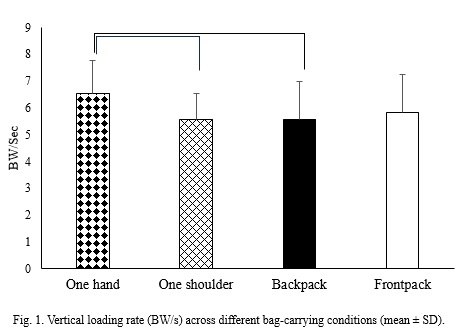
No significant differences were observed among bag-carrying conditions in peak vertical ground reaction force at heel contact (FzI.C), mid-stance (FzM.S), or propulsion phase (FzP.O) (P ≥ 0.05). Analysis of temporal variables revealed significant differences in time to peak vertical GRF. During single-hand carrying, time to peak at heel contact was significantly shorter compared with single-shoulder carrying (P = 0.003) and backpack carrying (P = 0.03). Additionally, time to peak at mid-stance was significantly shorter in the single-hand condition compared with the single-shoulder condition (P = 0.018). No other significant temporal differences were detected. Vertical loading rate differed significantly between conditions. Single-hand carrying resulted in a significantly greater loading rate compared with backpack carrying (P = 0.003) and single-shoulder carrying (P = 0.003). No significant differences were observed in vertical impulse across the different bag-carrying methods (P ≥ 0.05).
4. Discussion
The present study compared symmetrical and asymmetrical bag-carrying methods with respect to vertical ground reaction force (GRF) characteristics during walking. No significant differences were observed in peak vertical GRF across heel contact, mid-stance, or propulsion phases. This finding suggests that altering the method of load carriage at 10% body weight does not substantially change the magnitude of peak vertical force. Similar observations have been reported in previous studies examining load carriage and peak GRF responses (24). However, temporal characteristics of force application differed between conditions. Specifically, single-hand carrying resulted in a shorter time to peak vertical GRF at heel contact and mid-stance compared with selected symmetrical conditions. Because loading rate is mathematically influenced by both force magnitude and time to peak, the reduced time to peak in the single-hand condition contributed to a significantly greater vertical loading rate. Increased loading rate has been associated with stress-related musculoskeletal conditions, including stress fractures and patellofemoral pain (17–20). Although the present study did not assess injury outcomes, these findings suggest that asymmetrical single-hand carriage may increase instantaneous mechanical loading demands during walking. No significant differences were observed in vertical impulse, indicating that the total accumulated load during stance remained comparable across carrying methods. Therefore, the primary distinction between conditions appears to lie in how rapidly force is applied rather than in total load magnitude. From a practical perspective, when load carriage is necessary, symmetrical methods such as backpack use may provide a more mechanically favorable pattern of force application compared with single-hand carrying. However, given the modest load (10% body weight) and the absence of kinetic asymmetry measures or long-term follow-up, conclusions regarding injury risk should be interpreted cautiously. Future studies incorporating kinematic, electromyographic, and bilateral force analyses are warranted to further clarify the biomechanical consequences of different load carriage strategies.
Ethical Considerations
Compliance with ethical guidelines
All procedures performed in this study were conducted in accordance with established ethical principles for research involving human participants. The study protocol and procedures were explained clearly to all participants, and written informed consent was obtained prior to data collection.
Funding
This research received no specific grant from any funding agency in the public, commercial, or not-for-profit sectors.
Authors' contributions
The author was solely responsible for the study conception and design, data collection, data analysis and interpretation, manuscript drafting, and approval of the final version of the manuscript.
Conflicts of interest
The author declares no conflicts of interest.
No significant differences were observed among bag-carrying conditions in peak vertical ground reaction force at heel contact (FzI.C), mid-stance (FzM.S), or propulsion phase (FzP.O) (P ≥ 0.05). Analysis of temporal variables revealed significant differences in time to peak vertical GRF. During single-hand carrying, time to peak at heel contact was significantly shorter compared with single-shoulder carrying (P = 0.003) and backpack carrying (P = 0.03). Additionally, time to peak at mid-stance was significantly shorter in the single-hand condition compared with the single-shoulder condition (P = 0.018). No other significant temporal differences were detected. Vertical loading rate differed significantly between conditions. Single-hand carrying resulted in a significantly greater loading rate compared with backpack carrying (P = 0.003) and single-shoulder carrying (P = 0.003). No significant differences were observed in vertical impulse across the different bag-carrying methods (P ≥ 0.05).
4. Discussion
The present study compared symmetrical and asymmetrical bag-carrying methods with respect to vertical ground reaction force (GRF) characteristics during walking. No significant differences were observed in peak vertical GRF across heel contact, mid-stance, or propulsion phases. This finding suggests that altering the method of load carriage at 10% body weight does not substantially change the magnitude of peak vertical force. Similar observations have been reported in previous studies examining load carriage and peak GRF responses (24). However, temporal characteristics of force application differed between conditions. Specifically, single-hand carrying resulted in a shorter time to peak vertical GRF at heel contact and mid-stance compared with selected symmetrical conditions. Because loading rate is mathematically influenced by both force magnitude and time to peak, the reduced time to peak in the single-hand condition contributed to a significantly greater vertical loading rate. Increased loading rate has been associated with stress-related musculoskeletal conditions, including stress fractures and patellofemoral pain (17–20). Although the present study did not assess injury outcomes, these findings suggest that asymmetrical single-hand carriage may increase instantaneous mechanical loading demands during walking. No significant differences were observed in vertical impulse, indicating that the total accumulated load during stance remained comparable across carrying methods. Therefore, the primary distinction between conditions appears to lie in how rapidly force is applied rather than in total load magnitude. From a practical perspective, when load carriage is necessary, symmetrical methods such as backpack use may provide a more mechanically favorable pattern of force application compared with single-hand carrying. However, given the modest load (10% body weight) and the absence of kinetic asymmetry measures or long-term follow-up, conclusions regarding injury risk should be interpreted cautiously. Future studies incorporating kinematic, electromyographic, and bilateral force analyses are warranted to further clarify the biomechanical consequences of different load carriage strategies.
Ethical Considerations
Compliance with ethical guidelines
All procedures performed in this study were conducted in accordance with established ethical principles for research involving human participants. The study protocol and procedures were explained clearly to all participants, and written informed consent was obtained prior to data collection.
Funding
This research received no specific grant from any funding agency in the public, commercial, or not-for-profit sectors.
Authors' contributions
The author was solely responsible for the study conception and design, data collection, data analysis and interpretation, manuscript drafting, and approval of the final version of the manuscript.
Conflicts of interest
The author declares no conflicts of interest.
Type of Study: Applicable |
Subject:
Special
Received: 2026/01/26 | Accepted: 2026/02/25 | Published: 2026/04/28
Received: 2026/01/26 | Accepted: 2026/02/25 | Published: 2026/04/28
References
1. Hudson S, Cooke C, Davies S, West S, Gamieldien R, Low C, Lloyd R. A comparison of economy and sagittal plane trunk movements among back-, back/front- and head-loading. Ergonomics. 2018;61(9):1216-1222. [DOI:10.1080/00140139.2018.1474267]
2. Zagrodny B, Ludwicki M, Wojnicz W. The influence of external additional loading on the muscle activity and ground reaction forces during gait. Applied Bionics and Biomechanics. 2021;2021:5532012. [DOI:10.1155/2021/5532012]
3. Al-Khabbaz YS, Shimada T, Hasegawa M. The effect of backpack heaviness on trunk-lower extremity muscle activities and trunk posture. Gait and Posture. 2008;28(2):297-302. [DOI:10.1016/j.gaitpost.2008.01.002]
4. Adeyemi AJ, Rohani JM, Rani MRA. Backpack-back pain complexity and the need for multifactorial safe weight recommendation. Applied Ergonomics. 2017;58:573-582. [DOI:10.1016/j.apergo.2016.04.009]
5. Korovessis P, Koureas G, Papazisis Z. Correlation between backpack weight and way of carrying, sagittal and frontal spinal curvatures, athletic activity, and dorsal and low back pain in schoolchildren and adolescents. Clinical Spine Surgery. 2004;17(1):33-40. [DOI:10.1097/00024720-200402000-00008]
6. Abdon APV, Moraes TEG, Prado M, dos Santos Vasconcelos R, Braga TSP, Ferreira TSP, Mont'Alverne DGB. Relationship between shoulder pain and weight of shoulder bags in young women. Motricidade. 2018;14(2-3):40-47. [DOI:10.6063/motricidade.13180]
7. Menezes LTD, Barbosa PHFDA, Costa AS, Mundim AC, Ramos GC, Paz CCSC, Martins EF. Baropodometric technology used to analyze types of weight-bearing during hemiparetic upright position. Fisioterapia em Movimento. 2012;25(1):583-594. [DOI:10.1590/S0103-51502012000300014]
8. Sahrmann S, Azevedo DC, Van Dillen L. Diagnosis and treatment of movement system impairment syndromes. Brazilian Journal of Physical Therapy. 2017;21(6):391-399. [DOI:10.1016/j.bjpt.2017.08.001]
9. Lederman E. Neuromuscular rehabilitation in manual and physical therapies: Principles to practice. London: Churchill Livingstone; 2010. [DOI:10.1016/B978-0-443-06969-7.00014-0]
10. Chow DHK, Hin CKF, Ou D, Lai A. Carry-over effects of backpack carriage on trunk posture and repositioning ability. International Journal of Industrial Ergonomics. 2011;41(5):530-535. [DOI:10.1016/j.ergon.2011.04.001]
11. Phonpichit C, Chansirinukor W, Akamanon C. The response of the body when carrying a handbag. Work. 2016;55(3):673-678. [DOI:10.3233/WOR-162429]
12. Alami A, Lael-Monfared E, Teimori-Boghsani G, Fouladi B, Jafari A. A study of features of backpack carrying methods by schoolchildren: a population-based study. Journal of Pediatric Perspectives. 2018;6(11):8517-8525.
13. Talar I, Hasiński K, Semmad PA, Zagrodny B. Influence of an asymmetrical load on ground reaction forces during gait. Russian Journal of Biomechanics. 2019;23(4):557-565. [DOI:10.15593/RJBiomech/2019.4.06]
14. Zawadka M, Kochman M, Jablonski M, Gawda P. Effects of external light load on posture and foot pressure distribution in young adults: a pilot study. International Journal of Industrial Ergonomics. 2021;82:103102. [DOI:10.1016/j.ergon.2021.103102]
15. Anwer S, Li H, Antwi-Afari MF, Umer W, Mehmood I, Wong AYL. Effects of load carrying techniques on gait parameters, dynamic balance, and physiological parameters during a manual material handling task. Engineering, Construction and Architectural Management. 2022;29(9):3415-3438. [DOI:10.1108/ECAM-03-2021-0245]
16. Castro MP, Figueiredo MC, Abreu S, Sousa H, Machado L, Santos R, Vilas-Boas JP. The influence of gait cadence on the ground reaction forces and plantar pressures during load carriage of young adults. Applied Ergonomics. 2015;49:41-46. [DOI:10.1016/j.apergo.2015.01.004]
17. Zadpoor AA, Nikooyan AA. The relationship between lower-extremity stress fractures and the ground reaction force: a systematic review. Clinical Biomechanics. 2011;26(1):23-28. [DOI:10.1016/j.clinbiomech.2010.08.005]
18. Crowell HP, Davis IS. Gait retraining to reduce lower extremity loading in runners. Clinical Biomechanics. 2011;26(1):78-83. [DOI:10.1016/j.clinbiomech.2010.09.003]
19. Cheung RT, Davis IS. Landing pattern modification to improve patellofemoral pain in runners: a case series. Journal of Orthopaedic and Sports Physical Therapy. 2011;41(12):914-919. [DOI:10.2519/jospt.2011.3771]
20. Davis IS, Bowser BJ, Hamill J. Vertical impact loading in runners with a history of patellofemoral pain syndrome. Medicine and Science in Sports and Exercise. 2010;42(5):682. [DOI:10.1249/01.MSS.0000385903.65728.85]
21. Faul F, Erdfelder E, Lang AG, Buchner A. G*Power 3: A flexible statistical power analysis program for the social, behavioral, and biomedical sciences. Behavior Research Methods. 2007;39(2):175-191. [DOI:10.3758/BF03193146]
22. Zhou N, Yan J, Zhou J. Effects of different loads schoolbags on body posture of elementary students. China Leather. 2016;45(2):69-73.
23. Robertson DGE, Caldwell GE, Hamill J, Kamen G, Whittlesey S. Research methods in biomechanics. Champaign: Human Kinetics; 2013. [DOI:10.5040/9781492595809]
24. Escamilla-Galindo VL, Estal-Martínez A, Adamczyk JG, Brito CJ, Arnaiz-Lastras J, Sillero-Quintana M. Skin temperature response to unilateral training measured with infrared thermography. Journal of Exercise Rehabilitation. 2017;13(5):526-532. [DOI:10.12965/jer.1735046.523]
25. Oatis CA. Kinesiology: The mechanics and pathomechanics of human movement. 2nd ed. Philadelphia: Lippincott Williams and Wilkins; 2009.
26. Simonetti E, Bergamini E, Vannozzi G, Bascou J, Pillet H. Estimation of 3D body center of mass acceleration and instantaneous velocity from a wearable inertial sensor network in transfemoral amputee gait: a case study. Sensors. 2021;21(9):3129. [DOI:10.3390/s21093129]
27. Awrejcewicz J, Byczek S, Zagrodny B. Influence of the asymmetric loading of the body during the walk on the temperature distribution. Acta Bio-Optica et Informatica Medica. Biomedical Engineering. 2012;18(2):-.
28. DeVita P, Hong D, Hamill J. Effects of asymmetric load carrying on the biomechanics of walking. Journal of Biomechanics. 1991;24(12):1119-1129. [DOI:10.1016/0021-9290(91)90004-7]
29. Oliaei F, Jafarnezhadgero A, Fatahi A, Khezri D. The effect of using backpacks with different weights on plantar kinetics and balance variables among adolescent females during walking. Iranian Journal of Rehabilitation Research. 2024;10(2):1-9.
30. Piri E, Jafarnezhadgero A, Stålman A, Alihosseini S, Panahighaffarkandi Y. Comparison of the ground reaction force frequency spectrum during walking with and without anti-pronation insoles in individuals with pronated feet. Journal of Sport Biomechanics. 2025;11(1):20-33. [https://doi.org/10.61186/JSportBiomech.11.1.20]
31. Khazaei G, Ilbeigi S, Saghebjoo M, Farjad Pezeshk A. Effects of a 6-week TRX training program with and without curcumin supplementation on ground reaction forces and center of pressure in overweight women with nonspecific chronic low back pain. Journal of Sport Biomechanics. 2026;12(2):264-285. [https://doi.org/10.61882/JSportBiomech.12.2.264]
| Rights and permissions | |
 |
This work is licensed under a Creative Commons Attribution-NonCommercial 4.0 International License. |

Journal of Sport Biomechanics
Department of Sport Biomechanics, Faculty of Humanities, Islamic Azad University, Hamedan Branch, Prof. Mousivand Blvd, Imam Khomeini Blvd, Hamedan, Iran.
Journal Tel: +98 81 34494042
Website: http://biomechanics.iauh.ac.ir
Email: sportbiomechanics@iauh.ac.ir
