

Volume 12, Issue 3 (11-2026)
J Sport Biomech 2026, 12(3): 532-544 |
Back to browse issues page




Download citation:
BibTeX | RIS | EndNote | Medlars | ProCite | Reference Manager | RefWorks
Send citation to:


BibTeX | RIS | EndNote | Medlars | ProCite | Reference Manager | RefWorks
Send citation to:
Gheytasi M, Yazdani S, Ghiyami A. Comparison of Balance, Power, and Muscular Endurance Among Volleyball Players in Three Attacking Positions. J Sport Biomech 2026; 12 (3) :532-544
URL: http://biomechanics.iauh.ac.ir/article-1-500-en.html
URL: http://biomechanics.iauh.ac.ir/article-1-500-en.html


1- Department of Motor Behavior, Faculty of Physical Education and Sports Sciences, University of Tabriz, Tabriz, Iran.
Full-Text [PDF 1662 kb]
(9 Downloads)
| Abstract (HTML) (18 Views)
Full-Text: (8 Views)
Extended Abstract
1. Introduction
Volleyball is a fast-paced and multidimensional team sport that requires a combination of explosive power, balance, muscular endurance, technical proficiency, and rapid decision-making to achieve optimal performance (2, 11). Among the various playing positions, attacking players—including outside hitters, opposites, and middle blockers—play a decisive role in offensive actions and point scoring, requiring repeated jumping, landing, blocking, and spiking throughout a match (12, 20). Consequently, these athletes must generate high levels of upper- and lower-limb power while maintaining efficient neuromuscular coordination and postural control during dynamic game situations (1, 6). Balance is considered a fundamental component of neuromuscular control. Both static and dynamic balance contribute to movement efficiency, body stability during rapid directional changes, safe landing mechanics, and effective force transmission during volleyball-specific skills. Superior balance performance may also reduce the risk of sports injuries by improving postural stability and movement control (7, 8). Likewise, adequate muscular endurance, particularly of the core musculature, enables players to sustain repeated high-intensity actions throughout prolonged matches while minimizing fatigue-related declines in performance (4, 9).
Although previous studies have examined selected anthropometric, physiological, and physical characteristics of volleyball players, most have focused on isolated variables such as lower-limb power, body composition, or aerobic fitness, with inconsistent findings regarding positional differences among attacking players (5, 10, 18–20). Furthermore, few studies have simultaneously evaluated upper- and lower-limb power, static and dynamic balance, and core muscular endurance in professional volleyball players occupying specialized attacking positions. Therefore, the available evidence remains insufficient to determine whether these physical performance characteristics differ among elite attacking positions. Accordingly, the present study aimed to compare upper- and lower-limb power, balance, and core muscular endurance among professional male volleyball players occupying the three specialized attacking positions: outside hitter, middle blocker, and opposite hitter. A better understanding of these physical characteristics may provide valuable information for designing evidence-based training programs, improving talent identification, optimizing position-specific conditioning, and enhancing athletic performance in elite volleyball players (5, 10, 19).
2. Methods
A total of 30 male professional volleyball players were recruited through purposive sampling from first-division volleyball clubs in Tabriz, Iran (18). The participants had a mean age of 22.38 ± 4.07 years and were equally assigned to three specialized attacking positions: outside hitters (n = 10), opposites (n = 10), and middle blockers (n = 10) (20). Eligible participants were healthy, free from major musculoskeletal injuries during the previous six months, and actively participated in team training at least three times per week (8, 17). Before data collection, all participants were informed about the study objectives and testing procedures and provided written informed consent. Dynamic balance was evaluated using the Y-Balance Test, in which participants performed maximal reach tasks in the anterior, posteromedial, and posterolateral directions while standing on one leg. A normalized composite score was calculated for each participant (8, 24). Static balance was assessed using a digital balance board equipped with a mediolateral suspended platform (maximum oscillation ±15°, total range 30°). The device provided visual feedback and measured balance performance with a temporal resolution of 1 ms. The software recorded balance maintenance time (s) and calculated the final balance score as (balance time / total test time) × 100 (16). Upper-limb power was assessed using the 3-kg medicine ball chest throw test (13), whereas lower-limb power was evaluated using the standing long jump and vertical jump tests. Participants performed three maximal medicine ball throws from a semi-squat position behind a designated line, and the mean throwing distance was used for analysis. Core muscular endurance was assessed using the plank test, in which the duration for maintaining the correct plank position was recorded (14). All assessments were conducted indoors under standardized environmental conditions. Participants were allowed a 5-minute rest interval between consecutive tests to minimize fatigue, and the mean value of three trials was used for statistical analysis. Data were analyzed using SPSS version 27. Data normality was assessed using the Shapiro–Wilk test, whereas homogeneity of variances was examined using Levene's test. Differences among the three groups were analyzed using one-way analysis of variance (ANOVA), followed by Tukey's honestly significant difference (HSD) post hoc test when appropriate. Statistical significance was set at α = 0.05. Because of slight differences in the effective sample sizes used in some analyses, harmonic mean adjustments were applied where appropriate.
3. Results
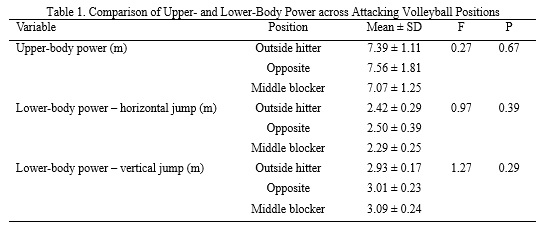
No statistically significant differences were observed among outside hitters, opposites, and middle blockers in any of the measured variables. Upper-limb power, assessed using the medicine ball chest throw test, was comparable across the three groups (outside hitters: 7.39 ± 1.11 m; opposites: 7.56 ± 1.81 m; middle blockers: 7.07 ± 1.25 m; F = 0.27, P = 0.67). Similarly, no significant between-group differences were found in lower-limb power, as measured by the standing long jump (outside hitters: 2.42 ± 0.29 m; opposites: 2.50 ± 0.39 m; middle blockers: 2.29 ± 0.25 m; F = 0.97, P = 0.39) or the vertical jump (outside hitters: 2.93 ± 0.17 m; opposites: 3.01 ± 0.23 m; middle blockers: 3.09 ± 0.24 m; F = 1.27, P = 0.29) (1, 6, 20). Measures of static and dynamic balance also did not differ significantly among the three attacking positions (P > 0.05) (Table 1). Likewise, core muscular endurance, assessed using the plank test, was similar across all groups (F = 0.56, P = 0.59). Overall, the results indicate comparable levels of balance, power, and muscular endurance among professional volleyball players occupying the three specialized attacking positions.
1. Introduction
Volleyball is a fast-paced and multidimensional team sport that requires a combination of explosive power, balance, muscular endurance, technical proficiency, and rapid decision-making to achieve optimal performance (2, 11). Among the various playing positions, attacking players—including outside hitters, opposites, and middle blockers—play a decisive role in offensive actions and point scoring, requiring repeated jumping, landing, blocking, and spiking throughout a match (12, 20). Consequently, these athletes must generate high levels of upper- and lower-limb power while maintaining efficient neuromuscular coordination and postural control during dynamic game situations (1, 6). Balance is considered a fundamental component of neuromuscular control. Both static and dynamic balance contribute to movement efficiency, body stability during rapid directional changes, safe landing mechanics, and effective force transmission during volleyball-specific skills. Superior balance performance may also reduce the risk of sports injuries by improving postural stability and movement control (7, 8). Likewise, adequate muscular endurance, particularly of the core musculature, enables players to sustain repeated high-intensity actions throughout prolonged matches while minimizing fatigue-related declines in performance (4, 9).
Although previous studies have examined selected anthropometric, physiological, and physical characteristics of volleyball players, most have focused on isolated variables such as lower-limb power, body composition, or aerobic fitness, with inconsistent findings regarding positional differences among attacking players (5, 10, 18–20). Furthermore, few studies have simultaneously evaluated upper- and lower-limb power, static and dynamic balance, and core muscular endurance in professional volleyball players occupying specialized attacking positions. Therefore, the available evidence remains insufficient to determine whether these physical performance characteristics differ among elite attacking positions. Accordingly, the present study aimed to compare upper- and lower-limb power, balance, and core muscular endurance among professional male volleyball players occupying the three specialized attacking positions: outside hitter, middle blocker, and opposite hitter. A better understanding of these physical characteristics may provide valuable information for designing evidence-based training programs, improving talent identification, optimizing position-specific conditioning, and enhancing athletic performance in elite volleyball players (5, 10, 19).
2. Methods
A total of 30 male professional volleyball players were recruited through purposive sampling from first-division volleyball clubs in Tabriz, Iran (18). The participants had a mean age of 22.38 ± 4.07 years and were equally assigned to three specialized attacking positions: outside hitters (n = 10), opposites (n = 10), and middle blockers (n = 10) (20). Eligible participants were healthy, free from major musculoskeletal injuries during the previous six months, and actively participated in team training at least three times per week (8, 17). Before data collection, all participants were informed about the study objectives and testing procedures and provided written informed consent. Dynamic balance was evaluated using the Y-Balance Test, in which participants performed maximal reach tasks in the anterior, posteromedial, and posterolateral directions while standing on one leg. A normalized composite score was calculated for each participant (8, 24). Static balance was assessed using a digital balance board equipped with a mediolateral suspended platform (maximum oscillation ±15°, total range 30°). The device provided visual feedback and measured balance performance with a temporal resolution of 1 ms. The software recorded balance maintenance time (s) and calculated the final balance score as (balance time / total test time) × 100 (16). Upper-limb power was assessed using the 3-kg medicine ball chest throw test (13), whereas lower-limb power was evaluated using the standing long jump and vertical jump tests. Participants performed three maximal medicine ball throws from a semi-squat position behind a designated line, and the mean throwing distance was used for analysis. Core muscular endurance was assessed using the plank test, in which the duration for maintaining the correct plank position was recorded (14). All assessments were conducted indoors under standardized environmental conditions. Participants were allowed a 5-minute rest interval between consecutive tests to minimize fatigue, and the mean value of three trials was used for statistical analysis. Data were analyzed using SPSS version 27. Data normality was assessed using the Shapiro–Wilk test, whereas homogeneity of variances was examined using Levene's test. Differences among the three groups were analyzed using one-way analysis of variance (ANOVA), followed by Tukey's honestly significant difference (HSD) post hoc test when appropriate. Statistical significance was set at α = 0.05. Because of slight differences in the effective sample sizes used in some analyses, harmonic mean adjustments were applied where appropriate.
3. Results
No statistically significant differences were observed among outside hitters, opposites, and middle blockers in any of the measured variables. Upper-limb power, assessed using the medicine ball chest throw test, was comparable across the three groups (outside hitters: 7.39 ± 1.11 m; opposites: 7.56 ± 1.81 m; middle blockers: 7.07 ± 1.25 m; F = 0.27, P = 0.67). Similarly, no significant between-group differences were found in lower-limb power, as measured by the standing long jump (outside hitters: 2.42 ± 0.29 m; opposites: 2.50 ± 0.39 m; middle blockers: 2.29 ± 0.25 m; F = 0.97, P = 0.39) or the vertical jump (outside hitters: 2.93 ± 0.17 m; opposites: 3.01 ± 0.23 m; middle blockers: 3.09 ± 0.24 m; F = 1.27, P = 0.29) (1, 6, 20). Measures of static and dynamic balance also did not differ significantly among the three attacking positions (P > 0.05) (Table 1). Likewise, core muscular endurance, assessed using the plank test, was similar across all groups (F = 0.56, P = 0.59). Overall, the results indicate comparable levels of balance, power, and muscular endurance among professional volleyball players occupying the three specialized attacking positions.
4. Discussion
The present study demonstrated that professional volleyball players occupying the three specialized attacking positions—outside hitter, opposite, and middle blocker—did not differ significantly in upper- and lower-limb power, static and dynamic balance, or core muscular endurance. These findings indicate that elite attacking players share a comparable physical profile despite performing different tactical roles during competition. The absence of significant differences in upper- and lower-limb power is consistent with previous studies conducted on professional volleyball players, which likewise reported no positional differences in jump performance or explosive power (1, 6, 20). This similarity is likely attributable to the comparable strength, plyometric, and conditioning programs commonly prescribed for attacking players competing at the elite level. Likewise, the comparable performance observed in both static and dynamic balance suggests that all attacking positions require a similarly high level of neuromuscular control for repeated jumping, landing, and rapid changes of direction. In addition, the similar levels of core muscular endurance indicate that all attacking players develop comparable fatigue resistance to sustain repeated high-intensity efforts throughout a match (11, 15). Although the present findings are generally consistent with several previous investigations, they differ from studies reporting positional advantages, particularly for middle blockers in explosive power or outside hitters in jumping performance (5, 10, 22). These inconsistencies may be explained by differences in participant characteristics, including age, competitive level, playing experience, and sex, as well as methodological variations in physical fitness assessment and player classification (2, 11, 19).
Moreover, because elite attacking players are exposed to similar physiological and biomechanical demands during training and competition, positional differences in these general physical performance characteristics may become less pronounced. Overall, the findings suggest that, at the professional level, the specific attacking position is not a primary determinant of general physical performance characteristics, including balance, power, and muscular endurance. From a practical perspective, coaches may implement common foundational conditioning programs for attacking players while reserving position-specific training for technical and tactical skills. Future studies including larger samples, longitudinal designs, and more sensitive biomechanical assessments are recommended to determine whether subtle position-specific adaptations exist among elite volleyball players.
5. Conclusion
Professional male volleyball players occupying the attacking positions of outside hitter, opposite, and middle blocker demonstrated comparable levels of upper- and lower-limb power, static and dynamic balance, and core muscular endurance. These findings indicate that the specific attacking position does not substantially influence these general physical performance characteristics in professional volleyball players. The observed similarity among attacking positions may reflect the common physical demands of modern volleyball and the comparable training programs performed by elite players. From a practical perspective, coaches may implement common foundational conditioning programs emphasizing power, balance, muscular endurance, and neuromuscular control for attacking players while tailoring technical and tactical training according to the specific requirements of each playing position. Future studies should include larger sample sizes, longitudinal designs, and more comprehensive biomechanical assessments to determine whether subtle position-specific adaptations exist among elite volleyball players.
Ethical Considerations
Compliance with ethical guidelines
This study was conducted in accordance with the ethical principles governing research involving human participants. The research protocol was approved by the Ethics Committee of the University of Tabriz (Approval No. IR.TABRIZU.REC.1404.207). All participants were fully informed about the study objectives and procedures before participation and provided written informed consent. All study procedures were performed in accordance with the approved ethical guidelines.
Funding
This research received no specific grant from any funding agency in the public, commercial, or not-for-profit sectors.
Authors' contributions
All authors contributed equally to the study conception and design, data collection, data analysis, interpretation of the findings, and manuscript preparation. All authors read and approved the final version of the manuscript.
Conflicts of interest
The authors declare that they have no conflict of interest.
The present study demonstrated that professional volleyball players occupying the three specialized attacking positions—outside hitter, opposite, and middle blocker—did not differ significantly in upper- and lower-limb power, static and dynamic balance, or core muscular endurance. These findings indicate that elite attacking players share a comparable physical profile despite performing different tactical roles during competition. The absence of significant differences in upper- and lower-limb power is consistent with previous studies conducted on professional volleyball players, which likewise reported no positional differences in jump performance or explosive power (1, 6, 20). This similarity is likely attributable to the comparable strength, plyometric, and conditioning programs commonly prescribed for attacking players competing at the elite level. Likewise, the comparable performance observed in both static and dynamic balance suggests that all attacking positions require a similarly high level of neuromuscular control for repeated jumping, landing, and rapid changes of direction. In addition, the similar levels of core muscular endurance indicate that all attacking players develop comparable fatigue resistance to sustain repeated high-intensity efforts throughout a match (11, 15). Although the present findings are generally consistent with several previous investigations, they differ from studies reporting positional advantages, particularly for middle blockers in explosive power or outside hitters in jumping performance (5, 10, 22). These inconsistencies may be explained by differences in participant characteristics, including age, competitive level, playing experience, and sex, as well as methodological variations in physical fitness assessment and player classification (2, 11, 19).
Moreover, because elite attacking players are exposed to similar physiological and biomechanical demands during training and competition, positional differences in these general physical performance characteristics may become less pronounced. Overall, the findings suggest that, at the professional level, the specific attacking position is not a primary determinant of general physical performance characteristics, including balance, power, and muscular endurance. From a practical perspective, coaches may implement common foundational conditioning programs for attacking players while reserving position-specific training for technical and tactical skills. Future studies including larger samples, longitudinal designs, and more sensitive biomechanical assessments are recommended to determine whether subtle position-specific adaptations exist among elite volleyball players.
5. Conclusion
Professional male volleyball players occupying the attacking positions of outside hitter, opposite, and middle blocker demonstrated comparable levels of upper- and lower-limb power, static and dynamic balance, and core muscular endurance. These findings indicate that the specific attacking position does not substantially influence these general physical performance characteristics in professional volleyball players. The observed similarity among attacking positions may reflect the common physical demands of modern volleyball and the comparable training programs performed by elite players. From a practical perspective, coaches may implement common foundational conditioning programs emphasizing power, balance, muscular endurance, and neuromuscular control for attacking players while tailoring technical and tactical training according to the specific requirements of each playing position. Future studies should include larger sample sizes, longitudinal designs, and more comprehensive biomechanical assessments to determine whether subtle position-specific adaptations exist among elite volleyball players.
Ethical Considerations
Compliance with ethical guidelines
This study was conducted in accordance with the ethical principles governing research involving human participants. The research protocol was approved by the Ethics Committee of the University of Tabriz (Approval No. IR.TABRIZU.REC.1404.207). All participants were fully informed about the study objectives and procedures before participation and provided written informed consent. All study procedures were performed in accordance with the approved ethical guidelines.
Funding
This research received no specific grant from any funding agency in the public, commercial, or not-for-profit sectors.
Authors' contributions
All authors contributed equally to the study conception and design, data collection, data analysis, interpretation of the findings, and manuscript preparation. All authors read and approved the final version of the manuscript.
Conflicts of interest
The authors declare that they have no conflict of interest.
Type of Study: Research |
Subject:
Special
Received: 2026/02/7 | Accepted: 2026/04/28 | Published: 2026/07/28
Received: 2026/02/7 | Accepted: 2026/04/28 | Published: 2026/07/28
References
1. Get persistent links for your reference list or bibliography.
Copy and paste the list, we’ll match with our metadata and return the links.
Members may also deposit reference lists here too.
1. Nejić K, Stanković M, Rančić D, Jelaska I, Pezelj L, Katanić B, et al. Associations between jump performance, speed, and change-of-direction abilities in young elite volleyball players. Applied Sciences. 2025;15(17):9489. [DOI:10.3390/app15179489]
2. Lidor R, Ziv G. Physical and physiological attributes of female volleyball players: a review. The Journal of Strength and Conditioning Research. 2010;24(7):1963-73. [DOI:10.1519/JSC.0b013e3181ddf835]
3. Oliveira JP, Marinho DA, Jacinto P, Sampaio T, Morais JE. Characterization of physical performance and change-of-direction deficit across age groups in young female volleyball players. BMC Sports Science, Medicine and Rehabilitation. 2025;17(1):209. [DOI:10.1186/s13102-025-01264-6]
4. Suchomel TJ, Nimphius S, Stone MH. The importance of muscular strength in athletic performance. Sports Medicine. 2016;46(10):1419-49. [DOI:10.1007/s40279-016-0486-0]
5. Milic M, Grgantov Z, Chamari K, Ardigo LP, Bianco A, Padulo J. Anthropometric and physical characteristics allow differentiation of young female volleyball players according to playing position and level of expertise. Biology of Sport. 2017;34(1):19-26. [DOI:10.5114/biolsport.2017.63382]
6. Bobula G, Piech J, Płonka A, Król P, Czarny W, Pinto R, et al. Evaluation of lower extremities power, movement, position and effectiveness in volleyball. Applied Sciences. 2024;14(21):10065. [DOI:10.3390/app142110065]
7. Wang J, Qin Z, Zhang Q, Wang J. Lower limb dynamic balance, strength, explosive power, agility, and injuries in volleyball players. Journal of Orthopaedic Surgery and Research. 2025;20(1):211. [DOI:10.1186/s13018-025-05566-w]
8. Latifi S, Kafshgar Z, Yousefi A. Evaluation of hop tests based on Y-Balance test and FMS test outcomes in volleyball and basketball players to identify those prone to injury: a potential predictor of injury. BMC Sports Science, Medicine and Rehabilitation. 2024;16(1):187. [DOI:10.1186/s13102-024-00976-5]
9. Milovancev A, Avakumovic J, Lakicevic N, Stajer V, Korovljev D, Todorovic N, et al. Cardiorespiratory fitness in volleyball athletes following a COVID-19 infection: a cross-sectional study. International Journal of Environmental Research and Public Health. 2021;18(8):4059. [DOI:10.3390/ijerph18084059]
10. Palao JM, Manzanares P, Valades D. Anthropometric, physical, and age differences by player position and performance level in volleyball. Journal of Human Kinetics. 2014;44:223-36. [DOI:10.2478/hukin-2014-0128]
11. Lidor R, Ziv G. Physical characteristics and physiological attributes of adolescent volleyball players: a review. Pediatric Exercise Science. 2010;22(1):114-34. [DOI:10.1123/pes.22.1.114]
12. Sheppard JM, Gabbett TJ, Stanganelli LC. An analysis of playing positions in elite men's volleyball: considerations for competition demands and physiological characteristics. The Journal of Strength and Conditioning Research. 2009;23(6):1858-66. [DOI:10.1519/JSC.0b013e3181b45c6a]
13. Hardy SGJ, Stelzer-Hiller OW, Edwards KM, Freeston J. Criterion validity and reliability of a new medicine ball rotational power test. The Journal of Strength and Conditioning Research. 2025;39(3). [DOI:10.1519/JSC.0000000000005001]
14. Rodríguez-Perea Á, Aragón-Aragón P, Cuenca-García M, Cruz-León C, Torres-Banduc M, Sánchez-Parente S, et al. Criterion-related validity and reliability of the front plank test in adults: the ADULT-FIT Project. Applied Sciences. 2025;15(5):2722. [DOI:10.3390/app15052722]
15. Nikolaidis PT, Ziv G, Arnon M, Lidor R. Physical characteristics and physiological attributes of female volleyball players: the need for individual data. The Journal of Strength and Conditioning Research. 2012;26(9):2547-57. [DOI:10.1519/JSC.0b013e31823f8c06]
16. Severini G, Straudi S, Pavarelli C, Da Roit M, Martinuzzi C, Di Marco Pizzongolo L, et al. Use of Nintendo Wii Balance Board for posturographic analysis of multiple sclerosis patients with minimal balance impairment. Journal of NeuroEngineering and Rehabilitation. 2017;14(1):19. [DOI:10.1186/s12984-017-0230-5]
17. Sohrabi A, Naderi A. Inter-limb asymmetry in Y Balance and single-leg hop as a predictor of sports injuries in volleyball players. Journal of Clinical Research in Paramedical Sciences. 2025;14(1). [DOI:10.5812/jcrps-158911]
18. Shavandi N, Saremi A. Physiological and anthropometric characteristics of Iranian national volleyball players according to their playing positions. Metabolism and Exercise. 2012;2(1):63-72.
19. Marques MC, van den Tillaar R, Gabbett TJ, Reis VM, Gonzalez-Badillo JJ. Physical fitness qualities of professional volleyball players: determination of positional differences. The Journal of Strength and Conditioning Research. 2009;23(4):1106-11. [DOI:10.1519/JSC.0b013e31819b78c4]
20. Sattler T, Sekulic D, Hadzic V, Uljevic O, Dervisevic E. Vertical jumping tests in volleyball: reliability, validity, and playing-position specifics. The Journal of Strength and Conditioning Research. 2012;26(6):1532-8. [DOI:10.1519/JSC.0b013e318234e838]
21. Duncan MJ, Woodfield L, al-Nakeeb Y. Anthropometric and physiological characteristics of junior elite volleyball players. British Journal of Sports Medicine. 2006;40(7):649-51. [DOI:10.1136/bjsm.2005.021998]
22. Nazari S, Salimi Avansar A, Nazari V. An investigation of anthropometric and physiological characteristics of junior volleyball players for talent identification based on playing positions. Journal of Sport Biosciences. 2015;7(2):187-209.
23. De la Rosa A, Camacho-Villa MA, Millan-Domingo F, Saavedra JC, Okoshi MP, Urbano Pagan L. Positional profiling of anthropometric, baropodometric, and grip strength traits in male volleyball players: insights from a national Colombian study. Journal of Functional Morphology and Kinesiology. 2025;10(2):197. [DOI:10.3390/jfmk10020197]
24. Darvishi S, Majlesi M, Azadian E. Comparative analysis of center of pressure responses during defensive landing in professional and novice volleyball players. Journal of Sport Biomechanics. 2025;11(2):162-74. [DOI:10.61186/JSportBiomech.11.2.162]
25. Mohammad Zaheri R, Majlesi M, Fatahi A. Assessing the effects of fatigue on ground reaction force variations during landing after a spike in professional volleyball players. Journal of Sport Biomechanics. 2024;10(1):54-68. [DOI:10.61186/JSportBiomech.10.1.54]
26. Brumitt J, Patterson C, Dudley R, Sorenson E, Hill G, Peterson C. Comparison of lower-quarter Y-Balance Test scores for female collegiate volleyball players based on competition level, position, and starter status. International Journal of Sports Physical Therapy. 2019;14(3):415-23. [DOI:10.26603/ijspt20190415]
| Rights and permissions | |
 |
This work is licensed under a Creative Commons Attribution-NonCommercial 4.0 International License. |

Journal of Sport Biomechanics
Department of Sport Biomechanics, Faculty of Humanities, Islamic Azad University, Hamedan Branch, Prof. Mousivand Blvd, Imam Khomeini Blvd, Hamedan, Iran.
Journal Tel: +98 81 34494042
Website: http://biomechanics.iauh.ac.ir
Email: sportbiomechanics@iauh.ac.ir
