

Volume 12, Issue 4 (2-2027)
J Sport Biomech 2027, 12(4): 920-944 |
Back to browse issues page




Download citation:
BibTeX | RIS | EndNote | Medlars | ProCite | Reference Manager | RefWorks
Send citation to:


BibTeX | RIS | EndNote | Medlars | ProCite | Reference Manager | RefWorks
Send citation to:
Yaghoubi Gorji B, Mimar R, Khaleghi Tazji M, aziminia M. Effects of Variable Resistance Using Elastic Bands and Chains on Lower-Limb Kinematics During Squatting: A Comparison with Traditional Resistance Training. , J Sport Biomech. 2027; 12 (4) :920-944
URL: http://biomechanics.iauh.ac.ir/article-1-507-en.html
URL: http://biomechanics.iauh.ac.ir/article-1-507-en.html


1- Department of Biomechanics and Sports Injuries, Faculty of Physical Education and Sports Sciences, Kharazmi University, Tehran, Iran.
Full-Text [PDF 1916 kb]
(14 Downloads)
| Abstract (HTML) (40 Views)

Full-Text: (12 Views)
Introduction
The squat is a fundamental movement pattern in resistance training that involves coordinated activation of multiple muscle groups in the lower limbs and trunk (1, 2). It is widely used to strengthen the hip and knee extensors and to assess lower-body strength in sports such as weightlifting and powerlifting (2, 3). In addition to strength development, squat training can contribute to improvements in explosive performance, including jumping and sprinting, and is commonly incorporated into corrective exercise and rehabilitation programs following joint injuries (4, 5). However, improper squat technique, particularly when lifting heavy loads, may increase mechanical stress on the musculoskeletal system, highlighting the importance of understanding the biomechanical characteristics of this exercise (2–4).
The traditional barbell back squat is widely used to develop lower-body strength. Heavy resistance exercise may also produce a temporary enhancement in subsequent explosive performance through post-activation performance enhancement (PAPE) (6). However, conventional free-weight squats have certain biomechanical limitations. Although the external load remains constant, the mechanical demands and force-producing capacity of the lower-limb joints vary throughout the movement, potentially contributing to a sticking region in which barbell velocity decreases markedly (7). Variable resistance training (VRT), using elastic bands or chains, has therefore been proposed as an approach to modify resistance throughout the range of motion and potentially accommodate changes in force-producing capacity (8, 9). Elastic bands generally provide increasing resistance as they stretch, whereas chains progressively increase the external load as additional links are lifted from the floor. Previous studies have reported improvements in strength and power with these resistance modalities, although their effects depend on the training protocol and loading characteristics (8–10). Lower-limb kinematic variables, including joint range of motion (ROM), angular velocity, and angular acceleration, provide important information about movement execution during squatting (2–10). These variables describe joint motion and, together with external forces and segmental inertial properties, contribute to the mechanical demands placed on the musculoskeletal system (4). For example, joint angular velocity may influence movement performance and the mechanical power generated during dynamic tasks, whereas angular acceleration provides information about changes in rotational motion (10–13). However, neither variable alone provides a direct measure of joint loading or injury risk. Examining these kinematic characteristics under different resistance conditions may therefore improve our understanding of how elastic bands and chains influence squat mechanics and inform the selection of resistance-training modalities (6–14).
Li et al. (2025) reported that long-term VRT may produce greater improvements in maximal strength and jump performance than traditional resistance training, with favorable acute responses reported when the variable resistance load proportion (VRLP) ranged from 21% to 37% of the total load (15). Yan et al. (2025), focusing specifically on squat training, reported that elastic bands may be particularly effective for maximal strength development, whereas chains may provide advantages for explosive power. Their findings also suggested that training status, intervention duration, and weekly training frequency may influence the effectiveness of these modalities (16). At the joint level, previous research has reported lower lumbar spine moments during band- and chain-assisted squats than during traditional squats, with elastic bands producing greater reductions in lumbar moments and chains associated with greater concentric hip power (17). Furthermore, Wu et al. (2025) reported that heavy chain squats (90% of one-repetition maximum [1RM], with a 20% VRLP) acutely enhanced countermovement jump (CMJ) performance, with improvements in impulse and peak power observed following a recovery interval of approximately 4–8 minutes (18). Collectively, these findings suggest that elastic bands and chains may produce different mechanical and performance-related responses.
Despite these findings, direct comparisons of traditional barbell squats, elastic band squats, and chain squats across multiple lower-limb kinematic outcomes remain limited. Previous investigations have frequently focused on individual variable-resistance modalities or selected biomechanical outcomes. A comparison of sagittal-plane hip, knee, and ankle ROM, angular velocity, and angular acceleration under these three resistance conditions may provide further insight into how resistance type influences squat movement characteristics. Such information may help practitioners understand the immediate kinematic consequences of selecting different resistance modalities, although these measurements alone cannot establish their long-term effects on strength, power, hypertrophy, stability, or injury prevention. Therefore, this study aimed to compare sagittal-plane hip, knee, and ankle kinematics, including ROM, angular velocity, and angular acceleration, during traditional barbell squats (TS), elastic band squats (EBS), and chain squats (CS) in physically active men. The findings may contribute to a more detailed biomechanical understanding of these resistance conditions and inform future investigations of their potential training applications (19).
Methods
Study Design
This study employed a quasi-experimental, within-subject comparative design. The study population comprised physically active male students at Kharazmi University (Table 1). The sample size was estimated using G*Power software, with a significance level of α = 0.05 and a statistical power of 0.80. Twenty-three physically active men volunteered to participate. All study procedures were reviewed and approved by the Ethics Committee for Research Involving Human Subjects at Kharazmi University (approval code: IR.KHU.REC.1403.153).
Participants
Participants were eligible if they were aged 18–30 years, scored 13–15 on the Baecke Habitual Physical Activity Questionnaire (BHPAQ), had no history of musculoskeletal injury within the preceding six months, were familiar with the squat exercise, and had at least three years of resistance training experience. Their characteristics were as follows: age, 21.77 ± 2.43 years; body mass, 72.11 ± 6.27 kg; height, 177.44 ± 5.93 cm; and body mass index, 22.88 ± 1.56 kg/m². Participants were also required to refrain from using supplements or medications that could affect neuromuscular performance during the study period. Exclusion criteria included a history of fractures, surgery, or joint disorders involving the spine or lower limbs; structural musculoskeletal injuries affecting the upper or lower limbs; active pain or inflammation at the time of testing; systemic diseases affecting motor performance; and any medical condition that could interfere with safe squat execution. Participants were free to withdraw at any stage, and testing was discontinued if they experienced pain or discomfort. Lower-limb dominance was assessed using preferred-leg tasks, including initiating walking and kicking a ball. All participants were classified as right-leg dominant. Scores of 13–15 on the BHPAQ were used to identify participants with high habitual physical activity levels, consistent with the study's eligibility criteria (20, 21).
Experimental Protocol
Before testing, participants attended the Biomechanics Laboratory at Kharazmi University, where the procedures, motion analysis equipment, and correct squat technique were explained. Those who agreed to participate completed a personal information questionnaire and provided written informed consent. Height was measured using a digital stadiometer (InBody BSM170, Japan), and body mass was measured using a Xiaomi smart scale (Mi Smart Scale 2, China) (20). Body composition was assessed using an InBody 770 body composition analyzer (Japan). Functional lower-limb dominance was determined using the preferred kicking leg (21). Three-dimensional kinematic data were collected using an eight-camera motion capture system (Motion Analysis
Table 1. Mean and standard deviation of demographic characteristics of the participants
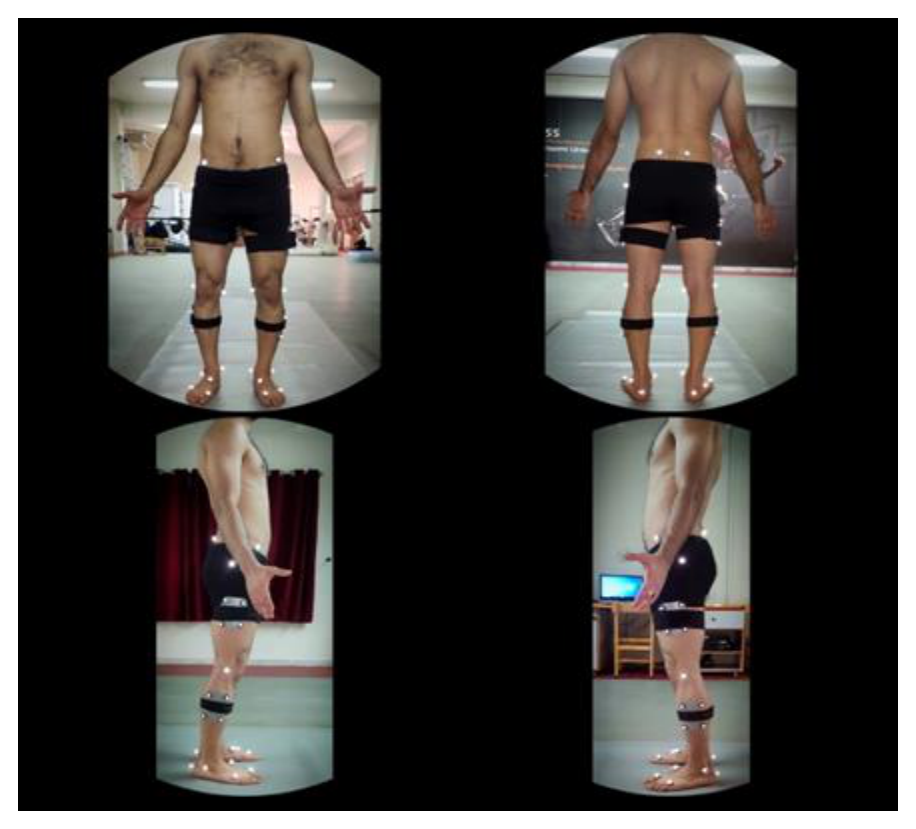
Corporation, Kestrel, California, USA) operating at a sampling frequency of 200 Hz. Reflective markers measuring 14 mm in diameter were used to track segmental motion (1). A CODA-based marker configuration was applied to the lower limbs, as illustrated in Fig. 1 (22). Markers were attached using double-sided adhesive tape to anatomical landmarks, including the first and fifth metatarsal heads, posterior heel, foot, medial and lateral malleoli, medial and lateral femoral epicondyles, anterior and posterior superior iliac spines, and the femoral head region. Four-marker clusters were also attached to the shank and thigh segments, and two markers were placed at the ends of the barbell. The cameras were arranged to ensure that each marker was visible to at least two cameras throughout the movement (22). The motion capture system was calibrated before each participant's testing session. Before the experimental trials, participants completed a five-minute general warm-up consisting of treadmill running at 4 m/s and dynamic exercises, including bodyweight squats. They then performed one set of 10 squats at 50% of their one-repetition maximum (1RM) (23).
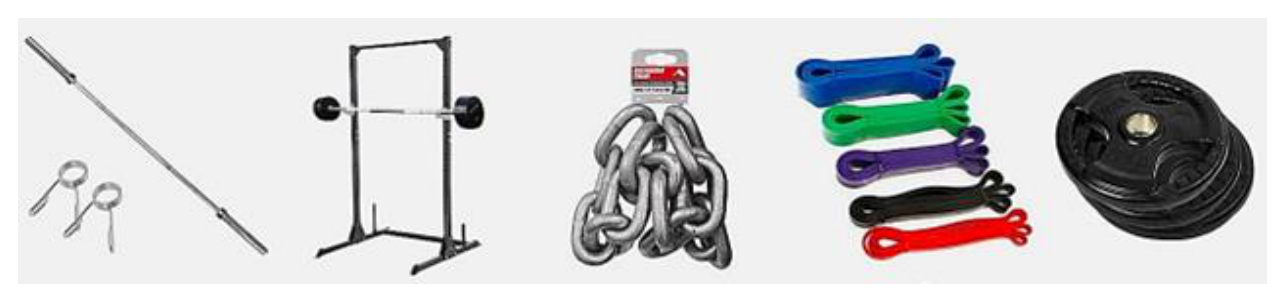
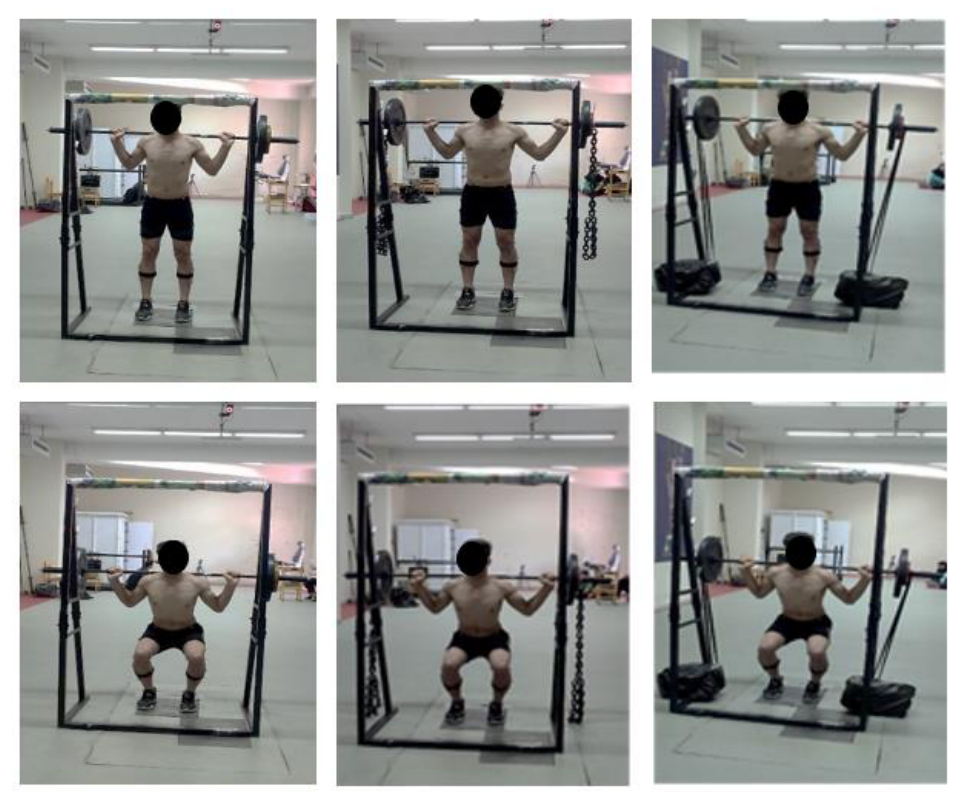
Following static and dynamic calibration, participants performed three squat conditions in a fixed sequence: traditional barbell squat (TS), elastic band squat (EBS), and chain squat (CS). Each condition consisted of three sets of five repetitions at 75% of 1RM. In the EBS and CS conditions, elastic bands and chains, respectively, contributed 25% of the total external load at the top of the squat. Five-minute rest intervals were provided between sets and conditions to reduce potential fatigue and carryover effects (23). For all conditions, participants positioned themselves in the center of the squat rack, held the barbell with both hands, maintained a stance approximately equal to hip width and a grip approximately equal to shoulder width, and descended until their thighs were parallel to the floor (Fig. 2 and 3) (22, 23). No externally imposed cadence was used because squat execution involves an individualized movement rhythm (24). Participants were instructed to perform each repetition at a consistent, self-selected pace while minimizing pauses at the upper and lower endpoints (17–25). Practice repetitions were performed to establish a consistent movement tempo (7–26). Repetition duration was subsequently assessed using the vertical displacement of the greater trochanter marker to evaluate the consistency of movement timing across repetitions and sets. Four types of Rogue Monster elastic bands were used: orange, red, blue, and green, in ascending order of resistance. All bands were 100 cm long and 0.5 cm thick but differed in width and resistance at 100% elongation. The orange band was 1.5 cm wide and provided 8 kg of resistance; the red band was 3 cm wide and provided 13.5 kg; the blue band was 4.5 cm wide and provided 18 kg; and the green band was 6.5 cm wide and provided 29.5 kg. Band selection was individualized according to each participant's 1RM and the target external load. Bands were selected to provide approximately 25% of the total external load at the top of the squat when stretched to 100% of their original length. When a single band could not provide the required resistance, two bands with different resistance levels were combined to achieve the target contribution. For the CS condition, galvanized steel chains were attached to the ends of the barbell using connectors. Each chain link weighed 1 kg. The number of links was selected individually so that the chain contribution at the top of the squat corresponded to approximately 25% of the total external load.
Data Processing and Analysis
Marker labeling, skeletal modeling, and gap filling were performed using Cortex software (Cortex-64, version 8.1.0.2017). Missing marker trajectory data were reconstructed using linear interpolation. The recorded trajectories were inspected for data quality and potential tracking errors. Raw kinematic data were subsequently filtered using a fourth-order low-pass Butterworth filter with a cutoff frequency of 6 Hz, based on previous squat kinematics research (27). Each participant completed 15 repetitions per condition (three sets of five repetitions), with each repetition treated as an individual trial. Movement cycles were identified from the vertical displacement of the greater trochanter marker. Each cycle was time-normalized to 101 points representing 0–100% of the squat cycle using spline interpolation, allowing comparisons across repetitions and participants (21–28). Sagittal-plane hip, knee, and ankle joint kinematics, including range of motion (ROM), angular velocity, and angular acceleration, were calculated in MATLAB (R2021a; MathWorks Inc., Natick, MA, USA). Joint angles were derived using an Euler–Cardan rotation sequence (XYZ) (22–29). For each participant, the values obtained across the 15 repetitions were averaged to provide a representative value for each kinematic variable under each squat condition. Measurement reliability was evaluated using the intraclass correlation coefficient (ICC), calculated with a two-way random-effects model and absolute agreement. ICC values greater than 0.90 were interpreted as indicating excellent reliability.
Fig. 1. CODA marker set model for the lower extremity.
Fig. 2. Equipment used for performing the squat exercise in three different conditions.
Fig. 3. Standing and bottom positions of the barbell back squat in three conditions: traditional squat, elastic band squat, and chain squat.
Statistical Analysis
Data normality was assessed using the Shapiro–Wilk test. Descriptive statistics are presented as means and standard deviations (mean ± SD). Differences among the three squat conditions were examined using repeated-measures analysis of variance (ANOVA). When significant main effects were identified, Bonferroni-adjusted pairwise comparisons were performed. Effect sizes were expressed as eta squared (η²). Statistical analyses were conducted using IBM SPSS Statistics (version 27.0; IBM Corp., Armonk, NY, USA), with statistical significance set at p < 0.05.
Results
To examine the normality of data distribution, the Shapiro-Wilk test was used, and the results indicated that the distribution of all investigated variables was normal (P > 0.05). The results of one-way repeated measures ANOVA showed a significant difference in hip joint range of motion among the three squat execution methods (P = 0.027). The Bonferroni post-hoc test revealed that this significant difference was due to a reduction in hip range of motion in the EBS (70.12 ± 5.87 degrees) compared to the TS alone (75.65 ± 5.45 degrees) (P = 0.047). Additionally, a significant difference was observed in knee joint range of motion among the three execution methods (P = 0.002) (Fig. 4). The post-hoc test results showed that knee range of motion in both the EBS (90.59 ± 4.68 degrees) and the CS (92.93 ± 4.54 degrees) was significantly lower than that in the TS alone (98.49 ± 6.34 degrees) (P = 0.029 and P = 0.004, respectively). In contrast, no significant difference was found in ankle joint range of motion among the three methods (P = 0.952). Data analysis revealed no significant differences in angular velocity of the hip (P = 0.210), knee (P = 0.600), or ankle (P = 0.870) joints among the three squat execution methods. Similarly, no significant differences were observed in angular acceleration of the hip (P = 0.564), knee (P = 0.750), or ankle (P = 0.370) joints among the three methods. The effect size analysis showed that knee joint range of motion was the most influenced variable by the type of external resistance, with an effect size of 0.48. Hip joint range of motion also showed a moderate to large effect size of 0.32. Other variables had effect sizes smaller than 0.14, indicating low influence from the type of external resistance, which is consistent with the lack of statistical significance for these variables (Table 2).
Table 2. Kinematic Variables of Lower Extremity Joints Across Three Squat Modalities
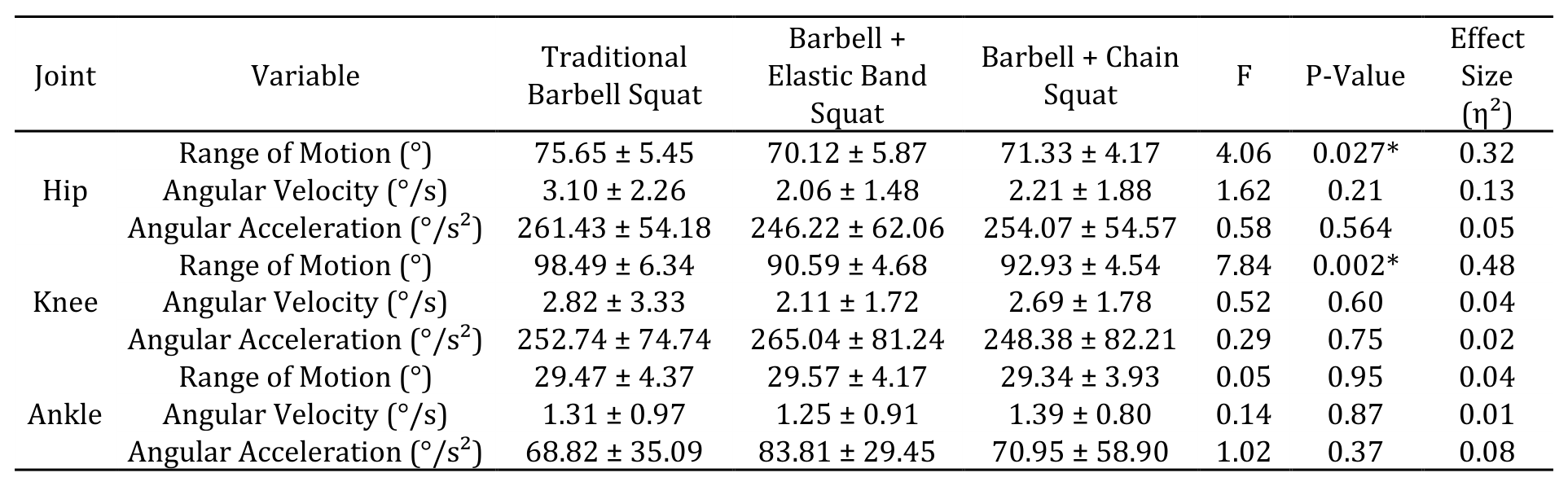
Note: *Values are presented as mean ± standard deviation. *Significant difference at P < 0.05.
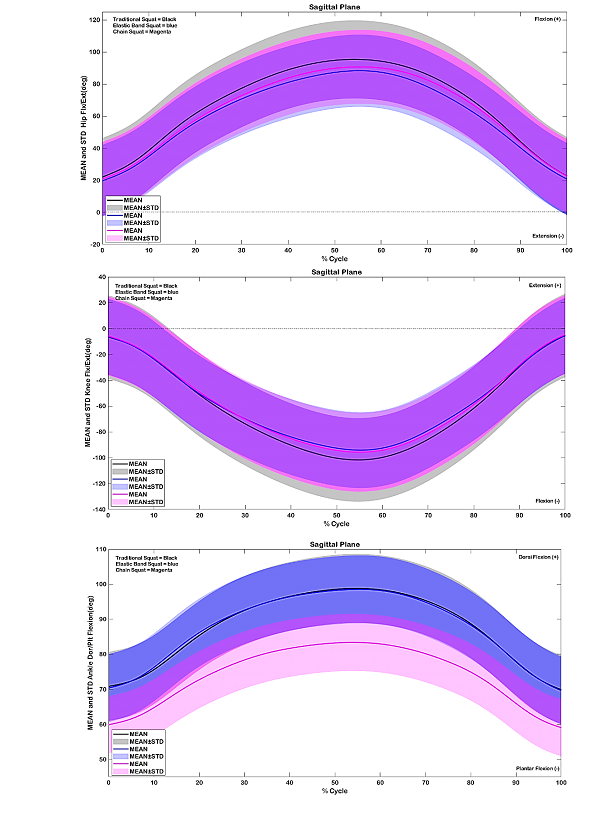 Fig. 4. Comparison of range of motion of the hip, knee, and ankle joints in the sagittal plane among three squat execution methods: traditional squat, elastic band squat, and chain squat
Discussion
Lower-limb joint range of motion (ROM) is an important kinematic characteristic of squat performance and may influence movement strategy, interjoint coordination, and the distribution of mechanical demands across the lower extremities (2). External resistance characteristics, particularly those associated with elastic bands and chains, may influence joint motion throughout different phases of the squat (10–32). The present study found that resistance condition was associated with joint-specific differences in sagittal-plane ROM. Specifically, hip ROM was significantly lower during elastic band squats than during traditional barbell squats, whereas knee ROM was significantly lower during both elastic band and chain squats. No significant differences were observed in ankle ROM or in joint angular velocity and angular acceleration across the three conditions.
The reduction in hip ROM was statistically significant only in the elastic band condition, whereas the difference between chain and traditional barbell squats was not significant. This finding may be related to differences in the resistance profiles of the two variable-resistance modalities. Elastic bands generally provide progressively greater resistance as they stretch, whereas chains increase the external load as additional links are lifted from the floor (17). These loading characteristics may influence movement strategies and joint excursions during squatting. However, because joint moments, trunk inclination, and muscle activation were not measured, the mechanisms underlying the observed reduction in hip ROM cannot be established from the present data (27–34). At the knee, both elastic band and chain squats were associated with significantly lower ROM than traditional barbell squats. Differences in resistance distribution throughout the movement may have contributed to these findings (4–26). For example, changes in external resistance during the descent and ascent phases could influence the depth or movement strategy adopted by participants. However, the present study did not directly measure joint loading, quadriceps activation, or resistance-related changes in neuromuscular control. Consequently, the reduced knee ROM should not be interpreted as evidence of lower knee joint stress or improved movement safety. In contrast, ankle ROM did not differ significantly among conditions. This finding suggests that sagittal-plane ankle excursion was relatively consistent across the three resistance modalities under the tested conditions, although the mechanisms responsible for this consistency remain uncertain (17, 35–38).
No statistically significant differences in hip angular velocity or angular acceleration were observed across resistance conditions. These findings indicate that the measured temporal characteristics of hip joint motion were broadly comparable under the three loading configurations. Previous research has emphasized the contribution of the hip extensors to squat performance and their capacity to generate substantial joint moments during loaded movements (4, 34, 39). Nevertheless, the present results do not establish whether muscular compensation or altered neuromuscular recruitment contributed to the absence of significant kinematic differences. Similarly, knee angular velocity and angular acceleration did not differ significantly among conditions. Although numerically higher angular acceleration values were observed in the elastic band condition, this difference was not statistically significant. Elastic bands modify external resistance as their length changes, potentially affecting the mechanical demands of different movement phases (17). However, without phase-specific analyses of joint angular acceleration, band tension, or joint moments, it is not possible to determine whether the observed numerical differences reflect a particular mechanical mechanism, such as elastic recoil or changes in acceleration near the sticking region (4, 18, 27).
At the ankle, angular velocity remained statistically comparable across conditions, whereas angular acceleration showed numerically higher values in the elastic band and chain conditions, particularly with elastic bands. Although these observations may warrant further investigation, they do not provide sufficient evidence that variable resistance increases ankle angular acceleration. The ankle contributes to lower-limb movement control and force transmission during squatting, and its kinematic behavior may be influenced by the interaction between external resistance, movement depth, and individual movement strategy (17, 35, 36, 39). Future studies incorporating phase-specific kinematic analyses, ground reaction forces, and inverse dynamics may help clarify whether different resistance profiles alter ankle joint mechanics. Although no externally imposed cadence was used, retrospective analysis indicated that participants completed each repetition in approximately 3 seconds, with each five-repetition set lasting approximately 15 seconds. This observation suggests that the participants maintained a relatively consistent self-selected movement tempo during testing (26). Their previous resistance training experience may have contributed to this consistency (7, 28). Nevertheless, similarity in average repetition duration does not necessarily establish equivalence in eccentric and concentric phase durations or eliminate potential differences in movement timing between conditions. Therefore, the absence of externally controlled pacing should be considered when interpreting the findings. From a practical perspective, the results suggest that resistance modality may influence the joint ROM achieved during squatting. Traditional barbell squats were associated with greater hip ROM than elastic band squats and greater knee ROM than both variable-resistance conditions. These differences may be relevant when selecting exercises according to desired movement characteristics. However, the present study did not assess muscle hypertrophy, maximal strength adaptations, explosive performance, joint loading, or injury outcomes. Accordingly, the findings do not establish the superiority of any resistance modality for these objectives. In particular, the nonsignificant differences in angular acceleration should not be used to recommend elastic bands for improving explosive performance or chains for reducing joint stress during rehabilitation (18).
The present study has several limitations. First, the sample size was relatively small (n = 23), which may have limited the precision of the estimates and the ability to detect small differences in angular velocity and angular acceleration. Second, the absence of electromyographic measurements prevented direct assessment of muscle activation patterns. Third, the study included only physically active men, limiting generalizability to women, older adults, injured individuals, and athletes with different training backgrounds. Fourth, although participants maintained a relatively consistent self-selected tempo, movement cadence was not externally standardized. In addition, the fixed sequence of squat conditions may have introduced order-related effects, including fatigue or familiarization, despite the rest intervals provided. The study also had methodological strengths, including the within-subject comparison of three resistance conditions, the use of three-dimensional motion capture at 200 Hz, and the assessment of sagittal-plane kinematics at the hip, knee, and ankle. The variable-resistance conditions were designed to provide a 25% contribution from bands or chains at the top of the squat. Nevertheless, this loading prescription does not necessarily establish equivalent resistance profiles throughout the movement. Future investigations should quantify the actual resistance provided by bands and chains across the squat cycle, use randomized or counterbalanced condition orders, and incorporate electromyography, force-platform measurements, and inverse dynamics. Larger studies involving different populations and longitudinal interventions are also needed to determine whether the observed acute kinematic differences translate into meaningful training adaptations or functional outcomes.
Conclusion
The findings of this study demonstrated that the type of external resistance during squatting modulates the kinematic pattern of the lower extremity in a joint-specific and resistance-dependent manner. The traditional squat was more suitable for achieving maximal range of motion in the hip and knee joints and for developing strength across the full range of motion, whereas variable resistance methods, particularly the elastic band squat, were associated with a significant reduction in range of motion at the hip and knee joints; a characteristic that may be considered in rehabilitation settings or for the purpose of reducing joint stress at end-range positions. Despite the absence of statistically significant differences in angular velocity and angular acceleration among the squat conditions, an increasing trend in angular acceleration was observed at the knee and ankle joints in the elastic band squat and at the ankle joint in the chain squat, which may indicate the potential capacity of these methods for enhancing explosive performance. Furthermore, the lack of significant differences in angular velocity among the resistance conditions suggests that this variable is likely influenced more by the athletes' voluntary neuromuscular control than by the type of external resistance. Overall, the findings of this study indicate that the selection of the squat execution method should be made in accordance with training objectives, individual fitness level, and injury prevention considerations, so that while benefiting from the advantages of each method, the potential risks arising from excessive reduction or increase in joint loads are minimized.
Ethical Considerations
Compliance with ethical guidelines
This study was conducted in accordance with the principles of research ethics. All procedures were reviewed and approved by the Ethics Committee for Research Involving Human Subjects at Kharazmi University (Ethics Code: IR.KHU.REC.1403.153). Written informed consent was obtained from all participants prior to their participation in the study. All research procedures were performed in compliance with the principles of the Declaration of Helsinki, and the confidentiality and anonymity of all participants' data were maintained.
Funding
This study received no external funding and was fully self-funded by the author.
Authors' contributions
Behzad Yaghoubi Gorji: Conceptualization and study design; conducting the research; data analysis and interpretation; drafting the original manuscript; critical revision and editing of the manuscript.
Raghad Mimar: Conceptualization and study design; data analysis and interpretation; drafting the original manuscript; critical revision and editing of the manuscript.
Mehdi Khaleghi Tazji: Conceptualization and study design; data analysis and interpretation; drafting the original manuscript; critical revision and editing of the manuscript.
Mohammad Aziminia: Data analysis and interpretation; drafting the original manuscript; critical revision and editing of the manuscript. All authors read and approved the final version of the manuscript.
All authors read and approved the final version of the manuscript.
Conflicts of interest
The author declares no conflict of interest.
Type of Study: Applicable |
Subject:
Special
Received: 2026/02/25 | Accepted: 2026/09/29 | Published: 2026/11/20
Received: 2026/02/25 | Accepted: 2026/09/29 | Published: 2026/11/20
References
1. Lu Y, Mei Q, Peng HT, Li J, Wei C, Gu Y. A comparative study on loadings of the lower extremity during deep squat in Asian and Caucasian individuals via OpenSim musculoskeletal modelling. BioMed Research International. 2020;2020:7531719. [DOI:10.1155/2020/7531719]
2. Schoenfeld BJ. Squatting kinematics and kinetics and their application to exercise performance. Journal of Strength and Conditioning Research. 2010;24(12):3497-3506. [DOI:10.1519/JSC.0b013e3181bac2d7]
3. Asayama A, Tateuchi H, Yamagata M, Ichihashi N. Influence of stance width and toe direction on medial knee contact force during bodyweight squats. Journal of Biomechanics. 2021;129:110798. [DOI:10.1016/j.jbiomech.2021.110824]
4. Lorenzetti S, Ostermann M, Zeidler F, Zimmer P, Jentsch L, List R, et al. How to squat? Effects of various stance widths, foot placement angles and level of experience on knee, hip and trunk motion and loading. BMC Sports Science, Medicine and Rehabilitation. 2018;10:14. [DOI:10.1186/s13102-018-0103-7]
5. Dali S, Justine M, Ahmad H, Othman Z. Comparison of ground reaction force during different angle of squatting. Journal of Human Sport and Exercise. 2013;8(3):778-787. [DOI:10.4100/jhse.2013.83.02]
6. Mina MA, Blazevich AJ, Giakas G, Kay AD. Influence of variable resistance loading on subsequent free weight maximal back squat performance. Journal of Strength and Conditioning Research. 2014;28(10):2988-2995. [DOI:10.1519/JSC.0000000000000471]
7. Ataee J, Koozehchian MS, Kreider RB, Zuo L. Effectiveness of accommodation and constant resistance training on maximal strength and power in trained athletes. PeerJ. 2014;2:e441. [DOI:10.7717/peerj.441]
8. Nijem RM, Coburn JW, Brown LE, Lynn SK, Ciccone AB. Electromyographic and force plate analysis of the deadlift performed with and without chains. Journal of Strength and Conditioning Research. 2016;30(5):1177-1182. [DOI:10.1519/JSC.0000000000001351]
9. Berning JM, Coker CA, Adams KJ. Using chains for strength and conditioning. Strength and Conditioning Journal. 2004;26(5):80-84. [DOI:10.1519/00126548-200410000-00017]
10. Wallace BJ, Winchester JB, McGuigan MR. Effects of elastic bands on force and power characteristics during the back squat exercise. Journal of Strength and Conditioning Research. 2006;20(2):268-272. [DOI:10.1519/R-16854.1]
11. Stevenson MW, Warpeha JM, Dietz CC, Giveans RM, Erdman AG. Acute effects of elastic bands during the free-weight barbell back squat exercise on velocity, power, and force production. Journal of Strength and Conditioning Research. 2010;24(11):2944-2954. [DOI:10.1519/JSC.0b013e3181db25de]
12. Hartmann H, Wirth K, Klusemann M. Analysis of the load on the knee joint and vertebral column with changes in squatting depth and weight load. Sports Medicine. 2013;43(10):993-1008. [DOI:10.1007/s40279-013-0073-6]
13. Erman B, Vural F, Dopsaj M, Ozkol MZ, Kose DE, Aksit T. The effects of fatigue on linear and angular kinematics during bilateral squat. PLOS ONE. 2023;18(11):e0289089. [DOI:10.1371/journal.pone.0289089]
14. Mojtahedi MZ, Fatahi A. The effects of increasing running speed on three-dimensional peak angle of the lower limb joints in stance phase. Journal of Sport Biomechanics. 2022;8. [DOI:10.52547/JSportBiomech.8.2.114]
15. Li J, Chen Z, Xu K, Wang Y, Gong M. Comparison of variable resistance and free weight training on long-term and acute effects on different assessments of strength: a systematic review and meta-analysis. Journal of Strength and Conditioning Research. 2026;40(2):e211-e223. [DOI:10.1519/JSC.0000000000005369]
16. Yan Z, Wu J, Lin S, Li Q, Liu R. Variable versus constant resistance squat training for lower-limb strength and power: a systematic review and meta-analysis. Applied Sciences. 2025;15(16):9144. [DOI:10.3390/app15169144]
17. Alves AV, Leicht AS, Deakin GB, Doma K, Singh U, Brice SM. Joint-level analysis of the barbell back squat during chain and elastic variable resistance use. Journal of Strength and Conditioning Research. 2026;40(5):511-518. [DOI:10.1519/JSC.0000000000005353]
18. Wu D, Feng S, Zhou A, Xie Y. Heavy load chain squats: a promising method for enhancing lower extremity explosive strength via post-activation performance enhancement. Frontiers in Physiology. 2025;16:1596200. [DOI:10.3389/fphys.2025.1596200]
19. Nazari F, Fatahi A. Football biomechanics and performance enhancement: a systematic review. Journal of Sport Biomechanics. 2024;9. [DOI:10.61186/JSportBiomech.9.3.252]
20. Aziminia M, Abbasi A. Comparing trunk and lower extremity kinematic variables during side-cutting maneuver in healthy and anterior cruciate ligament reconstructed athletes. Journal of Sport Biomechanics. 2022;8(1):50-64. [DOI:10.52547/JSportBiomech.8.1.3]
21. Weir G, Jewell C, van Emmerik R, Hamill J. Lower extremity coordination variability during anticipated and unanticipated sidestepping: implications for ACL injury prevention. In: Proceedings of the International Society of Biomechanics in Sports Conference; 2017. p. 125-128.
22. Graci V, Van Dillen LR, Salsich GB. Gender differences in trunk, pelvis and lower limb kinematics during a single leg squat. Gait & Posture. 2012;36(3):461-466. [DOI:10.1016/j.gaitpost.2012.04.006]
23. Ebben WP, Jensen RL. Electromyographic and kinetic analysis of traditional, chain, and elastic band squats. Journal of Strength and Conditioning Research. 2002;16(4):547-550. [DOI:10.1519/1533-4287(2002)0162.0.CO;2]
24. Sohn J, Koo D. Effects of load increase on lower extremity kinetic and kinematic variables in the back squat exercise. Technology and Health Care. 2023;31(S1):247-258. [DOI:10.3233/THC-236021]
25. Jiang D, Xu G. Effects of chains squat training with different chain load ratio on the explosive strength of young basketball players' lower limbs. Frontiers in Physiology. 2022;13:979367. [DOI:10.3389/fphys.2022.979367]
26. Myer GD, Kushner AM, Brent JL, Schoenfeld BJ, Hugentobler J, Lloyd RS, et al. The back squat: a proposed assessment of functional deficits and technical factors that limit performance. Strength and Conditioning Journal. 2014;36(6):4-27. [DOI:10.1519/SSC.0000000000000103]
27. Alizadeh S, Vardy L, Forman GN, Forman DA, Holmes MWR, Button DC. Sex difference in lower-limb electromyography and kinematics when using resistance bands during a barbell back squat. Journal of Human Kinetics. 2023;86:17-29. [DOI:10.5114/jhk/159585]
28. Pollard CD, Stearns KM, Hayes AT, Heiderscheit BC. Altered lower extremity movement variability in female soccer players during side-step cutting after anterior cruciate ligament reconstruction. The American Journal of Sports Medicine. 2015;43(2):460-465. [DOI:10.1177/0363546514560153]
29. Sinclair J, Taylor PJ, Bottoms L. The appropriateness of the helical axis technique and six available Cardan sequences for the representation of 3-D lead leg kinematics during the fencing lunge. Journal of Human Kinetics. 2013;37:7. [DOI:10.2478/hukin-2013-0020]
30. Rocha DS, Dibai-Filho AV, Pinheiro JS, de Azevedo LFS, Falcai A, de Jesus Tavarez RR, et al. The Baecke Habitual Physical Activity Questionnaire (BHPAQ): a valid internal structure of the instrument to assess healthy Brazilian adults. Revista da Associação Médica Brasileira. 2022;68(7):912-916. [DOI:10.1590/1806-9282.20211374]
31. Rafaei P, Lajevardi L, Kamali M, Azad A, Yazdani AH, Amini P. Face validity and test-retest reliability of Persian version of Baecke Physical Activity Questionnaire in patients with low back pain. Middle East Journal of Disability Studies. 2016;7:2-20.
32. Shi L, Lyons M, Duncan M, Chen S, Han D, Yang C. Kinetics, kinematics, and muscle activity patterns during back squat with different contributions of elastic resistance. International Journal of Sports Physiology and Performance. 2024;19(9):921-931. [DOI:10.1123/ijspp.2024-0009]
33. Illmeier G. Variations of the bilateral barbell squat: a brief review. Sports Injury and Medicine. 2023;7:196. [DOI:10.29011/2576-9596.100196]
34. Mina MA, Blazevich AJ, Giakas G, Draper N. Biomechanical effects of elastic bands, chains and free-weight resistance on submaximal back squat exercise. Journal of Strength and Conditioning Research. 2015;29(9):2600-2609.
35. Gomes J, Neto T, Vaz JR, Schoenfeld BJ, Freitas SR. Is there a relationship between back squat depth, ankle flexibility, and Achilles tendon stiffness? Sports Biomechanics. 2022;21(7):782-795. [DOI:10.1080/14763141.2019.1690569]
36. Imano T, Nakajima M. Exercise speed and workload effects on muscle hypoxia in vastus lateralis muscle during squatting exercises. Journal of Exercise Science & Fitness. 2024;3(4):464-470. [DOI:10.55860/KNXZ7210]
37. Kasahara S, Ishida T, Linjing J, Chiba A, Samukawa M, Tohyama H. Relationship among the COM motion, the lower extremity and the trunk during the squat. Journal of Human Kinetics. 2024;93:29-39. [DOI:10.5114/jhk/183066]
38. Ishida T, Samukawa M, Kasahara S, Tohyama H. The center of pressure position in combination with ankle dorsiflexion and trunk flexion is useful in predicting the contribution of the knee extensor moment during double-leg squatting. BMC Sports Science, Medicine and Rehabilitation. 2022;14:127. [DOI:10.1186/s13102-022-00523-0]
39. Stone MH, Hornsby WG, Mizuguchi S, Sato K, Gahreman D, Duca M, et al. The use of free weight squats in sports: a narrative review-terminology and biomechanics. Applied Sciences. 2024;14(5):1977. [DOI:10.3390/app14051977]
| Rights and permissions | |
 |
This work is licensed under a Creative Commons Attribution-NonCommercial 4.0 International License. |

Journal of Sport Biomechanics
Department of Sport Biomechanics, Faculty of Humanities, Islamic Azad University, Hamedan Branch, Prof. Mousivand Blvd, Imam Khomeini Blvd, Hamedan, Iran.
Journal Tel: +98 81 34494042
Website: http://biomechanics.iauh.ac.ir
Email: sportbiomechanics@iauh.ac.ir
