

Volume 12, Issue 4 (2-2027)
J Sport Biomech 2027, 12(4): 882-918 |
Back to browse issues page




Download citation:
BibTeX | RIS | EndNote | Medlars | ProCite | Reference Manager | RefWorks
Send citation to:


BibTeX | RIS | EndNote | Medlars | ProCite | Reference Manager | RefWorks
Send citation to:
Shah S, Motimath B, Dhaval D. Correlation Between Core Muscle Endurance and Dual-Task Performance Among Competitive Karate Kata Athletes: An Analytical Study. , J Sport Biomech. 2027; 12 (4) :882-918
URL: http://biomechanics.iauh.ac.ir/article-1-563-en.html
URL: http://biomechanics.iauh.ac.ir/article-1-563-en.html


1- Department of Sports Physiotherapy, KLE Institute of Physiotherapy, Nehru Nagar, Belagavi 590010, Karnataka, India.
Keywords: Martial arts, Physical endurance, Postural balance, Cognition, Task performance and analysis, Athletic performance
Full-Text [PDF 2135 kb]
(26 Downloads)
| Abstract (HTML) (34 Views)
Full-Text: (11 Views)
Introduction
Karate is among the most widely practised combat sports in the world and is contested in two formats: kumite, a regulated sparring discipline, and kata, an individually adjudicated form in which the athlete performs a codified sequence of stances, blocks, strikes and transitions against imagined opponents (1). Kata places predominantly alactic and aerobic demands on the athlete yet produces considerable cardiorespiratory and neuromuscular strain despite its short duration (1, 2). Injury surveillance at World Karate Federation championships shows that injuries cluster at the head, upper limb and lower limb (3). As kata does not involve direct contact between opponents, performance depends heavily on neuromuscular, postural and attentional factors. Judges score kata on stance stability, correct execution of technique, transitional control, rhythm, timing, breathing and overall coherence (4). Judging is comparative and margins are narrow, so slight losses of postural precision can cost points. High-level kata specialists have demonstrated better postural regulation than kumite specialists and untrained controls (5), but this advantage has been demonstrated under controlled laboratory conditions. Competition presents a different setting, since crowd noise, adjacent-tatami activity, sideline coaching and camera flashes can all compete for the athlete's attention.
The dual-task paradigm is an established method for quantifying performance under such conditions. When a motor task and a cognitive task are performed together and both draw on limited central attentional resources, performance on one or both tasks may deteriorate; the magnitude of that deterioration, expressed as dual-task cost, indexes cognitive–motor interference (6, 7). Dual-task cost varies with the complexity of the cognitive load, the automaticity of the motor skill and the attentional demands of the postural task itself (6, 8). Systematic review evidence indicates that concurrent cognitive loading can acutely degrade sport-specific motor output and that repeated dual-task training may reduce these decrements (9, 10). Yet the method has been applied predominantly to gait, balance platforms and open-skill team sports; closed-skill, aesthetically judged martial arts forms remain relatively understudied.
Trunk musculature plays an important role in athletic function. The core anchors the proximal end of the kinetic chain, and its capacity to maintain segmental stiffness influences how efficiently forces are transferred between body segments (11). Trunk endurance is an important component of functional stability, and the isometric field battery introduced by McGill and colleagues is widely used to assess it, with published normative values (12) and evidence of measurement reliability (13, 14). Trunk muscle training can yield small-to-moderate improvements in sport-specific performance (15, 16), and a controlled trial in youth karateka reported gains in balance, agility and strength (17, 18). Similar findings have been reported in other martial arts: six weeks of core stability training improved balance and competitive performance in male taekwondo athletes (19), and core stability work produced greater gains in static and dynamic balance than trampoline training in female athletes with chronic ankle instability (20). These studies suggest that trunk conditioning can improve balance under conditions without concurrent cognitive tasks; however, they did not examine whether trunk endurance is related to performance when attention is divided.
Taikyoku Shodan, the first kata of Shotokan karate, was chosen as the motor task. Funakoshi codified it as a deliberately simplified teaching form intended to distil the fundamental mechanics of the style (21). Twenty movements are executed along an I-shaped performance line, or embusen, using one stance, one block and one strike, with eight changes of direction and two prescribed kiai (21, 22). Containing no kicks, jumps or advanced hand techniques, it allows the assessment of competencies of interest here, namely sustained trunk control through repeated weight transfer, controlled rotation about the vertical axis and reproducible segmental timing, while minimising the technical complexity associated with advanced kata. As a basic Shotokan kata, it provides a relatively standardised motor task, although familiarity with the form may vary according to athletes' training backgrounds and styles. Karate practice is itself neurocognitively demanding, and practitioners have demonstrated enhanced attentional control and executive function (24–26); kata requires retrieval of a movement sequence from procedural memory, online postural regulation and suppression of distractors, the last of which relates to the construct assessed by the Stroop colour–word task (27, 28). A clear gap therefore remains. Core endurance contributes to postural stability and force transfer, and cognitive load can degrade motor performance, but whether baseline trunk endurance is associated with the magnitude of performance loss when attention is diverted has not been established. This study determined the association between core muscle endurance and dual-task performance in competitive kata athletes by quantifying composite trunk endurance, movement quality under single-task, auditory dual-task and visual dual-task conditions, and the resulting dual-task costs. The endurance–cost association was examined both before and after adjustment for age, training experience, body mass index and cognitive performance. We hypothesised an inverse association that would persist after multivariable adjustment.
Methods
Subjects
This single-centre, cross-sectional analytical study assessed each participant in one session and is reported in accordance with the STROBE statement (29). It was registered with the Clinical Trials Registry–India (CTRI/2026/02/103742). Registration took place after participant recruitment had commenced and was therefore retrospective; no claim of prospective registration is made. The eligibility criteria, outcome measures and analytical plan were fixed in the protocol approved by the institutional ethics committee on 5 January 2026, before any participant was assessed, and were not altered thereafter; the registry entry records these prespecified elements retrospectively rather than establishing them. No interim analysis was conducted and no outcome was defined or selected after inspection of the data. Data were collected at affiliated karate clubs and dojos across Belagavi, Karnataka, India, on the athletes' habitual training surface to preserve ecological validity, in areas standardised to a minimum clear floor space of 4 m × 4 m.
Eligible participants were male and female competitive kata athletes aged 15 to 35 years with at least two years of continuous kata training, a minimum of two kata events contested, and the ability to execute a complete standardised sequence appropriate to their grade. Athletes were excluded for any musculoskeletal injury, or neurological, vestibular or balance disorder, within the preceding six months; any cardiovascular or respiratory condition contraindicating moderate-to-vigorous activity; or uncorrectable visual or auditory impairment. Colour vision was screened with Ishihara plates, since normal colour discrimination is a prerequisite for the visual interference task. Recruitment used non-probability convenience sampling through club heads and chief instructors. Competitive standard was defined by the eligibility criteria themselves, namely at least two years of continuous kata training and competition and a minimum of two kata events contested. National or international ranking was not an inclusion requirement and was not used to stratify the sample. The cohort therefore comprises regularly competing club- and regional-standard athletes; the descriptor “elite” is not applied to this sample anywhere in the manuscript, and the terminology “competitive kata athletes” is used throughout. The observed age range of the enrolled sample was 15 to 32 years, within the 15 to 35 year eligibility window. Sample size was estimated for a two-tailed test of a single Pearson correlation using the Fisher z transformation, n = [(Zα/2 + Zβ) / C]² + 3, where C = 0.5 × ln[(1 + ρ) / (1 − ρ)]. The anticipated correlation of ρ = 0.31 was set a priori as a moderate association of the order reported for trunk conditioning and sport-specific performance (15, 16); it was not taken from a single prior study, since no published investigation had examined the endurance–dual-task relationship directly. With ρ = 0.31, α = 0.05 (Zα/2 = 1.96) and 90% power (Zβ = 1.2816), the minimum requirement was 106; the target was set at 108 to allow for unusable records, and the final analysed sample was 108 with no missing values. At n = 108 the smallest correlations detectable at two-tailed α = 0.05 were |r| = 0.27 with 80% power and |r| = 0.31 with 90% power.
Procedure
Ethical approval was obtained before the study began, and written informed consent, or parental consent with the minor's written assent, was obtained from every participant along with separate consent for video recording and anonymised publication. The standardised motor task was Taikyoku Shodan, selected because it is common to the syllabus of every participating athlete and because its restricted technical vocabulary allows movement quality to be scored without confounding by technical difficulty. The form comprises twenty counted movements along an I-shaped embusen: eight executions of gedan barai and twelve of oi-zuki at middle level, performed throughout in zenkutsu-dachi, with three ninety-degree turns, three one-hundred-and-eighty-degree pivots, two two-hundred-and-seventy-degree rotations, and kiai on the eighth and sixteenth movements. Athletes opened from yoi in hachiji-dachi and returned to it on the command yame, breathing to the conventional Shotokan pattern with controlled exhalation on completion of each technique and no breath-holding. The order of the three conditions was counterbalanced using a computer-generated Latin square to control for order, learning and fatigue effects. Participants could not be blinded to condition. All performances were exported as anonymised, code-labelled video files and scored as described in the “Movement Quality” subsection, which also sets out the blinding arrangements. Each session opened with a standardised ten-minute warm-up. Demographic and anthropometric data were recorded (height to the nearest 0.1 cm, body mass to the nearest 0.1 kg), followed by seated single-task baselines for both cognitive tasks and then the four endurance holds in fixed order with five-minute inter-test rest. After ten minutes of recovery, athletes completed two submaximal familiarisation repetitions at approximately 70% of competition intensity and then the three scored performances, separated by three-minute passive rest. A single performance lasted 30 to 40 seconds and total session duration was 45 to 60 minutes. Scored trials were performed at maximal technical effort with full kime, with Borg CR10 ratings recorded after each. Sessions were supervised on certified tatami by an instructor of at least third-dan grade and a physiotherapist with postgraduate training in sports physiotherapy, and any trial with an aborted sequence, abandoned concurrent task or inadequate video was repeated after five minutes of additional rest.
Outcome Measures
Four outcome domains were measured: core muscle endurance, movement quality, cognitive task performance and dual-task cost. The calculation of each is set out below.
Core Muscle Endurance
Anterior, lateral and posterior trunk endurance were assessed with four isometric holds adapted from the McGill protocol: the prone forearm plank, the left and right side planks, and the modified Biering–Sørensen extensor hold. Each hold was maintained until volitional fatigue, defined as the inability to sustain the prescribed alignment despite one verbal correction, with timing stopped at the second deviation. Holds were administered in fixed order with five minutes of rest between them, and each time was recorded in seconds. Composite core endurance was calculated for each athlete as the arithmetic sum of the four hold times (composite = prone plank + modified Biering–Sørensen + left side plank + right side plank). It therefore contains no cognitive or other non-endurance variable; in this sample it ranged from 155 to 350 s. The battery is the reference field standard, with published normative targets (12) and intraclass correlation coefficients of 0.93 to 0.97 (13, 14). An unweighted sum preserves the original metric (seconds) and remains comparable with normative values (12), but it gives the longer extensor hold proportionally greater influence; a composite of standardised (z) hold times was therefore analysed as a sensitivity analysis (“Reliability and Sensitivity Analyses” subsection).
Movement Quality
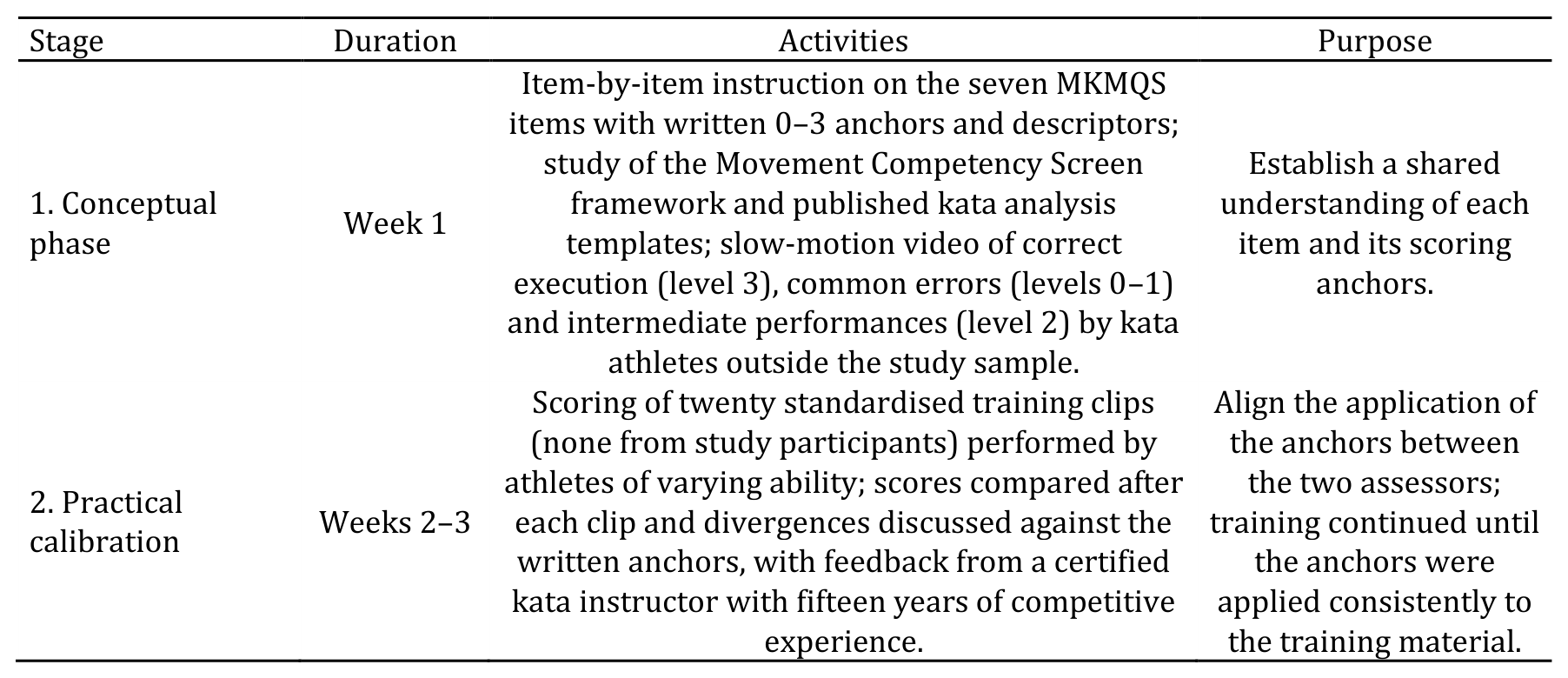
Movement quality was scored with the Modified Karate Movement Quality Scoring Sheet (MKMQS), a seven-item observational instrument adapted from the Movement Competency Screen framework and published kata analysis templates (4). The items are postural control, balance stability, coordination, rhythm and timing, technique precision, power dynamics, and focus and concentration, each scored 0 to 3 for a total of 0 to 21, a higher score indicating better movement quality. All seven items were adapted by rewriting the 0–3 anchors to the stances, blocks, strikes and direction changes of Taikyoku Shodan; no item kept its original anchors, and no formal item-by-item derivation table was constructed. The MKMQS has not been formally validated. No criterion, construct, convergent or discriminant validity evidence exists, and the present study establishes internal structure only, so scores are treated as a provisional index of kata movement quality. Item-level descriptive statistics are given in Supplementary Table S1. Performances were recorded simultaneously from frontal and sagittal cameras at 60 frames per second. Before any study scoring began, two assessors with postgraduate training in sports physiotherapy and at least three years of clinical experience in movement analysis completed a standardised training programme on the MKMQS (Table 1). Scoring was then carried out by two assessors of complementary expertise: the principal investigator, a postgraduate in sports physiotherapy, whose domain covers postural control, balance, coordination and segmental timing; and an independent karate coach of at least third-dan grade with national coaching accreditation, whose domain covers technical correctness, kime, power dynamics and kata-specific execution. Each of the 324 recordings (108 athletes × 3 conditions) was viewed by both assessors, who applied the anchors item by item and discussed any divergence until a single agreed score was entered for each item. Because the assessors were selected for different expertise rather than as interchangeable raters, consensus scoring allowed both perspectives to contribute to every score, and the consensus score was the unit of analysis.
Because the consensus procedure produced no parallel ratings, the karate coach subsequently re-scored all 324 recordings alone, without access to the consensus scores, the endurance data or participant identities. Agreement between the consensus and independent ratings was quantified with two-way random-effects, absolute-agreement intraclass correlation coefficients for single ratings, ICC(A,1), and averaged ratings, ICC(A,k), each with 95% confidence intervals. Because the re-scoring assessor had contributed to the consensus ratings, recall of the agreed scores cannot be excluded, and the coefficients are an upper bound on the agreement a wholly independent assessor would achieve. The independent ratings were also substituted for the consensus scores in a full re-analysis (“Reliability and Sensitivity Analyses” subsection). With regard to blinding, videos were exported as anonymised, code-labelled files (for example V_001_A, V_001_B, V_001_C for the three conditions of participant 001) without participant, condition or session information. This did not conceal the task condition, which is evident from the audio and from the stimulus display within the recorded field of view; recordings were not muted or cropped because rhythm, timing, breathing and postural stability are scored items. Neither assessor was therefore blind to condition. The karate coach took no part in recruitment, testing or data handling and was blind to athlete identity, endurance results and trial order. The principal investigator administered the testing sessions and was not blind to identity or endurance results. The statistician was blinded to participant identity during analysis.
Table 1. Assessor training and calibration before study scoring
Note: MKMQS, Modified Karate Movement Quality Scoring Sheet.
Cognitive Task Performance
Two cognitive tasks were used, each as a concurrent task during the kata and as a seated baseline test. In both dual-task conditions the stimulus stream began on the command hajime and ended at yame, so that presentation overlapped the entire motor sequence. In the auditory condition, a pre-recorded list of thirty phonetically neutral monosyllabic words was delivered through a speaker positioned approximately 1 m lateral to the performance area at floor level, at one word per second, so that the list spanned approximately the first 30 s of the performance. Playback volume was set before testing to a level clearly audible above ambient dojo noise and held constant, but the sound pressure level was not verified with a calibrated meter. Encoding was therefore concurrent with the kata and retrieval delayed: free verbal recall was requested during the 30 s immediately after yame. The task loads working memory throughout the performance but imposes no concurrent response demand. In the visual condition, approximately twenty standardised colour–word interference cards were presented in sequence, each displayed for about two seconds, on a fixed stand approximately 1.5 m directly ahead of the athlete's starting orientation. The athlete named the ink colour of each card aloud while performing the kata, so that this condition imposed a continuous concurrent response demand. Because the stand was fixed, the display left the athlete's field of view during turns away from the starting orientation and was reacquired on returning to it, so stimulus exposure was intermittent. The card-based implementation departs from standard administration of the Stroop paradigm (28). Before kata testing, each athlete completed seated, rested baselines of both tasks. The auditory baseline was free recall of a thirty-word list, scored as the number of words correctly recalled (range 0–30). The visual baseline was a 45-second colour–word (Stroop) test, scored as the number of ink colours correctly named in the 45 s (no fixed maximum; observed range 44 to 77). These baseline scores indexed each athlete's cognitive capacity and were used as covariates. The Stroop baseline score is unrelated in scale to the roughly twenty cards shown during the kata: the cards served only to impose concurrent load and were not a scored test, whereas the baseline score counts the namings completed in 45 s of seated testing. Performance on the concurrent tasks during the kata could not be analysed. Free recall was requested after the auditory dual-task kata, but those scores are not available for analysis, and responses during the visual dual-task kata were not recorded. Dual-task cost in this study is therefore a motor cost only, and engagement with, and prioritisation of, the concurrent tasks could not be verified (see the limitations in the Discussion).
Dual-Task Cost
Dual-task cost was the proportional decrement in movement quality from single-task to dual-task performance, following Plummer and Eskes (7). Auditory dual-task cost (%) = [(single-task score − auditory dual-task score) / single-task score] × 100; visual dual-task cost was calculated analogously, and overall dual-task cost was the mean of the auditory and visual costs. Positive values denote deterioration and negative values facilitation. The two costs were averaged because both derive from the same motor outcome, scored with the same instrument, and differ only in the modality of the concurrent load; the modality-specific costs are nonetheless reported separately, and the internal consistency of the overall index is given in the “Reliability and Sensitivity Analyses” subsection. Negative values, which denote a higher score under dual-task than single-task conditions, were retained without truncation or transformation.
Statistical Analysis
Analyses were performed in Python 3 (pandas, NumPy, SciPy, statsmodels) with α set at 0.05, two-tailed. Distributions were examined with the Shapiro–Wilk test and histograms. Continuous variables are summarised as mean ± standard deviation (SD) with range, and categorical variables as frequencies and percentages. Differences in movement quality between conditions were examined with paired-samples t tests (confirmed with the Wilcoxon signed-rank test) and are reported with 95% confidence intervals and Cohen d, interpreted as small (0.20), moderate (0.50), large (0.80) and very large (1.20). Associations were quantified with Pearson coefficients with Fisher-z 95% confidence intervals and checked with Spearman coefficients, interpreted as negligible (< 0.10), weak (0.10–0.39), moderate (0.40–0.69), strong (0.70–0.89) and very strong (≥ 0.90). Independence of the endurance–cost association was examined in four exploratory multiple linear regression models with overall dual-task cost as the dependent variable: Model 1, composite endurance alone; Model 2, composite endurance with years of kata training, age, body mass index, baseline auditory recall and baseline Stroop score; Model 3, Model 2 with sex added; and Model 4, composite endurance with years of kata training, age, baseline recall, baseline Stroop score, sex, stature and body mass, the last two replacing body mass index so that body size entered as separate terms. Assumptions were verified with variance inflation factors, the Durbin–Watson statistic, the Jarque–Bera test and Cook's distance. Sensitivity analyses repeated the primary correlation with a composite of standardised (z) hold times, within men and within women, in athletes aged 18 years and over, after excluding high-influence cases (Cook's D > 4/n), and with the independent re-scoring in place of the consensus scores; Model 2 was also refitted with heteroscedasticity-consistent (HC3) standard errors. Internal consistency of the MKMQS was quantified with Cronbach alpha (0.70 or above regarded as acceptable), factorability with the Kaiser–Meyer–Olkin measure and Bartlett's test, and dimensionality by principal component analysis; the consistency of the two-component overall cost index was quantified by the Spearman–Brown corrected correlation between the auditory and visual costs. The dataset was complete, so no imputation was required. The analysis script that reproduces every reported statistic is provided as Supplementary Data File 2.
Results
Participants
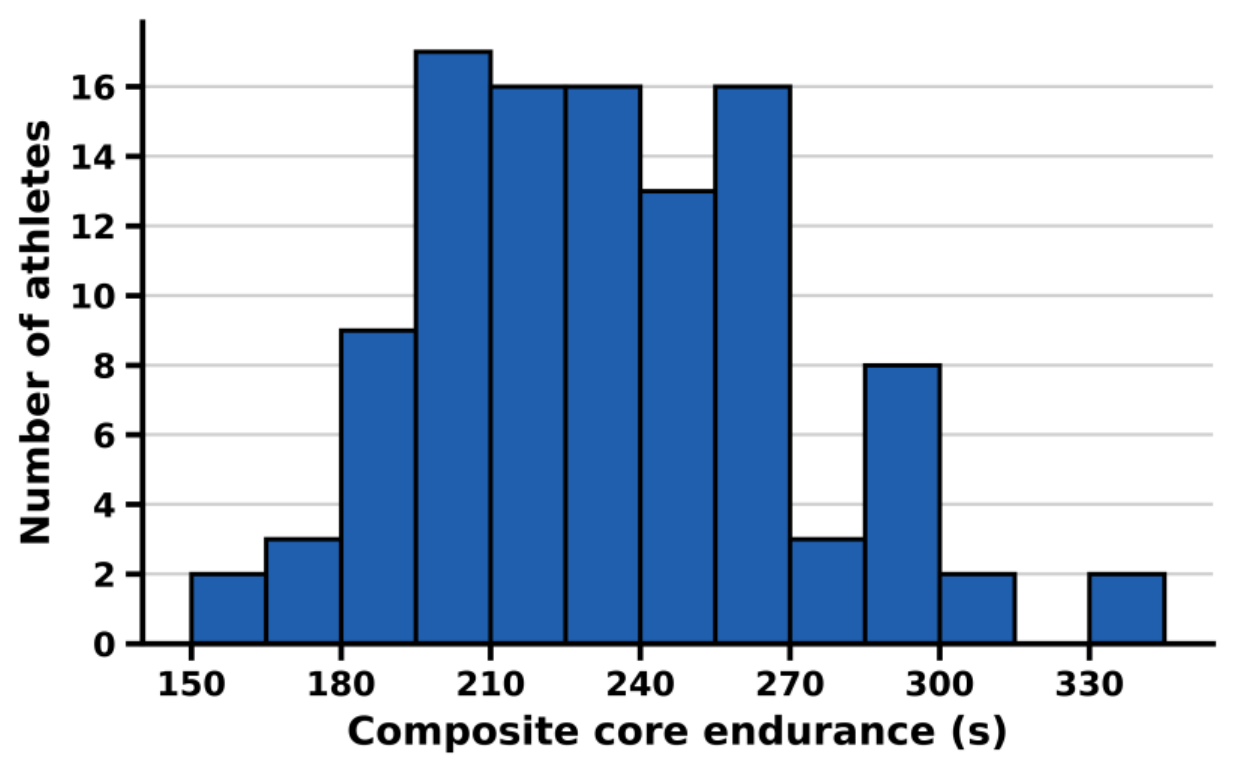
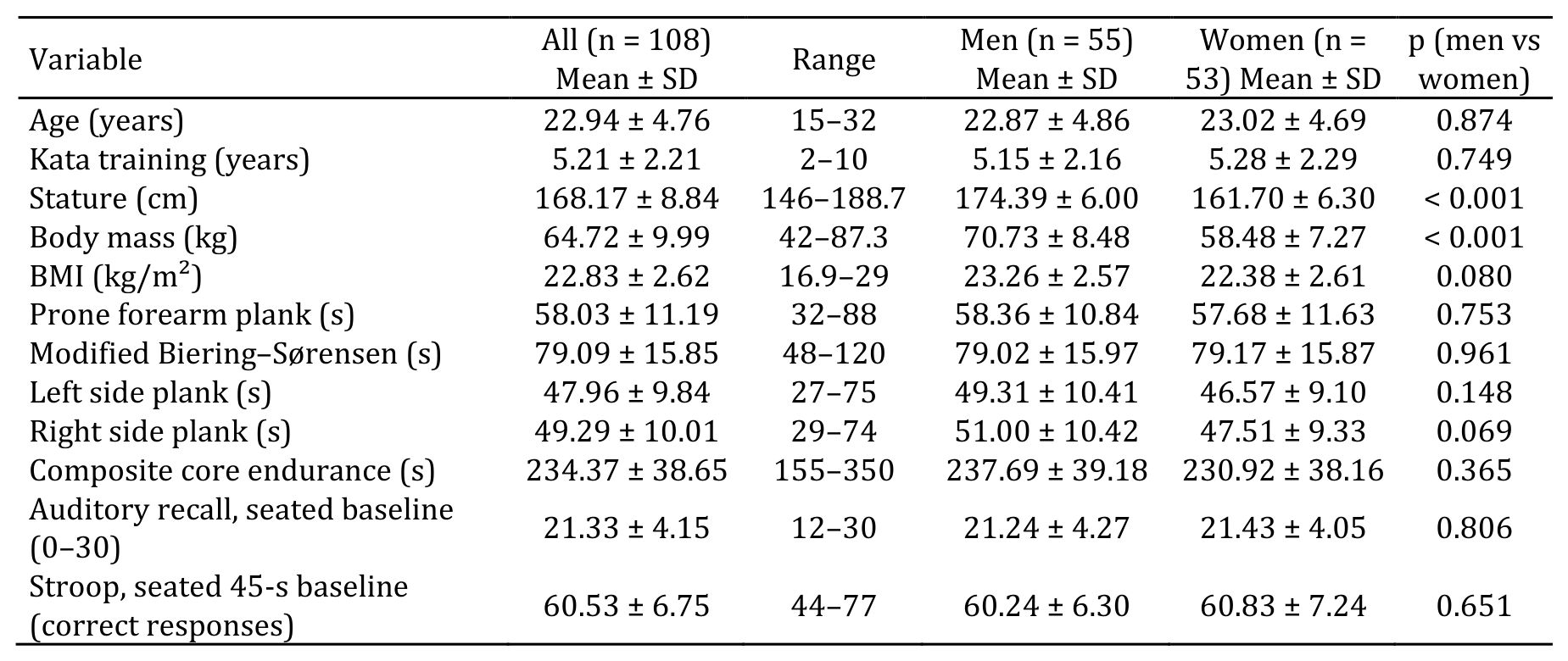
All 108 athletes (55 men, 53 women) were assessed and analysed, with no withdrawals and no missing values. Participant characteristics, endurance times and baseline cognitive scores are given in Table 2. Men and women differed in stature and body mass (both p < 0.001) but not in age, training history, any endurance measure or either baseline cognitive score. Composite core endurance averaged 234.37 ± 38.65 s (range 155–350 s; Fig. 1).
Fig. 1. Distribution of composite core endurance (sum of the four hold times) across the study sample (n = 108); mean 234.4 s, SD 38.7 s, range 155–350 s. Bars show the number of athletes in 15-s bins.
Table 2. Participant characteristics, endurance times and baseline cognitive scores (n = 108)
Note: Values are mean ± SD, with the range for the whole sample. The composite is the sum of the four hold times. p values are from Welch t tests comparing men and women.
Movement Quality and Dual-Task Cost
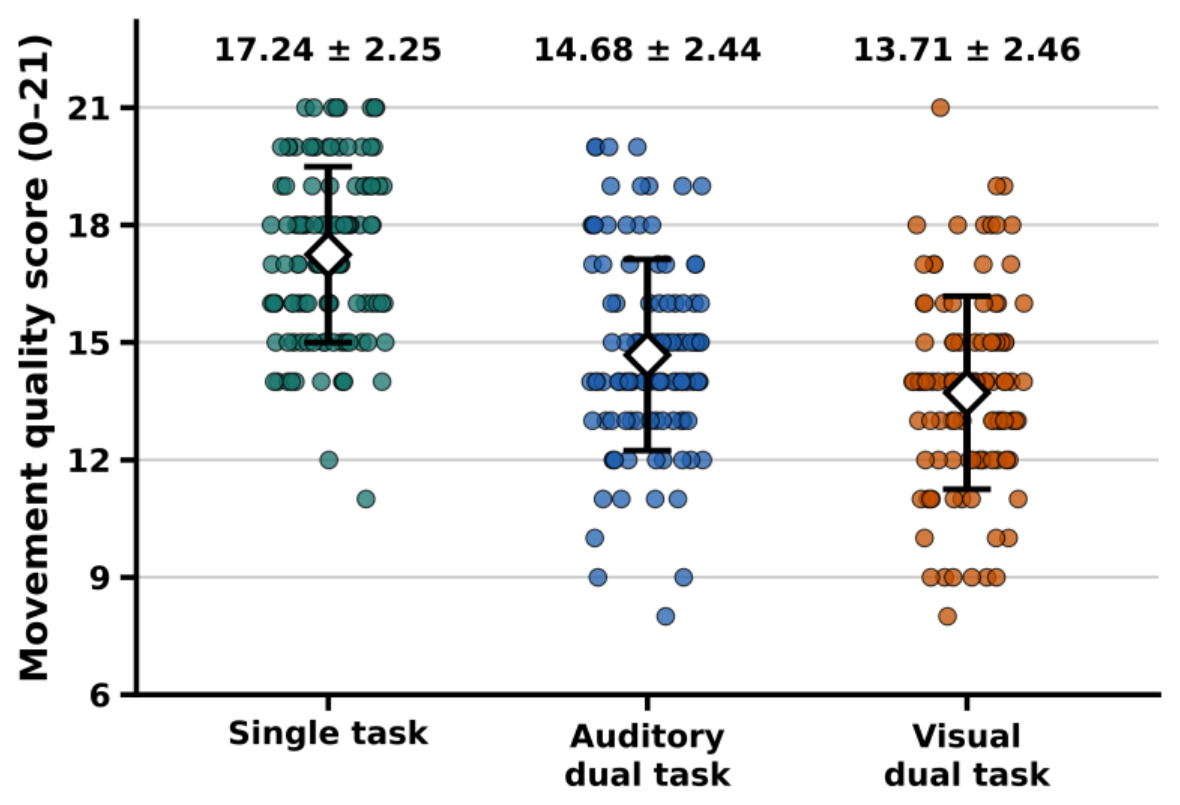
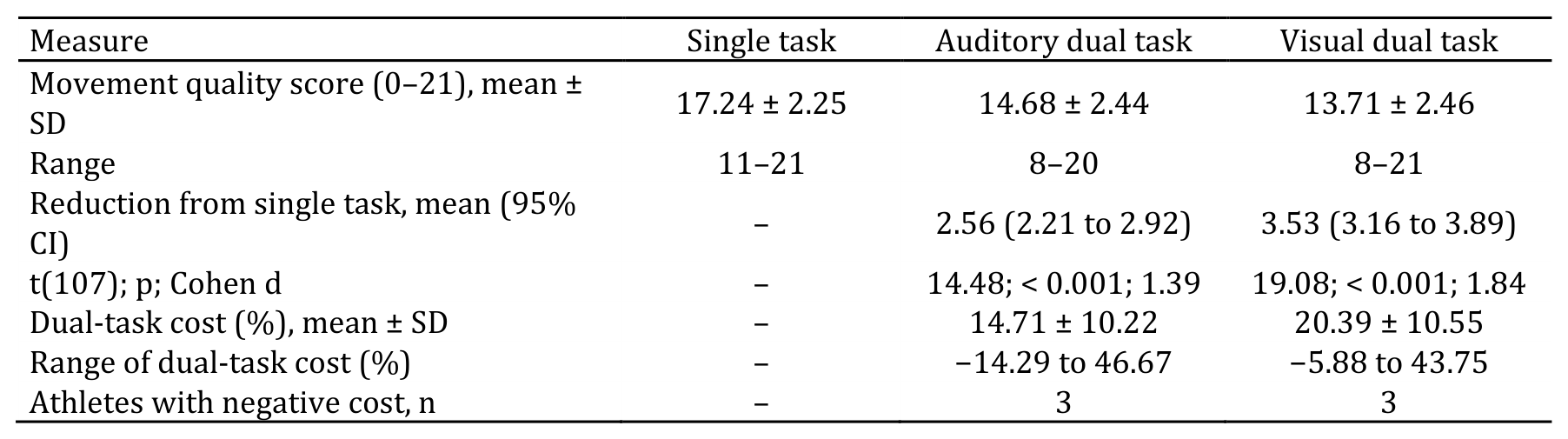
Movement quality was highest in the single-task condition and fell under both dual-task conditions (Table 3; Fig. 2). Single-task scores exceeded auditory scores by 2.56 points (d = 1.39) and visual scores by 3.53 points (d = 1.84), and visual loading was more disruptive than auditory loading (0.96 points, 95% CI 0.61 to 1.32; t(107) = 5.37; p < 0.001; d = 0.52). Overall dual-task cost averaged 17.56 ± 8.75%. Three athletes had a negative cost on each index (overall cost −3.58% at most); the corresponding gains were at most two points under auditory loading and one point under visual loading. Eight athletes (7.4%) scored the 21-point maximum in the single-task condition.
Fig. 2. Kata movement quality (0–21) under the single-task, auditory dual-task and visual dual-task conditions (n = 108). Points are individual athletes (offset horizontally for visibility); diamonds with bars show the mean ± SD, and the values above each condition give the mean ± SD.
Table 3. Movement quality and dual-task cost by condition (n = 108)
Note: Auditory versus visual dual task: mean difference 0.96 points (95% CI 0.61 to 1.32), t(107) = 5.37, p < 0.001, d = 0.52. Overall dual-task cost (mean of auditory and visual cost): 17.56 ± 8.75% (range −3.58 to 34.21). Dual-task cost (%) = (single-task score − dual-task score) / single-task score × 100.
Core Endurance and Dual-Task Cost
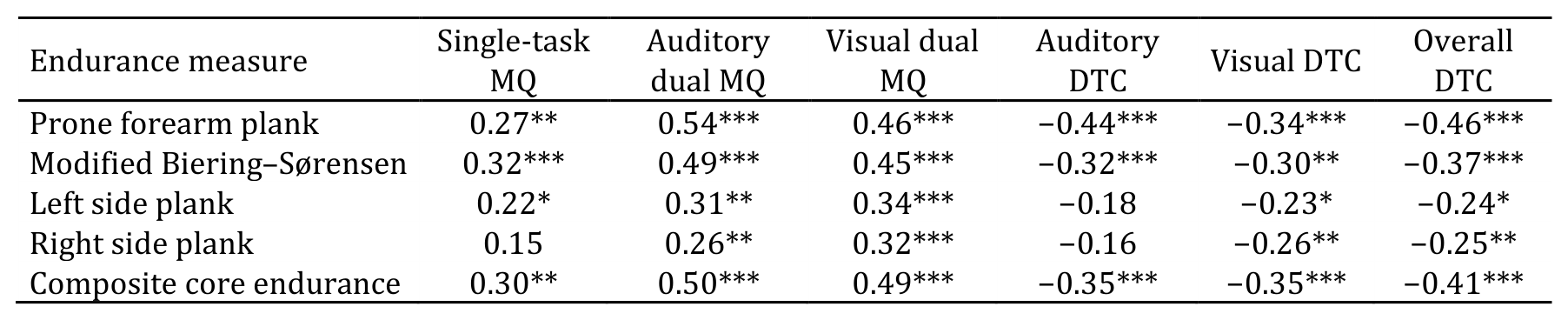
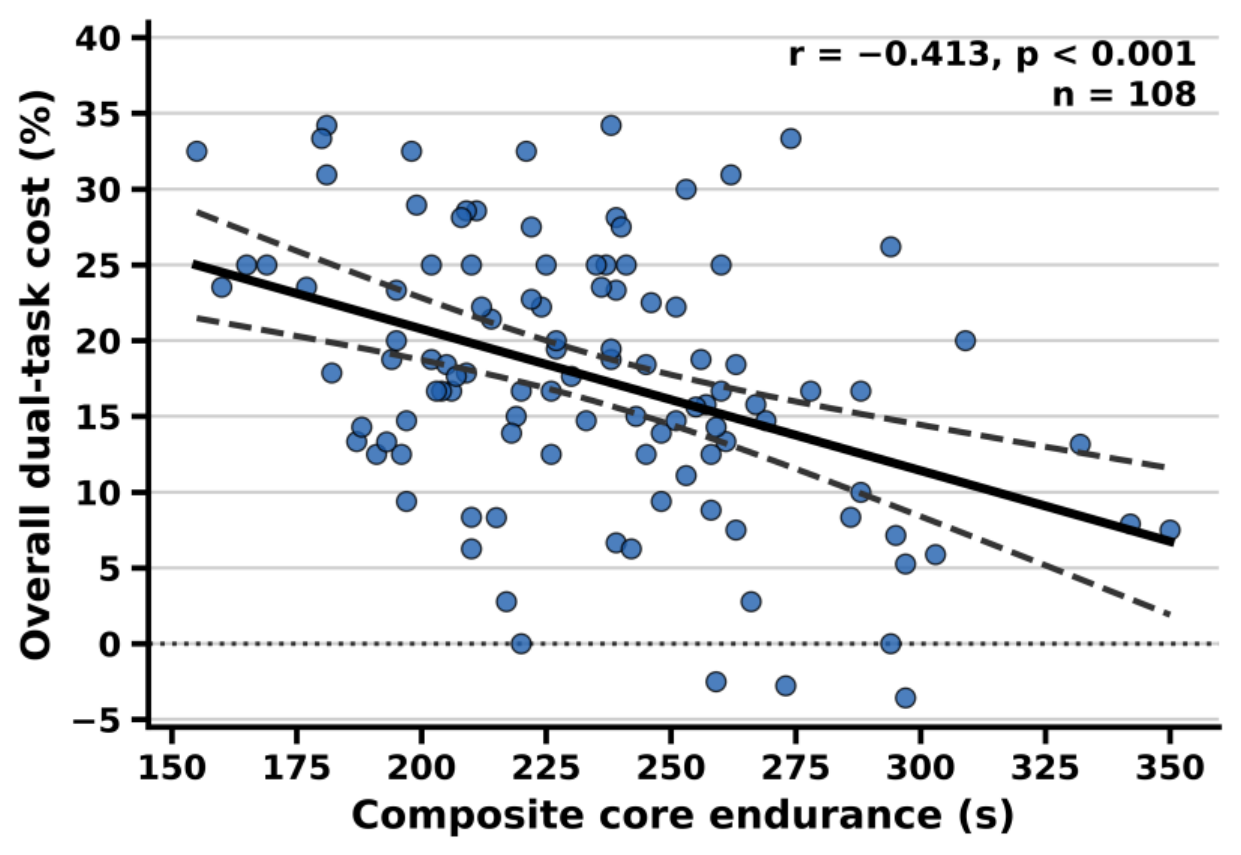
Composite core endurance correlated positively with movement quality in every condition, more strongly under dual-task conditions (r = 0.504 auditory, 0.486 visual) than in the single-task condition (r = 0.305), and inversely with all three cost indices (Table 4). The primary association, between composite endurance and overall dual-task cost, was r = −0.413 (95% CI −0.558 to −0.243; p < 0.001; Spearman ρ = −0.379, p < 0.001), so that 17.1% of the between-athlete variance in overall cost was shared with composite endurance (Fig. 3). Among the individual holds, the prone plank showed the strongest association with overall cost (r = −0.463) and the side planks the weakest (r = −0.245 left, −0.254 right).
Multivariable Regression
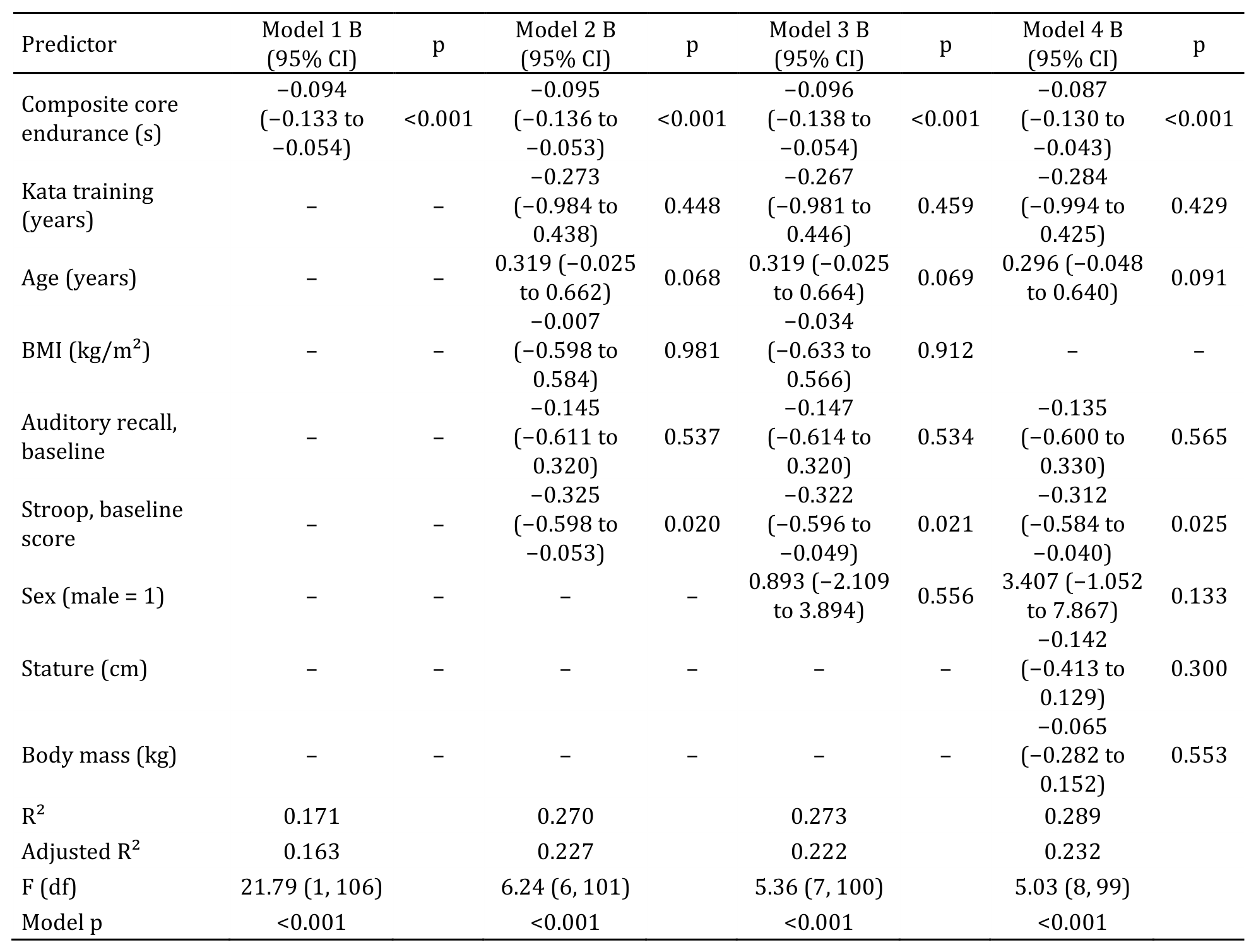
In the unadjusted model (Model 1), composite endurance accounted for 17.1% of the variance in overall cost (adjusted R² = 0.163; B = −0.094 per second, 95% CI −0.133 to −0.054). In the adjusted primary model (Model 2; Table 5), F(6, 101) = 6.24, p < 0.001, R² = 0.270, adjusted R² = 0.227, composite endurance remained independently associated with overall cost (B = −0.095, 95% CI −0.136 to −0.053; β = −0.419; p < 0.001), so that each additional 10 s of composite endurance corresponded to 0.95 percentage points lower overall cost. Baseline Stroop performance was also independently associated with overall cost (B = −0.325, 95% CI −0.598 to −0.053; β = −0.251; p = 0.020), whereas age, years of training, body mass index and baseline auditory recall were not (all p ≥ 0.068). Adding sex (Model 3) and replacing body mass index with sex, stature and body mass (Model 4) did not change this: the coefficient for composite endurance was −0.096 (p < 0.001) and −0.087 (95% CI −0.130 to −0.043; p < 0.001), and sex was not associated with cost in either model (p = 0.556 and 0.133). Variance inflation factors were below 2.7 in all models. Full output for all four models is given in Supplementary Table S3.
Reliability and Sensitivity Analyses
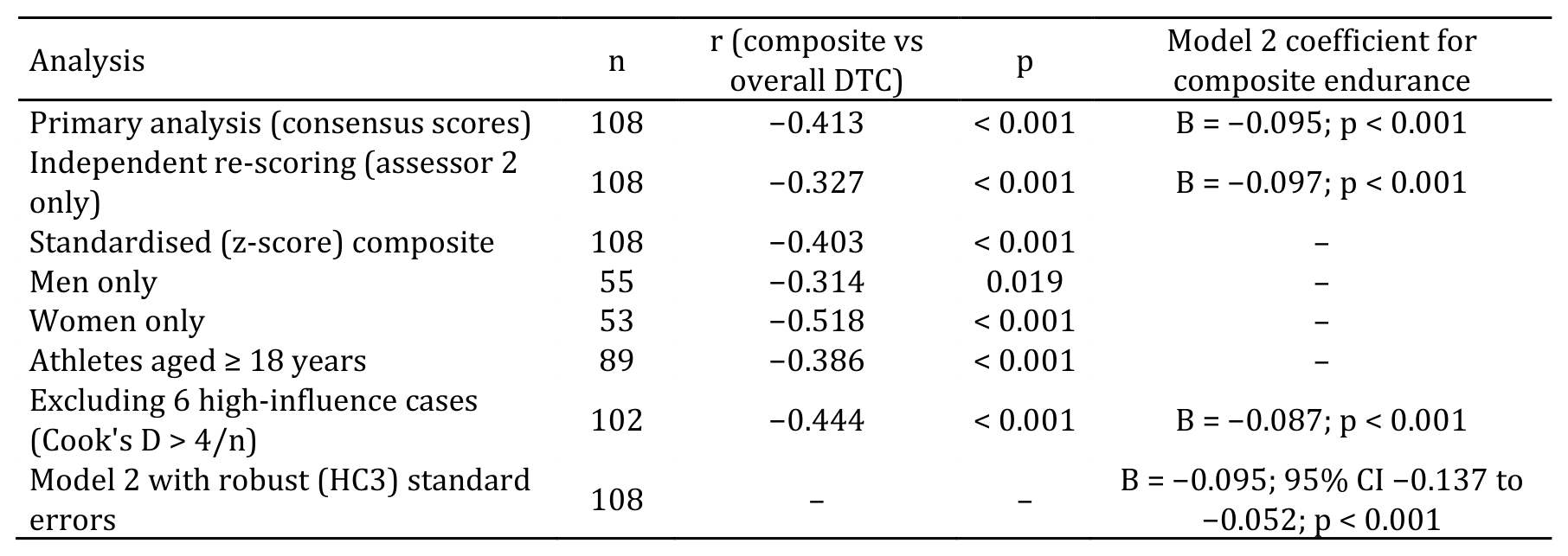
Agreement between the consensus scores and the independent re-scoring was good for the total score in every condition: ICC(A,1) = 0.874 (95% CI 0.805 to 0.917) for the single task, 0.888 (0.841 to 0.922) for the auditory dual task and 0.837 (0.768 to 0.886) for the visual dual task, with a pooled coefficient of 0.900 (0.875 to 0.920) across all 324 observations. Item-level coefficients were lower, from 0.547 to 0.803 (Supplementary Table S1). When the independent ratings replaced the consensus scores, movement quality again fell from 16.87 ± 2.20 (single task) to 14.61 ± 2.56 (auditory) and 13.40 ± 2.73 (visual), with visual loading again the more disruptive (d = 0.53), and composite endurance remained inversely associated with overall dual-task cost (r = −0.327, p < 0.001; Model 2 coefficient B = −0.097, 95% CI −0.154 to −0.039, β = −0.332, p = 0.001; adjusted R² = 0.116). The association was weaker with the independent ratings than with the consensus scores (r = −0.413). The primary association was otherwise insensitive to the analytic choices tested (Table 6). Internal consistency of the seven-item MKMQS was acceptable to good in every condition (Cronbach α = 0.746 single task, 0.827 auditory, 0.808 visual; 0.910 pooled over twenty-one items). The item set was suitable for dimensionality analysis (Kaiser–Meyer–Olkin 0.873; Bartlett χ²(210) = 834.65, p < 0.001), and a dominant first component accounted for 36.2% of standardised variance, with all items loading positively (0.473 to 0.749). These figures describe internal structure only and are not evidence of construct validity. The auditory and visual costs correlated at r = 0.420, giving a Spearman–Brown corrected value of 0.591 for the overall cost index.
Table 4. Pearson correlations of endurance measures with movement quality and dual-task cost (n = 108)
Note: MQ, movement quality; DTC, dual-task cost. *p < 0.05; **p < 0.01; ***p < 0.001. The full correlation matrix is given in Supplementary Table S2.
Fig. 3. Association between composite core endurance and overall dual-task cost with the least-squares regression line (solid) and its 95% confidence limits (dashed) (n = 108). Positive cost denotes deterioration of movement quality under dual-task conditions.
Table 5. Multiple linear regression models for overall dual-task cost (n = 108)
Note: B is the unstandardised coefficient (percentage points of overall dual-task cost per unit of the predictor) with its 95% confidence interval; – indicates that the predictor was not in the model. Model 1, composite endurance alone; Model 2, primary adjusted model; Model 3, Model 2 plus sex; Model 4, sex, stature and body mass entered in place of body mass index. Standard errors, standardised coefficients, t statistics and diagnostics are given in Supplementary Table S3.
Table 6. Sensitivity analyses for the association between composite core endurance and overall dual-task cost
Note: Model 2 coefficient: B for composite endurance (percentage points per second) in the primary adjusted model. HC3, heteroscedasticity-consistent standard errors; Cook's D, Cook's distance.
Discussion
This study asked whether core muscle endurance is related to how much kata movement quality is lost when attention is divided. Two findings emerged. First, concurrent cognitive load degraded movement quality in Taikyoku Shodan in almost every athlete, and visual loading was more disruptive than auditory loading. Second, athletes with lower composite trunk endurance lost proportionally more movement quality under load. This association was moderate, was stronger under dual-task than single-task conditions, and persisted after adjustment for age, training history,
body size, sex and baseline cognitive performance. Baseline Stroop performance was also independently associated with dual-task cost, whereas baseline auditory recall, age and training years were not.
Cognitive Load and Kata Movement Quality
The deterioration under concurrent load is consistent with capacity-sharing accounts, in which a secondary task competes with the attentional resources that regulate posture and movement (6, 7), and with reviews reporting acute degradation of sport-specific motor output under cognitive load and larger costs as the cognitive task becomes more complex (8–10). Most of that evidence comes from gait, balance platforms and open-skill team sports. The present result suggests that a closed-skill, aesthetically judged form that every athlete had automatised remains sensitive to divided attention, although the size of the cost is probably specific to this simplified kata and these tasks. Two readings of the greater cost under visual loading are possible, and the design cannot separate them. A structural reading holds that kata orientation, directional accuracy through changes of direction and gaze anchoring depend on visuospatial processing, which a visual task contests more directly than a verbal auditory task, while the Stroop paradigm adds suppression of a prepotent reading response (28). A procedural reading holds that the visual condition required a continuous spoken response and a display that left the field of view during turns, whereas the auditory condition required no response until after the kata. Studies that match response demands across modalities would be needed before the ordering of the two modalities is generalised.
Core Endurance and Dual-Task Cost
Lower trunk endurance accompanied larger dual-task cost. One interpretation, consistent with postural-control theory, is that greater endurance of the trunk musculature, which anchors the proximal end of the kinetic chain and governs segmental stiffness (11), reduces the attentional resources the athlete must devote to maintaining posture and leaves more available for the concurrent task (6). On this reading, athletes with less endurance would have a smaller attentional reserve. The pattern across conditions fits this idea, since endurance related only weakly to movement quality without a concurrent task but more strongly to quality under load. The interpretation remains a hypothesis; the present data cannot show that endurance determines the attentional demand of posture. Comparison with earlier work should be made cautiously. Trunk training improves balance and sport-specific performance in controlled studies of youth karateka, taekwondo athletes and athletes with chronic ankle instability (15–17, 19, 20). Those studies tested interventions, in different populations, with balance or physical-fitness outcomes measured without a concurrent cognitive task. The present study is cross-sectional, in athletes already competing, and its outcome is the change in observer-scored kata quality under load. The studies therefore agree in showing that trunk capacity and balance-related performance are linked, but none of them, and not the present one, tests whether training trunk endurance changes performance under divided attention. Among the four holds, the prone plank correlated most strongly with cost and exceeded the composite, and the side planks correlated least. These comparisons are exploratory, were not corrected for multiple testing, and should not be taken to identify a preferred test.
Several alternative explanations cannot be excluded. Athletes with greater endurance may have been less physiologically taxed by the kata, so that the cost partly reflects exertion rather than attention. Endurance may also mark general fitness, training quality or motivation not captured by years of training. Finally, the principal investigator who contributed to the consensus scores was not blind to endurance results, so rater expectancy could have strengthened the association; the weaker, though still significant, association with the independent ratings is compatible with this possibility, with measurement error in a single-rater score, or with both. Baseline cognitive capacity was also related to the cost: athletes with higher baseline Stroop scores lost proportionally less movement quality, independently of endurance, whereas baseline auditory recall was not an independent correlate. This is consistent with the view that inhibitory and attentional capacity contributes to dual-task performance (7, 28) and with reports of enhanced attentional control in karate practitioners (24–26). The finding was not an a priori hypothesis, the baseline test was taken seated and rested, and it should be treated as exploratory. It does show that endurance and cognitive capacity are separable correlates of dual-task cost and that models omitting cognitive capacity would overstate the contribution of endurance.
This study has several limitations. The primary outcome was scored with an instrument that has not been formally validated, and its internal consistency does not show that it measures movement quality as judges or biomechanists would define it. Neither assessor was blind to task condition, so expectancy could have inflated the measured dual-task costs, and the size of the condition effects cannot be separated from any such bias. The principal investigator, who contributed to every consensus score, was not blind to identity or endurance results. The independent re-scoring by the coach, who was blind to identity and endurance results, addresses this only partly: the coach had also contributed to the consensus ratings, so the agreement coefficients are an upper bound, and item-level agreement was only moderate for several items. Eight athletes reached the maximum single-task score, which truncates the upper end of the single-task distribution. Validation against expert panel or competition scores, with condition-blinded scoring, is needed before the estimates are relied upon. The two dual-task conditions were also not structurally equivalent. The auditory task required no response during the kata, whereas the visual task required continuous naming, and the card display left the field of view during turns, which may have altered head and gaze orientation and thereby degraded movement by a mechanical route. Playback volume was constant but not measured with a calibrated meter. Performance on the concurrent tasks during the kata was not available for analysis, so engagement and task prioritisation could not be verified, and the cost reported is a motor cost only.
Physiological arousal is a further concern. Cognitive baselines were taken seated and rested, whereas the concurrent tasks were performed during a kata that raises heart rate and metabolic demand. The decrement attributed to attentional interference cannot be cleanly separated from the effects of exertion and arousal, and athletes with greater endurance may have been less taxed. A matched physical control condition would be needed to isolate the attentional component; none was included, and perceived-exertion ratings, although recorded, only partly address this. The sample and the task also constrain the findings. Athletes were recruited by convenience from one district and were club- and regional-standard competitors, which limits generalisability. Ages spanned 15 to 32 years, and 19 athletes (17.6%) were under 18 years; the association was similar in athletes aged 18 years and over, but a linear age term may not capture developmental differences in executive function. Sex, stature and body mass were adjusted for, but the study was not powered for sex-stratified analysis, and sleep, menstrual cycle phase, anxiety and prior-day training load were not recorded. Taikyoku Shodan is a beginner's kata with a restricted movement vocabulary; it was chosen because every athlete had automatised it, but competition kata are more complex, and the magnitude of the association should not be assumed to generalise to them. Finally, the design is cross-sectional, so the study can show that greater trunk endurance accompanies smaller dual-task cost but not that it protects against interference or that increasing endurance would reduce cost. The regression models are exploratory, leave roughly three quarters of the variance in cost unexplained, and the single-hold comparisons were not adjusted for multiplicity. The composite is an unweighted sum in which the longer extensor hold has more influence, although a standardised composite gave a similar result. The overall cost index averages two costs with only moderate internal consistency.
Conclusion
Among 108 competitive kata athletes, movement quality in Taikyoku Shodan fell under concurrent cognitive load, more under visual than auditory loading, and athletes with lower composite trunk endurance lost proportionally more. This association persisted after adjustment for age, training experience, body size, sex and baseline cognitive performance. The study was exploratory and cross-sectional, and its movement-quality instrument has not been validated and was not scored blind to condition, so the findings are hypothesis-generating and do not support recommendations for training. Future controlled studies are needed, using validated movement-quality assessment tools, condition-blinded scoring, matched response demands across modalities and recorded cognitive performance, to evaluate cognitive–motor interference and the role of trunk endurance more rigorously.
Ethical Considerations
Compliance with ethical guidelines
The study protocol was reviewed and approved by the Institutional Ethical Committee of the KLE Institute of Physiotherapy, Belagavi, Karnataka, India (ethics approval code REF/2026/02/124281; date of approval 5 January 2026), and was retrospectively registered with the Clinical Trials Registry–India under registration number CTRI/2026/02/103742. Registration was completed after recruitment had begun and is therefore retrospective; the analytical plan was specified in the approved protocol before data collection, and no interim analyses were performed. All procedures conformed to the Declaration of Helsinki as revised in 2013 and to the National Ethical Guidelines for Biomedical and Health Research Involving Human Participants issued by the Indian Council of Medical Research.
Funding
This study was supported by a grant awarded under the Vice Chancellor's Grant Proposal scheme of KLE Academy of Higher Education and Research, Belagavi. The funder had no role in the design of the study, in data collection, analysis or interpretation, or in the preparation of the manuscript.
Authors' contributions
Saniya Shah: Conceptualization, Methodology, Investigation, Formal analysis, Writing – original draft, Writing – review & editing, Supervision.
Basavaraj Motimath: Conceptualization, Methodology, Writing – review & editing, Supervision.
Dhaval Chivate: Conceptualization, Methodology, Writing – review & editing, Supervision.
All authors read and approved the final version of the manuscript, made substantial scientific contributions to the work, and agree to be accountable for all aspects of the work.
Conflicts of interest
The authors declare no conflict of interest.
Data availability statement
The de-identified participant-level dataset (n = 108), from which participant names have been removed and replaced by study identifiers, including all demographic variables, core endurance test results, cognitive task scores, kata performance scores under all three conditions, and dual-task cost calculations are provided in Supplementary Data File 1 (Excel spreadsheet format), and the derived summary tables are given as Supplementary Tables S1 to S3 at the end of this manuscript. The analysis script and the complete output log that reproduce every reported statistic from this dataset are provided as Supplementary Data File 2, and editable source files for Figs. 1 to 3 are provided as Supplementary Data File 3. Video recordings remain the intellectual property of KLE Institute of Physiotherapy and are not publicly available to protect participant anonymity, but may be made available to researchers upon request subject to institutional data governance protocols.
Use of artificial intelligence
Claude (Anthropic) was used to assist with the statistical analysis, tables and figures in this revision. The authors reviewed and verified all content and take full responsibility for it.
Type of Study: Research |
Subject:
General
Received: 2026/08/19 | Accepted: 2026/11/5 | Published: 2026/11/15
Received: 2026/08/19 | Accepted: 2026/11/5 | Published: 2026/11/15
References
1. Chaabène H, Hachana Y, Franchini E, Mkaouer B, Chamari K. Physical and physiological profile of elite karate athletes. Sports Medicine. 2012;42(10):829-843. [DOI:10.2165/11633050-000000000-00000]
2. Doria C, Veicsteinas A, Limonta E, Maggioni MA, Aschieri P, Eusebi F, et al. Energetics of karate (kata and kumite techniques) in top-level athletes. European Journal of Applied Physiology. 2009;107(5):603-610. [DOI:10.1007/s00421-009-1154-y]
3. Arriaza R, Leyes M. Injury profile in competitive karate: prospective analysis of three consecutive World Karate Championships. Knee Surgery, Sports Traumatology, Arthroscopy. 2005;13(7):603-607. [DOI:10.1007/s00167-004-0593-6]
4. Augustovičová D, Argajová J, Rupčík L, Thomson E. Development of a reliable and valid kata performance analysis template. Journal of Physical Education and Sport. 2020;20(6):3553-3559.
5. Gauchard GC, Lion A, Bento L, Perrin PP, Ceyte H. Postural control in high-level kata and kumite karatekas. Movement & Sport Sciences - Science & Motricité. 2018;(100):21-26. [DOI:10.1051/sm/2017005]
6. Woollacott M, Shumway-Cook A. Attention and the control of posture and gait: a review of an emerging area of research. Gait & Posture. 2002;16(1):1-14. [DOI:10.1016/S0966-6362(01)00156-4]
7. Plummer P, Eskes G. Measuring treatment effects on dual-task performance: a framework for research and clinical practice. Frontiers in Human Neuroscience. 2015;9:225. [DOI:10.3389/fnhum.2015.00225]
8. Salihu AT, Hill KD, Jaberzadeh S. Effect of cognitive task complexity on dual task postural stability: a systematic review and meta-analysis. Experimental Brain Research. 2022;240(3):703-731. [DOI:10.1007/s00221-021-06299-y]
9. Moreira PED, Dieguez GTO, Bredt SGT, Praça GM. The acute and chronic effects of dual-task on the motor and cognitive performances in athletes: a systematic review. International Journal of Environmental Research and Public Health. 2021;18(4):1732. [DOI:10.3390/ijerph18041732]
10. Wu J, Qiu P, Lv S, Chen M, Li Y. The effects of cognitive-motor dual-task training on athletes' cognition and motor performance. Frontiers in Psychology. 2024;15:1284787. [DOI:10.3389/fpsyg.2024.1284787]
11. Kibler WB, Press J, Sciascia A. The role of core stability in athletic function. Sports Medicine. 2006;36(3):189-198. [DOI:10.2165/00007256-200636030-00001]
12. McGill SM, Childs A, Liebenson C. Endurance times for low back stabilization exercises: clinical targets for testing and training from a normal database. Archives of Physical Medicine and Rehabilitation. 1999;80(8):941-944. [DOI:10.1016/S0003-9993(99)90087-4]
13. Waldhelm A, Li L. Endurance tests are the most reliable core stability related measurements. Journal of Sport and Health Science. 2012;1(2):121-128. [DOI:10.1016/j.jshs.2012.07.007]
14. Althobaiti S, Rushton A, Aldahas A, Falla D, Heneghan NR. Practicable performance-based outcome measures of trunk muscle strength and their measurement properties: a systematic review and narrative synthesis. PLOS ONE. 2022;17(6):e0270101. [DOI:10.1371/journal.pone.0270101]
15. Saeterbakken AH, Stien N, Andersen V, Scott S, Cumming KT, Behm DG, et al. The effects of trunk muscle training on physical fitness and sport-specific performance in young and adult athletes: a systematic review and meta-analysis. Sports Medicine. 2022;52(7):1599-1622. [DOI:10.1007/s40279-021-01637-0]
16. Dong K, Yu T, Chun B. Effects of core training on sport-specific performance of athletes: a meta-analysis of randomized controlled trials. Behavioral Sciences. 2023;13(2):148. [DOI:10.3390/bs13020148]
17. Kabadayı M, Karadeniz S, Yılmaz AK, Karaduman E, Bostancı Ö, Akyildiz Z, et al. Effects of core training in physical fitness of youth karate athletes: a controlled study design. International Journal of Environmental Research and Public Health. 2022;19(10):5816. [DOI:10.3390/ijerph19105816]
18. Saeterbakken AH, Andersen V, Behm DG, Cumming KT, Prieske O, Solstad TEJ, et al. The role of trunk training for physical fitness and sport-specific performance: protocol for a meta-analysis. Frontiers in Sports and Active Living. 2021;3:625098. [DOI:10.3389/fspor.2021.625098]
19. Ebrahimi E, Mozafari S. The effect of six weeks of core stability training on balance and performance improvement among male taekwondo athletes. Journal of Sport Biomechanics. 2024;10(2):160-173. [DOI:10.61186/JSportBiomech.10.2.160]
20. Bahrami F, Sabbagh Langeroudi M. Comparison of the effects of core stability and trampoline exercises on static and dynamic balance, and ankle proprioception in female volleyball players with chronic ankle instability. Journal of Sport Biomechanics. 2023;9(2):140-154. [DOI:10.61186/JSportBiomech.9.2.140]
21. Funakoshi G. Karate-do Kyohan: The Master Text. Tokyo: Kodansha International; 1973.
22. Nakayama M. Best Karate. Vol. 1, Comprehensive. Tokyo: Kodansha International; 1977.
23. Bussweiler J, Hartmann U. Energetics of basic karate kata. European Journal of Applied Physiology. 2012;112(12):3991-3996. [DOI:10.1007/s00421-012-2383-z]
24. Alesi M, Bianco A, Padulo J, Vella FP, Petrucci M, Paoli A, et al. Motor and cognitive development: the role of karate. Muscles, Ligaments and Tendons Journal. 2014;4(2):114-120. [DOI:10.32098/mltj.02.2014.04]
25. Jansen P, Dahmen-Zimmer K. Effects of cognitive, motor, and karate training on cognitive functioning and emotional well-being of elderly people. Frontiers in Psychology. 2012;3:40. [DOI:10.3389/fpsyg.2012.00040]
26. Zou L, Huang T, Tsang T, Pan Z, Wang C, Liu Y, et al. Hard martial arts for cognitive function across the lifespan: a systematic review. Archives of Budo. 2018;14.
27. Wulf G. Attentional focus and motor learning: a review of 15 years. International Review of Sport and Exercise Psychology. 2013;6(1):77-104. [DOI:10.1080/1750984X.2012.723728]
28. Scarpina F, Tagini S. The Stroop color and word test. Frontiers in Psychology. 2017;8:557. [DOI:10.3389/fpsyg.2017.00557]
29. von Elm E, Altman DG, Egger M, Pocock SJ, Gøtzsche PC, Vandenbroucke JP. The Strengthening the Reporting of Observational Studies in Epidemiology (STROBE) statement: guidelines for reporting observational studies. The Lancet. 2007;370(9596):1453-1457. [DOI:10.1016/S0140-6736(07)61602-X]
| Rights and permissions | |
 |
This work is licensed under a Creative Commons Attribution-NonCommercial 4.0 International License. |

Journal of Sport Biomechanics
Department of Sport Biomechanics, Faculty of Humanities, Islamic Azad University, Hamedan Branch, Prof. Mousivand Blvd, Imam Khomeini Blvd, Hamedan, Iran.
Journal Tel: +98 81 34494042
Website: http://biomechanics.iauh.ac.ir
Email: sportbiomechanics@iauh.ac.ir
