

Volume 12, Issue 4 (2-2027)
J Sport Biomech 2027, 12(4): 854-881 |
Back to browse issues page




Download citation:
BibTeX | RIS | EndNote | Medlars | ProCite | Reference Manager | RefWorks
Send citation to:


BibTeX | RIS | EndNote | Medlars | ProCite | Reference Manager | RefWorks
Send citation to:
Zanguie H, Yousefi M, Azade M, Zivari S. Musculoskeletal Simulation Methods for Estimating Anterior Cruciate Ligament Loading during High-Risk Lower Extremity Tasks: A Systematic Review. , J Sport Biomech. 2027; 12 (4) :854-881
URL: http://biomechanics.iauh.ac.ir/article-1-571-en.html
URL: http://biomechanics.iauh.ac.ir/article-1-571-en.html


1- Department of Sports Injury and Biomechanics, Faculty of Sport Sciences and health, University of Tehran, Tehran, Iran.
2- Department of Sports Biomechanic, Faculty of Sports Sciences, University of Birjand, Birjand, Iran.
3- Department of Corrective Exercises and Sport Injury, Faculty of Physical Education and Sport Sciences, Allameh Tabataba'i University, Tehran, Iran.
4- Department of Sport Biomechanics, Faculty of Sport Sciences, Kharazmi University, Tehran, Iran.
Full-Text [PDF 1650 kb]
(18 Downloads)
| Abstract (HTML) (49 Views)
Full-Text: (13 Views)
Introduction
The anterior cruciate ligament (ACL) is a major passive stabilizer of the knee, playing a critical role in restraining anterior tibial translation and contributing to rotational stability (1). Excessive ACL loading during dynamic lower-limb tasks, particularly landing, cutting, and change-of-direction maneuvers, has been implicated in non-contact ACL injury mechanisms (6). Understanding the mechanical factors contributing to ACL loading is therefore essential for elucidating injury mechanisms and informing injury prevention strategies (7, 9). However, direct measurement of ACL forces and tissue-level mechanical responses during dynamic movements in vivo remains challenging and is not routinely feasible (9, 11). Consequently, musculoskeletal simulation has emerged as a noninvasive approach for estimating internal joint and ligament loading using experimentally measured kinematic and external force data (13, 15–17).
Various computational approaches have been developed to characterize neuromuscular contributions and ligament mechanics, including conventional musculoskeletal models, EMG-informed approaches, subject-specific models, and integrated musculoskeletal–finite element frameworks (14, 17). These approaches differ in model structure, input data, assumptions underlying muscle force estimation, ACL representation, and procedures for model evaluation and validation (13, 17). Furthermore, ACL-related outcomes vary across studies. While some models explicitly estimate ACL force or strain, others report surrogate measures, such as anterior tibial shear force or anterior knee joint force, which do not necessarily represent ACL loading directly. Therefore, meaningful comparisons across studies require careful consideration of the outcomes reported and the methodological evidence supporting each modeling approach (13). Given previous evidence that variations in modeling parameters can influence predicted knee ligament mechanics (13), we hypothesized that studies estimating ACL loading through musculoskeletal simulation would exhibit substantial heterogeneity in model structures, reported outcomes, and evaluation and validation procedures.
This systematic review aimed to identify, describe, and critically appraise musculoskeletal simulation approaches used to quantitatively estimate ACL loading during dynamic lower-limb tasks associated with an increased risk of ACL injury. Specifically, the review examined the modeling approaches employed, ACL representation, input data, model evaluation and validation procedures, and biomechanical factors associated with ACL loading.
Methods
A systematic literature search was conducted in MEDLINE/PubMed, Scopus, Web of Science, SPORTDiscus, and Google Scholar to identify English-language studies published between 2010 and 2026 that used computational musculoskeletal simulation to quantitatively estimate anterior cruciate ligament (ACL) loading during dynamic lower-limb tasks.
Studies were eligible if they involved human participants and employed musculoskeletal modeling to estimate ACL force, strain, strain rate, or clearly defined surrogate measures of ACL loading. Eligible approaches included conventional musculoskeletal modeling, EMG-informed or EMG-driven modeling, and integrated musculoskeletal–finite element frameworks. Studies examining dynamic tasks associated with ACL injury risk, including landing, jump-landing, cutting, and change-of-direction maneuvers, were considered. Studies without explicitly quantified ACL-related outcomes and those relying exclusively on finite element modeling without a musculoskeletal simulation component were excluded. Following screening, 12 studies met the inclusion criteria. Data were extracted on study characteristics, movement tasks, modeling software or computational frameworks, ACL-related outcomes, experimental and computational inputs, model evaluation and validation procedures, and principal findings.
Given the heterogeneity of modeling approaches and reported outcomes, direct estimates of ACL loading were distinguished from surrogate measures. Model-estimated ACL force, strain, and strain rate were classified as tissue-level outcomes, whereas anterior tibial shear force and anterior knee joint force were considered surrogate measures rather than direct estimates of ACL force. Methodological quality was assessed using the Downs and Black checklist (23), focusing on reporting quality and aspects of internal validity relevant to the included studies. Model evaluation and validation procedures were classified according to the evidence reported in each study. Comparisons with experimental measurements, previously published findings, or measured muscle activation patterns were distinguished from cadaveric validation and sensitivity analyses rather than being collectively interpreted as direct validation of ACL loading predictions. The review protocol was registered in PROSPERO (CRD420261486837).
Results
Twelve studies met the inclusion criteria, encompassing dynamic tasks such as single-leg landing, drop landing, jump-landing, cutting, alpine skiing maneuvers, and change-of-direction tasks. OpenSim was the most frequently used modeling platform, with studies employing conventional musculoskeletal models, EMG-informed approaches, and integrated musculoskeletal–finite element frameworks (25–30, 32). Reported ACL-related outcomes varied across studies and included ACL force, strain, strain rate, and surrogate measures such as anterior tibial shear force and anterior knee joint force (28, 30, 32, 35, 38). Importantly, these surrogate measures reflect mechanical factors associated with ACL loading and should not be interpreted as direct estimates of ACL force or tissue-level strain (28).
Across studies, ACL loading estimates were associated with interactions among muscle forces, external loads, multiplanar joint kinematics, and neuromuscular control (26–28, 30, 34). Variations in hamstring strength, soleus force, hip abductor function, muscle activation, and external knee moments were associated with changes in predicted ACL loading, although the direction and magnitude of these associations depended on the movement task and overall movement strategy (26, 27, 34). Modifications in landing strategy could alter muscle forces and knee mechanics without necessarily producing significant changes in predicted ACL force (25). More sophisticated modeling approaches provided additional insights into neuromuscular contributions and tissue-level mechanical responses (28, 32). EMG-informed models incorporated experimentally measured muscle activation data, whereas integrated musculoskeletal–finite element frameworks enabled the estimation of ACL force and strain (28, 38). Predictive simulations further suggested that task-related factors, including landing height, hip rotation, trunk control, and change-of-direction angle, may influence ACL-related mechanical outcomes (30, 33).
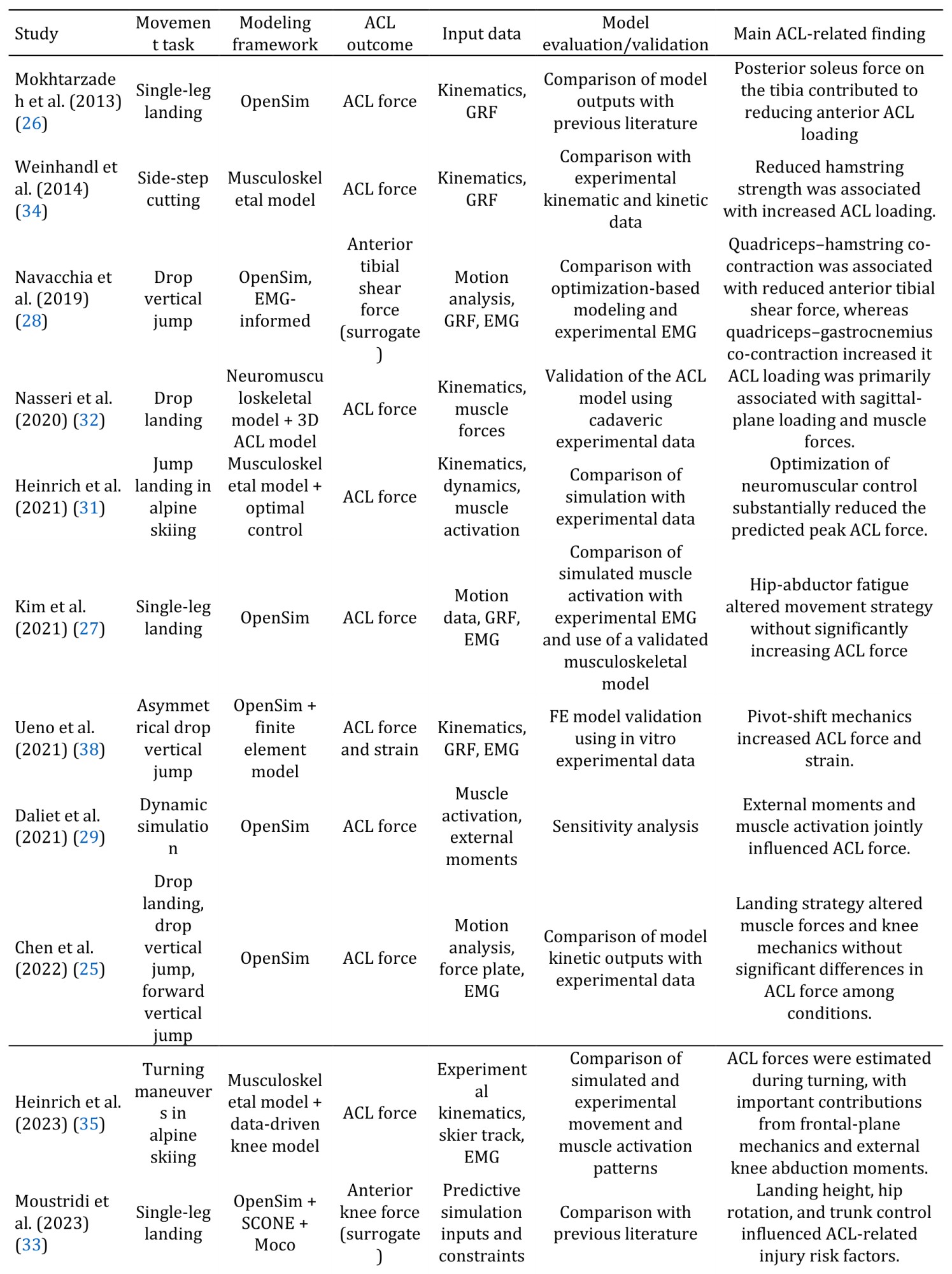
Model evaluation and validation procedures varied substantially across studies. Reported approaches included comparisons with cadaveric experimental data, assessments of simulated kinematics, kinetics, or muscle activation against experimental measurements, comparisons with previously published findings, and sensitivity analyses. These procedures provide different types and levels of supporting evidence and should not be regarded as equivalent forms of direct validation of ACL loading predictions (32, 33). A summary of the included studies is presented in Table 1.
Table 1. Characteristics of studies, modeling methods, input data, evaluation methods, and findings related to ACL loading
Discussion
The findings of this systematic review suggest that computational estimates of anterior cruciate ligament (ACL) loading reflect complex interactions among multiple biomechanical and neuromuscular factors. Across the included studies, predicted ACL forces and tissue-level responses were associated with muscle forces, external loads, multiplanar joint kinematics, and neuromuscular control (32, 36). These findings indicate that ACL loading cannot be adequately characterized by a single external biomechanical variable (32). The contribution of individual muscle groups varied according to the movement task and overall neuromuscular strategy. Changes in hamstring capacity, soleus force, and hip abductor function were associated with different loading responses across tasks (26, 27, 34). Accordingly, the influence of individual muscles on ACL loading should be interpreted within the broader context of muscle force distribution and movement mechanics rather than as an isolated mechanism (29). The findings also highlight the importance of distinguishing model-estimated ACL outcomes from surrogate measures. Estimates of ACL force, strain, and strain rate provide information about tissue-level mechanical responses, whereas anterior tibial shear force and anterior knee joint force represent indirect mechanical indicators that should not be interpreted as equivalent to ACL force (28, 30, 38). This distinction is particularly relevant when comparing studies that employ different computational representations of the knee and ACL.
Substantial methodological heterogeneity was also evident across the included studies. Differences in model architecture, subject representation, muscle force estimation, experimental inputs, ACL representation, and evaluation procedures complicate direct comparisons (26, 30, 32, 34, 38). Although EMG-informed and integrated musculoskeletal–finite element frameworks may provide additional insights into neuromuscular activation and tissue-level mechanics (28, 38), current evidence does not establish their consistent superiority over conventional approaches. Direct comparisons using identical participants, movement tasks, input data, and outcome measures are needed to determine whether specific modeling frameworks yield more accurate or reliable ACL loading estimates. Model validation remains particularly challenging because direct in vivo measurements of ACL force are rarely feasible. Consequently, computational predictions are often evaluated indirectly using experimental measurements, cadaveric data, or previously published findings. The included studies employed different evaluation procedures, ranging from cadaveric validation to comparisons of simulated kinematics, kinetics, and muscle activation patterns with experimental measurements (26, 30, 32, 34, 38). However, these approaches provide different levels of evidence and should not be considered interchangeable forms of direct validation of ACL loading predictions.
Subject-specific modeling represents a potentially valuable direction for future research. Individual differences in anatomical geometry, muscle capacity, tissue properties, and movement strategies may affect predicted ACL loading. Incorporating subject-specific information could therefore enhance the physiological relevance of model predictions. Nevertheless, available evidence remains insufficient to establish whether subject-specific models consistently improve the accuracy of ACL loading estimates. Future investigations should directly compare generic and subject-specific models under standardized conditions, using independent experimental reference measures whenever feasible. Overall, musculoskeletal simulation provides a useful framework for investigating potential ACL loading mechanisms, but the current evidence does not support identifying any single modeling approach as universally superior. Greater methodological transparency, standardized reporting, and independent validation are essential for improving confidence in computational estimates of ACL loading.
Conclusion
This systematic review of 12 studies highlights the potential of musculoskeletal simulation to investigate anterior cruciate ligament (ACL) loading during dynamic lower-limb tasks associated with injury risk. The findings suggest that predicted ACL loading reflects complex interactions among muscle forces, external loads, multiplanar joint kinematics, and neuromuscular control. However, model-estimated ACL force, strain, and strain rate should be distinguished from surrogate loading measures, as these outcomes are not interchangeable. Substantial heterogeneity in modeling approaches, input data, ACL representation, and validation procedures limits the comparability and generalizability of current findings. Moreover, the scarcity of direct in vivo ACL measurements remains a major challenge for model validation. Future research should emphasize subject-specific modeling, standardized methodologies and reporting, and rigorous validation against independent experimental reference measures to improve the reliability of ACL loading estimates and support their application in injury prevention research and, following adequate validation, clinical practice.
Ethical Considerations
Compliance with ethical guidelines
There were no ethical considerations to be considered in this research.
Funding
This research received no specific grant from any funding agency in the public, commercial, or not-for-profit sectors.
Authors' contributions
Hamidreza Zanguie and Mohammad Yousefi contributed to the study conception and design, literature search, study selection, data extraction, analysis and interpretation of findings, and preparation of the original manuscript draft. Mahsa Azadeh and Shaghayegh Zivari contributed to methodological oversight, interpretation of findings, and critical review and revision of the manuscript. All authors reviewed and approved the final version of the manuscript.
Conflicts of interest
The authors declare no conflict of interest.
Type of Study: Research |
Subject:
Special
Received: 2026/08/26 | Accepted: 2026/10/12 | Published: 2026/10/31
Received: 2026/08/26 | Accepted: 2026/10/12 | Published: 2026/10/31
References
1. Duthon VB, Barea C, Abrassart S, Fasel JH, Fritschy D, Ménétrey J. Anatomy of the anterior cruciate ligament. Knee Surgery, Sports Traumatology, Arthroscopy. 2006;14(3):204-213. [DOI:10.1007/s00167-005-0679-9]
2. Sharabi M, Agron R, Dolev A, Haj-Ali R, Yassin M. Predictive refined computational modeling of ACL tear injury patterns. Bioengineering. 2024;11(5):413. [DOI:10.3390/bioengineering11050413]
3. Larwa J, Stoy C, Chafetz RS, Boniello M, Franklin C. Stiff landings, core stability, and dynamic knee valgus: a systematic review on documented anterior cruciate ligament ruptures in male and female athletes. International Journal of Environmental Research and Public Health. 2021;18(7):3826. [DOI:10.3390/ijerph18073826]
4. Montalvo AM, Schneider DK, Yut L, Webster KE, Beynnon B, Kocher MS, et al. What's my risk of sustaining an ACL injury while playing sports? A systematic review with meta-analysis. British Journal of Sports Medicine. 2019;53(16):1003-1012. [DOI:10.1136/bjsports-2016-096274]
5. Ilbeigi S, Motedayyen H, Yousefi M, Hosseini SN, Hoseinzadeh E. Comparison of the effects of exercise therapy and orthokine therapy on pain intensity, joint stiffness, and quadriceps muscle strength in middle-aged women with knee osteoarthritis. Journal of Sport Biomechanics. 2026;12(3):546-568. [DOI:10.66224/JSportBiomech.12.3.546]
6. Griffin LY, Agel J, Albohm MJ, Arendt EA, Dick RW, Garrett WE, et al. Noncontact anterior cruciate ligament injuries: risk factors and prevention strategies. Journal of the American Academy of Orthopaedic Surgeons. 2000;8(3):141-150. [DOI:10.5435/00124635-200005000-00001]
7. Donelon TA, Dos'Santos T, Pitchers G, Brown M, Jones PA. Biomechanical determinants of knee joint loads associated with increased anterior cruciate ligament loading during cutting: a systematic review and technical framework. Sports Medicine - Open. 2020;6(1):53. [DOI:10.1186/s40798-020-00276-5]
8. Yousefi M, Borhani R, Aleghabi M, Mohammadnia Ahmadi S. The effect of thermoplastic insoles on center of pressure parameters in individuals with flatfoot deformity. Journal of Sport Biomechanics. 2026;12(3):626-640. [DOI:10.66224/JSportBiomech.12.3.626]
9. Zhang Q, Adam NC, Hosseini Nasab SH, Taylor WR, Smith CR. Techniques for in vivo measurement of ligament and tendon strain: a review. Annals of Biomedical Engineering. 2021;49(1):7-28. [DOI:10.1007/s10439-020-02635-5]
10. Beynnon B, Howe JG, Pope MH, Johnson RJ, Fleming BC. The measurement of anterior cruciate ligament strain in vivo. International Orthopaedics. 1992;16(1):1-12. [DOI:10.1007/BF00182976]
11. Zhang Q, Bossuyt F, Adam N, Llerena B, Stauffer F, Rennhard P, et al. A stretchable strain sensor system for wireless measurement of musculoskeletal soft tissue strains. Advanced Materials Technologies. 2023;8(12):2202041. [DOI:10.1002/admt.202202041]
12. Markolf KL, Burchfield DM, Shapiro MM, Shepard MF, Finerman GA, Slauterbeck JL. Combined knee loading states that generate high anterior cruciate ligament forces. Journal of Orthopaedic Research. 1995;13(6):930-935. [DOI:10.1002/jor.1100130618]
13. Farshidfar SS, Cadman J, Deng D, Appleyard R, Dabirrahmani D. The effect of modelling parameters in the development and validation of knee joint models on ligament mechanics: a systematic review. PLOS ONE. 2022;17(1):e0262684. [DOI:10.1371/journal.pone.0262684]
14. Fleming BC, Beynnon BD, Renstrom PA, Johnson RJ, Nichols CE, Peura GD, et al. The strain behavior of the anterior cruciate ligament during stair climbing: an in vivo study. Arthroscopy. 1999;15(2):185-191. [DOI:10.1053/ar.1999.v15.015018]
15. Delp SL, Anderson FC, Arnold AS, Loan P, Habib A, John CT, et al. OpenSim: open-source software to create and analyze dynamic simulations of movement. IEEE Transactions on Biomedical Engineering. 2007;54(11):1940-1950. [DOI:10.1109/TBME.2007.901024]
16. Damsgaard M, Rasmussen J, Christensen ST, Surma E, de Zee M. Analysis of musculoskeletal systems in the AnyBody Modeling System. Simulation Modelling Practice and Theory. 2006;14(8):1100-1111. [DOI:10.1016/j.simpat.2006.09.001]
17. Lloyd DG, Besier TF. An EMG-driven musculoskeletal model to estimate muscle forces and knee joint moments in vivo. Journal of Biomechanics. 2003;36(6):765-776. [DOI:10.1016/S0021-9290(03)00010-1]
18. Englander ZA, Baldwin EL III, Smith WAR, Garrett WE, Spritzer CE, DeFrate LE. In vivo anterior cruciate ligament deformation during a single-legged jump measured by magnetic resonance imaging and high-speed biplanar radiography. The American Journal of Sports Medicine. 2019;47(13):3166-3172. [DOI:10.1177/0363546519876074]
19. Naghibi SE, Anbarian M, Yousefi M, Shirzad E, Aziziyan S. Principal component analysis of anthropometric and biomechanical variables in adolescent elite karateka athletes. Journal of Sport Biomechanics. 2017;3(2):27.
20. Belkhelladi M, Cierson T, Martineau PA. Biomechanical risk factors for increased anterior cruciate ligament loading and injury: a systematic review. Orthopaedic Journal of Sports Medicine. 2025;13(2):23259671241312681. [DOI:10.1177/23259671241312681]
21. Cronström A, Creaby MW, Ageberg E. Do knee abduction kinematics and kinetics predict future anterior cruciate ligament injury risk? A systematic review and meta-analysis of prospective studies. BMC Musculoskeletal Disorders. 2020;21(1):563. [DOI:10.1186/s12891-020-03552-3]
22. Bramer WM, Giustini D, de Jonge GB, Holland L, Bekhuis T. De-duplication of database search results for systematic reviews in EndNote. Journal of the Medical Library Association. 2016;104(3):240-243. [DOI:10.3163/1536-5050.104.3.014]
23. Carroll M, Parmar P, Dalbeth N, Boocock M, Rome K. Gait characteristics associated with the foot and ankle in inflammatory arthritis: a systematic review and meta-analysis. BMC Musculoskeletal Disorders. 2015;16:134. [DOI:10.1186/s12891-015-0596-0]
24. Downs SH, Black N. The feasibility of creating a checklist for the assessment of the methodological quality both of randomised and non-randomised studies of health care interventions. Journal of Epidemiology and Community Health. 1998;52(6):377-384. [DOI:10.1136/jech.52.6.377]
25. Chen L, Jiang Z, Yang C, Cheng R, Zheng S, Qian J. Effect of different landing actions on knee joint biomechanics of female college athletes: based on OpenSim simulation. Frontiers in Bioengineering and Biotechnology. 2022;10:899799. [DOI:10.3389/fbioe.2022.899799]
26. Mokhtarzadeh H, Yeow CH, Hong Goh JC, Oetomo D, Malekipour F, Lee PV. Contributions of the soleus and gastrocnemius muscles to the anterior cruciate ligament loading during single-leg landing. Journal of Biomechanics. 2013;46(11):1913-1920. [DOI:10.1016/j.jbiomech.2013.04.010]
27. Kim N, Lee SY, Lee SC, Rosen AB, Grindstaff TL, Knarr BA. Effect of isolated hip abductor fatigue on single-leg landing mechanics and simulated ACL loading. The Knee. 2021;31:118-126. [DOI:10.1016/j.knee.2021.05.007]
28. Navacchia A, Ueno R, Ford KR, DiCesare CA, Myer GD, Hewett TE. EMG-informed musculoskeletal modeling to estimate realistic knee anterior shear force during drop vertical jump in female athletes. Annals of Biomedical Engineering. 2019;47(12):2416-2430. [DOI:10.1007/s10439-019-02318-w]
29. Daliet OJ, Briem K, Brynjólfsson S, Sigurðsson HB. Combined effects of external moments and muscle activations on ACL loading during numerical simulations of a female model in OpenSim. Applied Sciences. 2021;11(24):11971. [DOI:10.3390/app112411971]
30. Huthöfer M, Kainz H, Holder J, Horsak B, Kurz G, Schwameder H. Decreased change of direction angle, increased ACL load: angle-dependent anterior cruciate ligament loading across different change of direction sprints in male soccer players. Journal of Biomechanics. 2026;205:113388. [DOI:10.1016/j.jbiomech.2026.113388]
31. Heinrich D, van den Bogert AJ, Csapo R, Nachbauer W. A model-based approach to predict neuromuscular control patterns that minimize ACL forces during jump landing. Computer Methods in Biomechanics and Biomedical Engineering. 2021;24(6):612-622. [DOI:10.1080/10255842.2020.1842376]
32. Nasseri A, Khataee H, Bryant AL, Lloyd DG, Saxby DJ. Modelling the loading mechanics of anterior cruciate ligament. Computer Methods and Programs in Biomedicine. 2020;184:105098. [DOI:10.1016/j.cmpb.2019.105098]
33. Moustridi E, Risvas K, Moustakas K. Predictive simulation of single-leg landing scenarios for ACL injury risk factors evaluation. PLOS ONE. 2023;18(3):e0282186. [DOI:10.1371/journal.pone.0282186]
34. Weinhandl JT, Earl-Boehm JE, Ebersole KT, Huddleston WE, Armstrong BS, O'Connor KM. Reduced hamstring strength increases anterior cruciate ligament loading during anticipated sidestep cutting. Clinical Biomechanics. 2014;29(7):752-759. [DOI:10.1016/j.clinbiomech.2014.05.013]
35. Heinrich D, van den Bogert AJ, Mössner M, Nachbauer W. Model-based estimation of muscle and ACL forces during turning maneuvers in alpine skiing. Scientific Reports. 2023;13(1):9026. [DOI:10.1038/s41598-023-35775-4]
36. Beaulieu ML, Ashton-Miller JA, Wojtys EM. Loading mechanisms of the anterior cruciate ligament. Sports Biomechanics. 2023;22(1):1-29. [DOI:10.1080/14763141.2021.1916578]
37. Song Y, Li L, Hughes G, Dai B. Trunk motion and anterior cruciate ligament injuries: a narrative review of injury videos and controlled jump-landing and cutting tasks. Sports Biomechanics. 2023;22(1):46-64. [DOI:10.1080/14763141.2021.1877337]
38. Ueno R, Navacchia A, Schilaty ND, Myer GD, Hewett TE, Bates NA. Anterior cruciate ligament loading increases with pivot-shift mechanism during asymmetrical drop vertical jump in female athletes. Orthopaedic Journal of Sports Medicine. 2021;9(3):2325967121989095. [DOI:10.1177/2325967121989095]
39. Hliš T, Fister I, Fister I Jr. Digital twins in sport: concepts, taxonomies, challenges and practical potentials. Expert Systems with Applications. 2024;258:125104. [DOI:10.1016/j.eswa.2024.125104]
| Rights and permissions | |
 |
This work is licensed under a Creative Commons Attribution-NonCommercial 4.0 International License. |

Journal of Sport Biomechanics
Department of Sport Biomechanics, Faculty of Humanities, Islamic Azad University, Hamedan Branch, Prof. Mousivand Blvd, Imam Khomeini Blvd, Hamedan, Iran.
Journal Tel: +98 81 34494042
Website: http://biomechanics.iauh.ac.ir
Email: sportbiomechanics@iauh.ac.ir
