

Volume 12, Issue 4 (2-2027)
J Sport Biomech 2027, 12(4): 772-790 |
Back to browse issues page




Download citation:
BibTeX | RIS | EndNote | Medlars | ProCite | Reference Manager | RefWorks
Send citation to:


BibTeX | RIS | EndNote | Medlars | ProCite | Reference Manager | RefWorks
Send citation to:
Hajikhani P, Bayati R, Mashhadi M. Effects of an Eight-Week Core Stability Training Program on Functional Movement Quality, Balance, Explosive Power, and Punch Impact Force in Amateur Boxers. J Sport Biomech 2027; 12 (4) :772-790
URL: http://biomechanics.iauh.ac.ir/article-1-560-en.html
URL: http://biomechanics.iauh.ac.ir/article-1-560-en.html


1- Department of Physical Education, University of Tolo-e-Mehr, Qom, Iran.
2- Department of Sport Injuries and Corrective Exercises, Allameh Tabataba'i University, Tehran, Iran.
2- Department of Sport Injuries and Corrective Exercises, Allameh Tabataba'i University, Tehran, Iran.
Keywords: Core stability training, Functional Movement Screen. Balance, Explosive power, Punch impact force, Amateur boxing
Full-Text [PDF 1399 kb]
(9 Downloads)
| Abstract (HTML) (25 Views)
Full-Text: (8 Views)
Introduction
Boxing is recognized as a high-intensity Olympic sport that requires a combination of speed, power, muscular strength, balance, and neuromuscular coordination (1). In this discipline, successful competitive performance depends not only on technical and tactical skills but also on the ability to generate and effectively transfer force from the lower to the upper extremities (2). This kinetic chain, which originates from the ground and passes through the ankle, knee, hip, spine, and shoulder girdle before terminating at the fist, requires biomechanical integrity and precise neuromuscular control (3).
Given the unilateral and striking nature of boxing, boxers are frequently exposed to single-leg, rotational, and unstable positions, further emphasizing the importance of balance and postural control (7). Boxers spend approximately 60–70% of combat time in a single-leg stance, and any deficit in static or dynamic balance may lead to reduced quality of defensive and offensive actions, increased postural sway, and a higher incidence of injuries such as ankle sprains, knee injuries, and low back pain (8). Furthermore, the Functional Movement Screen (FMS) is a practical tool for identifying fundamental movement patterns, asymmetries, and core stability deficiencies. A low FMS score (particularly ≤14) has been associated with an increased risk of injury in athletes (9).
Accordingly, the present study was designed to investigate the effects of an eight-week core stability training program on selected neuromuscular performance indicators and kinetic parameters in amateur boxers. The dependent variables included the total FMS score and its subcomponents as measures of fundamental movement quality; static balance (Stork Balance Test) and dynamic balance (Y-Balance Test in three directions for both the upper and lower extremities) as indicators of postural control and proprioception; vertical jump height as an indicator of lower-limb kinetic chain force-generating capacity; and punch impact force (including peak and mean force indices) as the final biomechanical output of the kinetic chain in boxing.
Methods
This quasi-experimental study employed a pretest–posttest design with a control group. The study population consisted of adult amateur boxers from Qom, Iran, with at least one year of continuous training experience. Twenty-four amateur boxers with Functional Movement Screen (FMS) scores of 14 or less were selected through convenience sampling and randomly assigned to experimental (n = 12) and control (n = 12) groups. All participants were healthy and free from acute or chronic musculoskeletal injuries (13). The inclusion criteria were age 18–35 years, at least one year of regular amateur boxing training, an FMS score ≤14, good physical health, and no musculoskeletal injuries in the preceding six months. The exclusion criteria were absence from more than two training sessions, voluntary withdrawal, injury or illness during the intervention, or participation in additional training outside the study protocol. All participants provided written informed consent. Anthropometric measurements included height and body mass. FMS assessment followed the standard protocol described by Cook (15). Dynamic balance was assessed using the Y-Balance Test for both the upper and lower extremities (16, 17), while static balance was evaluated using the Stork Balance Test (18). Lower-limb explosive power was assessed using the vertical jump test (19), and punch impact force was measured using a specialized device equipped with pressure sensors and accelerometers (20).
The experimental group performed an eight-week core stability training program (three sessions per week, 30–40 minutes per session) based on Brown et al. (2021) (11), in addition to their regular boxing training. The program consisted of two levels (Level 1: weeks 1–4; Level 2: weeks 5–8), with progressive intensity and resistance. The control group continued their regular boxing training without additional core stability exercises. Data were analyzed using SPSS version 26. Normality was assessed using the Shapiro–Wilk test, and homogeneity of variances was assessed using Levene's test. A two-way repeated-measures analysis of variance (ANOVA) was used to examine the main effects of time and group, as well as the group × time interaction. Effect sizes were calculated using partial eta squared (ηp²). Statistical significance was set at P < 0.05.
Results
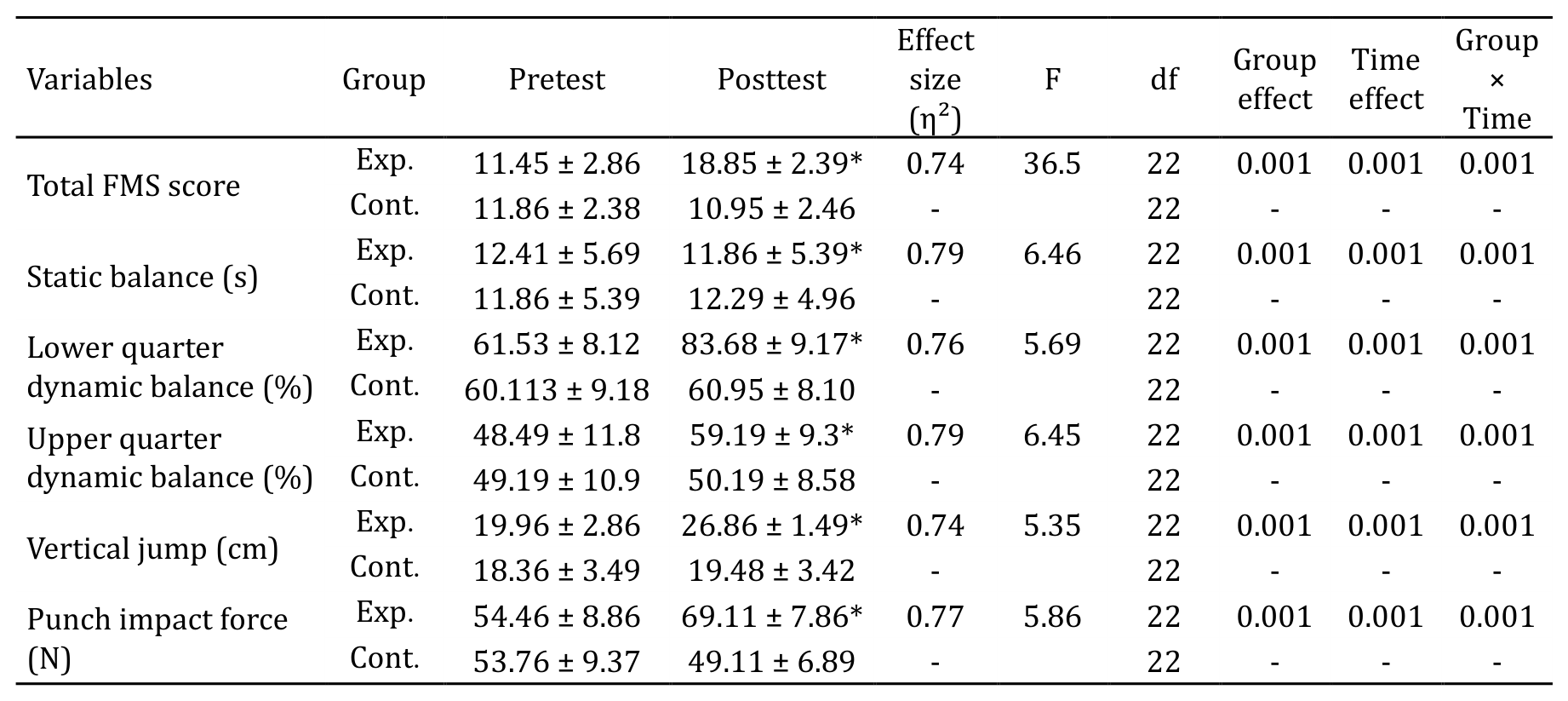
The results of the two-way repeated-measures ANOVA indicated no significant differences between the experimental and control groups in any of the study variables at pretest (P > 0.05), suggesting that the groups were comparable at baseline. However, significant group × time interaction effects were observed for all study variables, including the total Functional Movement Screen (FMS) score, static balance, lower- and upper-extremity dynamic balance, lower-limb explosive power, and punch impact force (P = 0.001). These findings indicate that the experimental group showed significantly greater improvements than the control group across all study variables. Furthermore, post hoc analyses revealed significant improvements from pretest to posttest in all variables within the experimental group (P < 0.001), whereas no significant changes were observed in the control group (P > 0.05) (Table 1).
Discussion
The present study investigated the effects of eight weeks of core stability training on FMS scores, static and dynamic balance, lower-limb explosive power, and punch impact force in amateur boxers. The findings revealed that the training intervention had significant positive effects on all dependent variables, with large effect sizes indicating substantial effects of the intervention. These findings are consistent with those of previous studies on core stability training and can be interpreted in light of biomechanical and physiological principles.
The results demonstrated that eight weeks of core stability training significantly improved fundamental movement quality (as measured by FMS scores), static and dynamic balance of the upper and lower extremities, lower-limb explosive power (vertical jump), and punch impact force in amateur boxers. The increase in FMS scores from below the commonly cited injury-risk threshold (≤14) to above this threshold suggests a potential reduction in injury-related risk factors. However, because injury incidence was not directly measured, it cannot be concluded that the intervention reduced injury risk. Future research involving direct monitoring of injury rates is needed to confirm
Table 1. Changes in dependent variables across testing phases (mean ± SD)
Note. Values are presented as mean ± standard deviation (SD). FMS, Functional Movement Screen; Exp., experimental group; Cont., control group; F, F-statistic; df, degrees of freedom; η², eta squared. Group, time, and group × time effects were assessed using two-way repeated-measures ANOVA. *Indicates a significant difference from pretest (P < 0.05).
this relationship. The observed improvements in static and dynamic balance may be particularly relevant for boxers, who spend approximately 60–70% of match time in single-leg stances (21). These improvements may contribute to better postural control and a reduced risk of lower-limb injuries, although this hypothesis requires direct investigation (22).
Overall, the results indicate that core stability training is an effective intervention for improving functional movement patterns, static and dynamic balance, lower-limb explosive power, and punch impact force in amateur boxers. Given the risk of musculoskeletal injuries associated with the unilateral and striking nature of boxing, improvements in these variables through core stability training may contribute to reducing injury-related risk factors and enhancing athletic performance (23, 24). The large effect sizes observed across all variables suggest that the intervention may have practical relevance for coaches and sports specialists. Therefore, incorporating core stability training into amateur boxers' training programs, particularly during the preseason, and using the Functional Movement Screen (FMS) in preseason assessments to identify individuals with movement limitations and guide corrective exercise programs are recommended as potential practical applications of the findings (25).
The present study had several limitations that should be considered when interpreting the results. These include the relatively small sample size, the absence of a follow-up period to assess the sustainability of training effects, the inclusion of only male boxers, and the lack of precise control over individual factors such as sleep patterns, nutrition, and participants' psychological states, all of which may limit the generalizability of the findings. Accordingly, future research should include larger samples and female boxers, employ longitudinal designs with long-term follow-up periods, use more precise assessment tools such as electromyography and isokinetic testing to investigate neuromuscular mechanisms, and examine the combined effects of core stability training and other training methods on boxing performance.
The concurrent improvements in vertical jump height and punch impact force suggest that core stability training may enhance force production and transmission along the kinetic chain. However, because kinetic chain mechanics, trunk rotation, and neuromuscular coordination were not directly measured, the proposed mechanisms, including improved force transfer and trunk control, remain speculative and should be interpreted with caution. Future studies employing direct biomechanical measurements (e.g., electromyography, kinematic analysis, or force plate data) are needed to clarify the underlying mechanisms (26). Overall, core stability training appears to be an effective, low-cost intervention for improving multiple performance-related and injury-risk-related variables in amateur boxers. Based on the observed improvements in FMS scores, balance, explosive power, and punch impact force, incorporating these exercises into regular training programs, particularly during the preseason, may be beneficial for coaches and sports specialists seeking to enhance performance-related characteristics and address potential injury risk factors. However, the effectiveness of this intervention in reducing injury incidence or improving competitive performance requires confirmation through future longitudinal studies with direct outcome measures.
Conclusion
Eight weeks of core stability training significantly improved functional movement patterns, static and dynamic balance, lower-limb explosive power, and punch impact force in amateur boxers. Given that boxers spend a considerable portion of their fighting time in a single-leg stance and that punch force generation depends on the kinetic chain, improvements in these variables may contribute to enhanced athletic performance, better technical execution, and a reduced risk of injury. However, further research involving direct assessments of boxers' performance under actual fighting conditions is needed to draw definitive conclusions about the effects of these exercises on competitive performance. Based on the present findings, incorporating core stability training into amateur boxers' training programs is recommended as an effective complementary strategy.
Ethical Considerations
Compliance with ethical guidelines
According to the regulations of the university where the research was conducted and the guidelines for reviewing research proposals in sports sciences, this non-invasive, minimal-risk study did not require a specific ethics approval code from the university's ethics committee and was authorized through approval by the relevant Vice-Chancellery for Research. Nevertheless, the researchers adhered to the ethical principles outlined in the Declaration of Helsinki (2013 revision). Before any assessments or interventions were conducted, all participants received verbal and written explanations of the study objectives, testing procedures, and expected duration of participation. Written informed consent was obtained from all participants. Participants were also informed that their participation was entirely voluntary and that they could withdraw from the study at any time without penalty or adverse consequences. The confidentiality of participants' personal information and research data was maintained throughout data collection, analysis, and reporting. In addition, all assessments and interventions were conducted under appropriate supervision to minimize the risk of physical or psychological harm.
Funding
This research received no specific grant from any funding agency in the public, commercial, or not-for-profit sectors.
Authors' contributions
Rasoul Bayati: Conceptualization, Methodology, Formal analysis, Supervision, Writing – original draft, Writing – review & editing.
Mohammad Mashhadi: Conceptualization, Methodology, Writing – original draft, Writing – review & editing.
Pouriya hajikhani: Investigation, Project administration, Writing – review & editing.
All authors read and approved the final version of the manuscript.
Conflicts of interest
The authors declare no conflict of interest.
Type of Study: Research |
Subject:
General
Received: 2026/08/16 | Accepted: 2026/09/20 | Published: 2026/10/19
Received: 2026/08/16 | Accepted: 2026/09/20 | Published: 2026/10/19
References
1. Liu Y, Li L, Yan X, He X, Zhao B. Biomechanics of the lead straight punch and related indexes between sanda fighters and boxers from the perspective of cross-border talent transfer. Frontiers in Physiology. 2023;13:1099682. [DOI:10.3389/fphys.2022.1099682]
2. Wan J, Liu Y. Kinematic and kinetic differences between lead and rear straight punches in elite boxers: bilateral asymmetry and training implications. BMC Sports Science, Medicine and Rehabilitation. 2026;18(1):292. [DOI:10.1186/s13102-026-01738-1]
3. Mosler D, Kacprzak J, Wąsik J. Higher values of force and acceleration in rear cross than lead jab: differences in technique execution by boxers. Applied Sciences. 2024;14(7):2830. [DOI:10.3390/app14072830]
4. Dong K, Yu T, Chun B. Effects of core training on sport-specific performance of athletes: a meta-analysis of randomized controlled trials. Behavioral Sciences. 2023;13(2):148. [DOI:10.3390/bs13020148]
5. Zhang Y, Fan Q, Liu K, Zhou L, Zhou Y, Ding M, et al. Effects of core resistance training on pugilism in boxers. Revista Brasileira de Medicina do Esporte. 2023;29:e2022_0589. [DOI:10.1590/1517-8692202329012022_0589]
6. Sun H, Shao Z. Abdominal core muscle strength training in badminton players. Revista Brasileira de Medicina do Esporte. 2023;29:e2022_0609. [DOI:10.1590/1517-8692202329012022_0609]
7. Perliński J, Bukowska JM, Rydzik Ł, Wąsacz W, Kruczkowski D, Ambroży T, et al. Gait analysis of male professional boxers. Baltic Journal of Health and Physical Activity. 2024;16(1):1. [DOI:10.29359/BJHPA.16.1.01]
8. De Blasiis P, Fullin A, Caravaggi P, Lus G, Melone MA, Sampaolo S, et al. Long-term effects of asymmetrical posture in boxing assessed by baropodometry. The Journal of Sports Medicine and Physical Fitness. 2022;62(3):350-355. [DOI:10.23736/S0022-4707.21.12040-7]
9. Trinidad-Fernandez M, Gonzalez-Sanchez M, Cuesta-Vargas AI. Is a low Functional Movement Screen score (≤14/21) associated with injuries in sport? A systematic review and meta-analysis. BMJ Open Sport & Exercise Medicine. 2019;5(1):e000501. [DOI:10.1136/bmjsem-2018-000501]
10. Lenetsky S, Harris N, Brughelli M. Assessment and contributors of punching forces in combat sports athletes: implications for strength and conditioning. Strength & Conditioning Journal. 2013;35(2):1-7. [DOI:10.1519/SSC.0b013e31828b6c12]
11. Brown L, Hastings K, Doyle G, Bruce-Low S, Galbraith A. The effects of lower core resistance training on rear hand punching performance in professional boxers. Journal of Australian Strength and Conditioning. 2021;29(5):15-24.
12. Hernandez-Martinez J, Cid-Calfucura I, Valdés-Badilla P, Franchini E, Garcia-Garcia JM, Herrera-Valenzuela T. Acute and chronic effects of muscle strength training on physical fitness in boxers: a scoping review. Applied Sciences. 2024;14(21):9706. [DOI:10.3390/app14219706]
13. Saeidizadeh A, Piri H, Rahimi M, Nourbakhsh SA, Ebrahimi E, Zare A, et al. Core stability training improves movement quality, balance, and performance in basketball players. Physical Treatments-Specific Physical Therapy Journal. 2026;16(2):161-172.
14. Villarini M, Acito M, Gianfredi V, Berrino F, Gargano G, Somaini M, et al. Validation of self-reported anthropometric measures and body mass index in a subcohort of the DianaWeb population study. Clinical Breast Cancer. 2019;19(4):e511-e518. [DOI:10.1016/j.clbc.2019.04.008]
15. Pfeifer CE, Sacko RS, Ortaglia A, Monsma EV, Beattie PF, Goins J, et al. Functional Movement Screen™ in youth sport participants: evaluating the proficiency barrier for injury. International Journal of Sports Physical Therapy. 2019;14(3):436. [DOI:10.26603/ijspt20190436]
16. Schwiertz G, Brueckner D, Beurskens R, Muehlbauer T. Lower quarter Y Balance Test performance: reference values for healthy youth aged 10 to 17 years. Gait & Posture. 2020;80:148-154. [DOI:10.1016/j.gaitpost.2020.05.041]
17. Williamson JD, Lawson BL, Sigley D, Nasypany A, Baker RT. Intra- and inter-rater reliability for limb length measurement and trial error assessment of the upper quarter Y-Balance Test in healthy adults. International Journal of Sports Physical Therapy. 2019;14(5):707. [DOI:10.26603/ijspt20190707]
18. Sadeghi H, Noori S. Reliability assessment of functional balance tests in endomorph healthy women 24-34 years old. Research in Sport Medicine and Technology. 2015;13(10):1-15. [DOI:10.18869/acadpub.jsmt.13.10.1]
19. Yingling VR, Castro DA, Duong JT, Malpartida FJ, Usher JR. The reliability of vertical jump tests between the Vertec and My Jump phone application. PeerJ. 2018;6:e4669. [DOI:10.7717/peerj.4669]
20. Del Vecchio L, Whitting J, Hollier J, Keene A, Climstein M. Reliability and practical use of a commercial device for measuring punch and kick impact kinetics. Sports. 2022;10(12):206. [DOI:10.3390/sports10120206]
21. Bagherian S, Ghasempoor K, Rahnama N, Wikstrom EA. The effect of core stability training on functional movement patterns in college athletes. Journal of Sport Rehabilitation. 2019;28(5):444-449. [DOI:10.1123/jsr.2017-0107]
22. Maleki AA, Mousavi SH, Biabangard MA, Minoonejad H. Influence of exercise interventions on Functional Movement Screen scores in athletes: a systematic review and meta-analysis. Scientific Reports. 2025;15(1):26335. [DOI:10.1038/s41598-025-12371-2]
23. Huang Y, Song J. Core stability training for post-stroke recovery: a multifaceted approach to enhance postural control and motor function. Physiotherapy Research International. 2026;31(3):e70242. [DOI:10.1002/pri.70242]
24. Bayati R, Shamsi Majelan A, Mirzaei B, Barbas I. The effect of 12 weeks of Wrestling+ warm-up program on Functional Movement Screen scores in cadet wrestlers. Annals of Applied Sport Science. 2019;7(1):39-47. [DOI:10.29252/aassjournal.7.1.39]
25. Johnson CD, Whitehead PN, Pletcher ER, Faherty MS, Lovalekar MT, Eagle SR, et al. The relationship of core strength and activation and performance on three functional movement screens. Journal of Strength and Conditioning Research. 2018;32(4):1166-1173. [DOI:10.1519/JSC.0000000000001943]
26. Chorba RS, Chorba DJ, Bouillon LE, Overmyer CA, Landis JA. Use of a functional movement screening tool to determine injury risk in female collegiate athletes. North American Journal of Sports Physical Therapy. 2010;5(2):47.
27. Barbas I, Gioftsidou A, Gkrekidis T, Makri E, Malliou P, Beneka A. The effects of Wrestling+ injury prevention program on lower limbs strength and balance. In: Экстрабилити как феномен инклюзивной культуры: формирование инклюзивной культуры в организациях. Екатеринбург; 2020. p. 34-39.
28. Esmailnezhad S, Daneshmandi H, Samami N, Mirzaei B. The effect of Wrestling+ warm-up program on balance and proprioception of adolescent wrestlers. Journal of Kinesiology and Exercise Sciences. 2024;34(107):45-52. [DOI:10.5604/01.3001.0054.6754]
29. Sharma L, Jamali SN, Sharma J, Khanum S. Relationship between core stability and static balance in non-elite collegiate athletes. Archives of Medicine and Health Sciences. 2020;8(2):236-239. [DOI:10.4103/amhs.amhs_96_20]
30. Bayati R, Shamsi Majelan A, Mirzaei B. The effect of 12 weeks of Wrestling+ specific warm-up program on dynamic balance in cadet wrestlers. Journal of Sport Biomechanics. 2018;4(1):63-73. [DOI:10.29252/aassjournal.7.1.39]
31. Gheytasi M, Yazdani S, Ghiyami A. Comparison of balance, power, and muscular endurance among volleyball players in three attacking positions. Journal of Sport Biomechanics. 2026;12(3):532-544. [DOI:10.66224/JSportBiomech.12.3.532]
32. Zemková E, Zapletalová L. The role of neuromuscular control of postural and core stability in functional movement and athlete performance. Frontiers in Physiology. 2022;13:796097. [DOI:10.3389/fphys.2022.796097]
33. Chtara M, Rouissi M, Bragazzi NL, Owen AL, Haddad M, Chamari K. Dynamic balance ability in young elite soccer players: implication of isometric strength. The Journal of Sports Medicine and Physical Fitness. 2018;58(4):414-420. [DOI:10.23736/S0022-4707.16.06724-4]
34. Rickta JF, Mukta FTJ, Shaim SNS, Rahaman M, Arafat Y. Anaerobic power cycling training and lower-extremity performance in elite female handball players: a predictive model based on morphological indices. Journal of Sport Biomechanics. 2026;12(3):460-482. [DOI:10.66224/JSportBiomech.12.3.460]
35. Yang KH. Immediate effect of biofeedback training of gluteus medius on dynamic balance during single leg squat. PNF and Movement. 2023;21(2):255-263.
36. Liu Y, Xiao J, Chen Z. Isokinetic strength characteristics of trunk rotation and knee joint in female amateur boxers: asymmetry and implications for injury prevention. Research Square; 2026. [DOI:10.21203/rs.3.rs-9121035/v1]
37. Cosio-Lima LM, Crawley A, Adlof LE, Straughn M, Wallop JD, Lee Y. Effects of a periodized training program and a traditional military training program on Functional Movement and Y-Balance Tests in ROTC cadets. Sports and Exercise Medicine - Open Journal. 2017;3(2):46-52. [DOI:10.17140/SEMOJ-3-147]
38. Nuhmani S. Correlation between core stability and upper-extremity performance in male collegiate athletes. Medicina. 2022;58(8):982. [DOI:10.3390/medicina58080982]
39. Bruzas V, Kamandulis S, Venckunas T, Snieckus A, Mockus P. Effects of plyometric exercise training with external weights on punching ability of experienced amateur boxers. The Journal of Sports Medicine and Physical Fitness. 2018;58(3):221-226. [DOI:10.23736/S0022-4707.16.06674-3]
40. Amiri-Khorasani MT, Mohammadi Pour F, Shokrollahi A, Amiri Khorasani A. Acute effects of post-activation performance enhancement-based warm-up protocols on knee joint kinematics and countermovement jump performance in male physical education students. Journal of Sport Biomechanics. 2026;12(3):394-414. [DOI:10.66224/JSportBiomech.12.3.394]
41. Söyler M, Gürkan AC, Kayantaş İ, Aydın S, Karataş B, Eraslan M, et al. Investigation of the effects of different plyometric training protocols on punching force and muscle performance in male boxers. Applied Sciences. 2025;15(12):6532. [DOI:10.3390/app15126532]
| Rights and permissions | |
 |
This work is licensed under a Creative Commons Attribution-NonCommercial 4.0 International License. |

Journal of Sport Biomechanics
Department of Sport Biomechanics, Faculty of Humanities, Islamic Azad University, Hamedan Branch, Prof. Mousivand Blvd, Imam Khomeini Blvd, Hamedan, Iran.
Journal Tel: +98 81 34494042
Website: http://biomechanics.iauh.ac.ir
Email: sportbiomechanics@iauh.ac.ir
