

Volume 12, Issue 3 (11-2026)
J Sport Biomech 2026, 12(3): 606-624 |
Back to browse issues page




Download citation:
BibTeX | RIS | EndNote | Medlars | ProCite | Reference Manager | RefWorks
Send citation to:


BibTeX | RIS | EndNote | Medlars | ProCite | Reference Manager | RefWorks
Send citation to:
Asgari P, Zandi S, Tabatabai Ghomsheh F, Nikmohammad H. Comparison of Knee Contact Force Estimation Errors Between Two OpenSim Musculoskeletal Models During Walking and Squatting. J Sport Biomech 2026; 12 (3) :606-624
URL: http://biomechanics.iauh.ac.ir/article-1-514-en.html
URL: http://biomechanics.iauh.ac.ir/article-1-514-en.html


1- Department of Sport Injuries and Biomechanics, Faculty of Sports and Health Sciences, University of Tehran, Tehran, Iran.
2- Department of Ergonomics, Pediatric Neurorehabilitation Research Center, School of Rehabilitation Sciences, University of Social Welfare and Rehabilitation Sciences (USWR), Tehran, Iran.
2- Department of Ergonomics, Pediatric Neurorehabilitation Research Center, School of Rehabilitation Sciences, University of Social Welfare and Rehabilitation Sciences (USWR), Tehran, Iran.
Full-Text [PDF 2210 kb]
(4 Downloads)
| Abstract (HTML) (12 Views)
Full-Text: (3 Views)
1. Introduction
Musculoskeletal modeling has become one of the most important tools for biomechanical analysis of human movement in recent years, enabling non-invasive estimation of muscle forces, joint reaction forces, and mechanical loads applied to musculoskeletal structures (1). These models have been widely used in gait analysis, orthopedic prosthesis design, rehabilitation planning, and prevention of musculoskeletal injuries (2). Despite continuous development of musculoskeletal models, the validity and accuracy of joint force estimation remain among the most important challenges in movement simulation studies, as modeling outcomes depend on factors such as model structure, muscle and joint definitions, optimization methods, and biomechanical assumptions (1, 3). Therefore, validating and comparing the performance of different musculoskeletal models is essential for selecting appropriate models in biomechanical analyses and clinical applications.
Joint contact forces, particularly at the knee joint, are considered important biomechanical indicators in the study of musculoskeletal injuries, joint loading analysis, and prosthesis design. The earliest studies on direct measurement of internal joint forces date back to the 1960s, when Rydell successfully measured hip joint contact force for the first time using implanted sensors (4). Subsequently, the development of musculoskeletal models enabled non-invasive estimation of joint forces. Nevertheless, several studies have reported discrepancies between forces predicted by musculoskeletal models and actual values measured using instrumented implants (5–7). Hernández et al. (2020), in a study comparing direct measurements of isometric shoulder forces with musculoskeletal modeling results, also demonstrated significant differences between model-based estimations and direct measurements (8). In recent years, validation of musculoskeletal models using in vivo data has received considerable attention, as insufficient validation may lead to inaccurate estimations and misleading biomechanical interpretations (7). In this context, the Knee-CAMS project, developed through collaboration between ETH Zurich and Universitätsmedizin Berlin, represents one of the most comprehensive datasets available for knee joint contact force measurements (9). This dataset includes simultaneous recordings of kinematic data, kinetic data, and actual knee joint forces obtained using instrumented implants, and has been widely used as a reliable reference for evaluating the accuracy of musculoskeletal models (9). Despite the importance of this dataset, only a limited number of studies have directly compared the accuracy of different OpenSim models using real intra-articular measurements.
Among the various models available in OpenSim, the Gait2392 and Rajagopal models are among the most commonly used for functional movement and gait analysis (10, 11). The Gait2392 model has been extensively used in biomechanical gait studies (10). In contrast, the Rajagopal model was developed as an improved version of previous OpenSim models with the aim of enhancing the accuracy of functional movement simulations (11). Differences in muscle definitions, joint representations, and biomechanical parameters between these two models may influence joint force estimations. It has also been reported that structural differences among musculoskeletal models can lead to variations in computational time and simulation accuracy (11, 12). Recent studies have shown that the accuracy of musculoskeletal models is not consistent across different movement tasks. For example, Catelli et al. (2019) reported that the Rajagopal model may demonstrate lower accuracy in estimating certain biomechanical parameters during movements involving large ranges of motion, such as squatting (13). Similarly, Imani Nejad et al. (2020) showed that the error in estimating knee joint contact forces is greater during squatting than during walking, and that model accuracy decreases during the stance phase of gait (1). In addition, improvements in knee structure representation and joint modeling may enhance the accuracy of biomechanical predictions (14). On the other hand, muscle force distribution, joint kinematic definitions, and the structural characteristics of musculoskeletal models are among the factors influencing knee joint contact force estimation (10, 15–17). Differences in the representation of structures such as the patellar mechanism and knee joint within different OpenSim models may also result in discrepancies in simulation outcomes (10, 11). In addition to studies on walking and squatting, recent research has expanded the application of musculoskeletal models to other functional activities. For example, Sun et al. (2026), in a study on stair-climbing patterns, reported that a single-step climbing strategy may reduce joint loading in individuals with knee injuries and could serve as a safer rehabilitation option (18). In another study, Imani Nejad et al. (2023) reported considerable differences among various musculoskeletal models in the kinetic analysis of squat movement (19). Despite these advances, only a limited number of studies have evaluated the accuracy of OpenSim models using in vivo data obtained from instrumented implants (1).
Despite the development of multiple musculoskeletal models within the OpenSim environment, there is still no clear consensus regarding the relative accuracy of commonly used models in estimating knee joint contact forces during functional activities (1, 17). Furthermore, differences in muscle definitions, joint kinematics, and model structures may lead to substantial variations in simulation results (10, 11). Given the limited number of studies comparing the performance of OpenSim models using real sensor-based implant data (1, 9), the aim of the present study was to compare the accuracy of knee joint reaction force estimation between the Gait2392 and Rajagopal musculoskeletal models during walking and squatting tasks. The findings of this study may contribute to more informed selection of musculoskeletal models in biomechanical research, rehabilitation protocol design, and knee joint loading analysis.
2. Methods
2.1. Participants
The present study was a descriptive-comparative investigation in which the accuracy of knee joint reaction force modeling was examined using two OpenSim musculoskeletal models, namely Gait2392 and Rajagopal. In this study, the error between joint forces predicted by the musculoskeletal models and the in vivo measured forces was compared. Participants were selected from the CAMS-Knee dataset and included five males and one female (9). The participants had a mean age of 68 ± 5 years, a mean body weight of 88 ± 12 kg, and a mean height of 173 ± 4 cm. Four participants had sensor-instrumented implants in the left knee, while two participants had implants in the right knee. The age range of participants was 41 to 78 years, body weight ranged from 66.5 to 101.5 kg, and height ranged from 165 to 175 cm.
2.2. Data Collection
The CAMS-Knee dataset is a comprehensive and synchronized biomechanical database of six patients with instrumented knee implants that provides direct in vivo measurements of three-dimensional internal knee joint forces and moments, together with three-dimensional movement kinematics obtained using mobile fluoroscopy. In addition to these invasive measurements, the dataset includes standard laboratory data such as full-body kinematics recorded using a Vicon motion capture system, ground reaction forces measured by force plates, and lower-limb muscle activity recorded using surface electromyography. All data were collected during a variety of daily functional activities, including level walking, incline walking, stair ascent and descent, squatting, and sit-to-stand tasks.
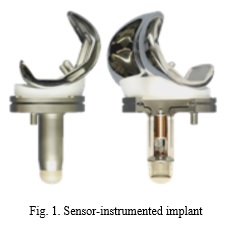
In the present study, two tasks, namely walking and squatting, were selected from this dataset. Among the recorded trials for each activity, five valid trials were selected. The initial number of recorded trials for each participant ranged from five to ten. Each trial consisted of one complete walking or squat cycle extracted from the full movement data. During walking, each trial included one complete gait cycle. For the squat task, participants started from a standing position with their feet shoulder-width apart, flexed their knees to the maximum possible range, and then returned to the initial position (9). To enable comparisons across participants, all extracted forces were normalized to body weight and expressed as a percentage of the movement cycle. Advanced biomechanical equipment was used in the CAMS-Knee project for collecting movement and joint force data (9). Kinematic data were recorded using a Vicon motion analysis system (OMG, UK) at a sampling frequency of 100 Hz. Ground reaction forces were measured using six Kistler force plates at a sampling frequency of 2000 Hz, which were directly mounted on a concrete foundation. All kinematic and kinetic data were recorded simultaneously. To measure intra-articular forces, sensor-instrumented implants were used (Fig. 1), which were capable of measuring knee joint forces and moments in three components: vertical, anterior-posterior, and medial-lateral (9). In addition, knee joint motion was recorded using a video fluoroscopy system equipped with a mobile C-arm. This system had a field of view of 30.5 cm, an imaging rate of 25 Hz, an exposure time of 8 milliseconds, and a resolution of 1000 × 1000 pixels. All measurement sessions were also recorded using a Panasonic NV-GS400 digital camera and a GV-D1000 video recorder (9).
Musculoskeletal modeling has become one of the most important tools for biomechanical analysis of human movement in recent years, enabling non-invasive estimation of muscle forces, joint reaction forces, and mechanical loads applied to musculoskeletal structures (1). These models have been widely used in gait analysis, orthopedic prosthesis design, rehabilitation planning, and prevention of musculoskeletal injuries (2). Despite continuous development of musculoskeletal models, the validity and accuracy of joint force estimation remain among the most important challenges in movement simulation studies, as modeling outcomes depend on factors such as model structure, muscle and joint definitions, optimization methods, and biomechanical assumptions (1, 3). Therefore, validating and comparing the performance of different musculoskeletal models is essential for selecting appropriate models in biomechanical analyses and clinical applications.
Joint contact forces, particularly at the knee joint, are considered important biomechanical indicators in the study of musculoskeletal injuries, joint loading analysis, and prosthesis design. The earliest studies on direct measurement of internal joint forces date back to the 1960s, when Rydell successfully measured hip joint contact force for the first time using implanted sensors (4). Subsequently, the development of musculoskeletal models enabled non-invasive estimation of joint forces. Nevertheless, several studies have reported discrepancies between forces predicted by musculoskeletal models and actual values measured using instrumented implants (5–7). Hernández et al. (2020), in a study comparing direct measurements of isometric shoulder forces with musculoskeletal modeling results, also demonstrated significant differences between model-based estimations and direct measurements (8). In recent years, validation of musculoskeletal models using in vivo data has received considerable attention, as insufficient validation may lead to inaccurate estimations and misleading biomechanical interpretations (7). In this context, the Knee-CAMS project, developed through collaboration between ETH Zurich and Universitätsmedizin Berlin, represents one of the most comprehensive datasets available for knee joint contact force measurements (9). This dataset includes simultaneous recordings of kinematic data, kinetic data, and actual knee joint forces obtained using instrumented implants, and has been widely used as a reliable reference for evaluating the accuracy of musculoskeletal models (9). Despite the importance of this dataset, only a limited number of studies have directly compared the accuracy of different OpenSim models using real intra-articular measurements.
Among the various models available in OpenSim, the Gait2392 and Rajagopal models are among the most commonly used for functional movement and gait analysis (10, 11). The Gait2392 model has been extensively used in biomechanical gait studies (10). In contrast, the Rajagopal model was developed as an improved version of previous OpenSim models with the aim of enhancing the accuracy of functional movement simulations (11). Differences in muscle definitions, joint representations, and biomechanical parameters between these two models may influence joint force estimations. It has also been reported that structural differences among musculoskeletal models can lead to variations in computational time and simulation accuracy (11, 12). Recent studies have shown that the accuracy of musculoskeletal models is not consistent across different movement tasks. For example, Catelli et al. (2019) reported that the Rajagopal model may demonstrate lower accuracy in estimating certain biomechanical parameters during movements involving large ranges of motion, such as squatting (13). Similarly, Imani Nejad et al. (2020) showed that the error in estimating knee joint contact forces is greater during squatting than during walking, and that model accuracy decreases during the stance phase of gait (1). In addition, improvements in knee structure representation and joint modeling may enhance the accuracy of biomechanical predictions (14). On the other hand, muscle force distribution, joint kinematic definitions, and the structural characteristics of musculoskeletal models are among the factors influencing knee joint contact force estimation (10, 15–17). Differences in the representation of structures such as the patellar mechanism and knee joint within different OpenSim models may also result in discrepancies in simulation outcomes (10, 11). In addition to studies on walking and squatting, recent research has expanded the application of musculoskeletal models to other functional activities. For example, Sun et al. (2026), in a study on stair-climbing patterns, reported that a single-step climbing strategy may reduce joint loading in individuals with knee injuries and could serve as a safer rehabilitation option (18). In another study, Imani Nejad et al. (2023) reported considerable differences among various musculoskeletal models in the kinetic analysis of squat movement (19). Despite these advances, only a limited number of studies have evaluated the accuracy of OpenSim models using in vivo data obtained from instrumented implants (1).
Despite the development of multiple musculoskeletal models within the OpenSim environment, there is still no clear consensus regarding the relative accuracy of commonly used models in estimating knee joint contact forces during functional activities (1, 17). Furthermore, differences in muscle definitions, joint kinematics, and model structures may lead to substantial variations in simulation results (10, 11). Given the limited number of studies comparing the performance of OpenSim models using real sensor-based implant data (1, 9), the aim of the present study was to compare the accuracy of knee joint reaction force estimation between the Gait2392 and Rajagopal musculoskeletal models during walking and squatting tasks. The findings of this study may contribute to more informed selection of musculoskeletal models in biomechanical research, rehabilitation protocol design, and knee joint loading analysis.
2. Methods
2.1. Participants
The present study was a descriptive-comparative investigation in which the accuracy of knee joint reaction force modeling was examined using two OpenSim musculoskeletal models, namely Gait2392 and Rajagopal. In this study, the error between joint forces predicted by the musculoskeletal models and the in vivo measured forces was compared. Participants were selected from the CAMS-Knee dataset and included five males and one female (9). The participants had a mean age of 68 ± 5 years, a mean body weight of 88 ± 12 kg, and a mean height of 173 ± 4 cm. Four participants had sensor-instrumented implants in the left knee, while two participants had implants in the right knee. The age range of participants was 41 to 78 years, body weight ranged from 66.5 to 101.5 kg, and height ranged from 165 to 175 cm.
2.2. Data Collection
The CAMS-Knee dataset is a comprehensive and synchronized biomechanical database of six patients with instrumented knee implants that provides direct in vivo measurements of three-dimensional internal knee joint forces and moments, together with three-dimensional movement kinematics obtained using mobile fluoroscopy. In addition to these invasive measurements, the dataset includes standard laboratory data such as full-body kinematics recorded using a Vicon motion capture system, ground reaction forces measured by force plates, and lower-limb muscle activity recorded using surface electromyography. All data were collected during a variety of daily functional activities, including level walking, incline walking, stair ascent and descent, squatting, and sit-to-stand tasks.
In the present study, two tasks, namely walking and squatting, were selected from this dataset. Among the recorded trials for each activity, five valid trials were selected. The initial number of recorded trials for each participant ranged from five to ten. Each trial consisted of one complete walking or squat cycle extracted from the full movement data. During walking, each trial included one complete gait cycle. For the squat task, participants started from a standing position with their feet shoulder-width apart, flexed their knees to the maximum possible range, and then returned to the initial position (9). To enable comparisons across participants, all extracted forces were normalized to body weight and expressed as a percentage of the movement cycle. Advanced biomechanical equipment was used in the CAMS-Knee project for collecting movement and joint force data (9). Kinematic data were recorded using a Vicon motion analysis system (OMG, UK) at a sampling frequency of 100 Hz. Ground reaction forces were measured using six Kistler force plates at a sampling frequency of 2000 Hz, which were directly mounted on a concrete foundation. All kinematic and kinetic data were recorded simultaneously. To measure intra-articular forces, sensor-instrumented implants were used (Fig. 1), which were capable of measuring knee joint forces and moments in three components: vertical, anterior-posterior, and medial-lateral (9). In addition, knee joint motion was recorded using a video fluoroscopy system equipped with a mobile C-arm. This system had a field of view of 30.5 cm, an imaging rate of 25 Hz, an exposure time of 8 milliseconds, and a resolution of 1000 × 1000 pixels. All measurement sessions were also recorded using a Panasonic NV-GS400 digital camera and a GV-D1000 video recorder (9).
2.3. Modeling and Data Processing
Musculoskeletal modeling was performed using OpenSim version 3.3, and statistical analyses were performed using MATLAB version 2017b. First, the anthropometric data of the participants were scaled to both the Gait2392 and Rajagopal musculoskeletal models. Subsequently, inverse kinematics, static optimization, and joint reaction analyses were performed for both models. During the inverse kinematics step, joint angles were calculated using marker trajectory data. Next, muscle forces required to generate joint moments were estimated using the static optimization method. Finally, knee joint reaction forces were extracted through joint reaction analysis. To evaluate model accuracy, the forces predicted by the musculoskeletal models were compared with the actual forces measured by the sensor-instrumented implants. The modeling error percentage was calculated using the following equation (1):
Musculoskeletal modeling was performed using OpenSim version 3.3, and statistical analyses were performed using MATLAB version 2017b. First, the anthropometric data of the participants were scaled to both the Gait2392 and Rajagopal musculoskeletal models. Subsequently, inverse kinematics, static optimization, and joint reaction analyses were performed for both models. During the inverse kinematics step, joint angles were calculated using marker trajectory data. Next, muscle forces required to generate joint moments were estimated using the static optimization method. Finally, knee joint reaction forces were extracted through joint reaction analysis. To evaluate model accuracy, the forces predicted by the musculoskeletal models were compared with the actual forces measured by the sensor-instrumented implants. The modeling error percentage was calculated using the following equation (1):
KCF_error (%)=((KCF_predicted -KCF_measured ))/KCF_measured ×100
where:
KCF_predicted represents the contact force predicted by the model.
KCF_measured represents the force measured by the intra-articular sensor.
In all modeling steps, the RMS error reported by OpenSim was below 0.02, indicating acceptable modeling accuracy.
2.4. Statistical Analysis
To compare modeling errors between the two musculoskeletal models, a paired-sample time-series t-test based on Statistical Parametric Mapping (SPM) was used. Statistical analyses were performed in MATLAB at a significance level of 0.05. In addition to SPM analysis, root mean square error (RMSE) and the coefficient of determination (R²) between predicted and measured forces were calculated for all participants to evaluate model accuracy. These indices were used as quantitative measures of agreement between musculoskeletal model predictions and real in vivo measurements.
3. Results
The results of knee joint reaction force modeling using the two musculoskeletal models, Gait2392 and Rajagopal, were compared with in vivo data obtained from sensor-instrumented implants.
3.1. Knee Joint Reaction Force During Walking
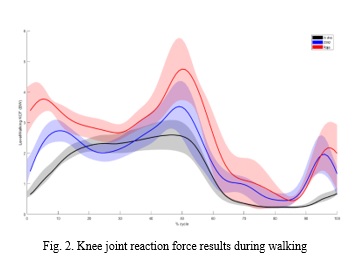
Fig. 2 illustrates the changes in knee joint reaction force throughout the gait cycle for the two musculoskeletal models and the in vivo data.
The results showed that the knee joint reaction force pattern predicted by the Gait2392 model was more similar to the measured data obtained from intra-articular sensors. In contrast, the Rajagopal model showed greater deviation from the measured data during certain portions of the gait cycle, particularly during the stance phase. To statistically compare the modeling errors of the two models throughout the gait cycle, a paired t-test based on Statistical Parametric Mapping (SPM) was performed. The results of this analysis are presented in Fig. 3.
KCF_predicted represents the contact force predicted by the model.
KCF_measured represents the force measured by the intra-articular sensor.
In all modeling steps, the RMS error reported by OpenSim was below 0.02, indicating acceptable modeling accuracy.
2.4. Statistical Analysis
To compare modeling errors between the two musculoskeletal models, a paired-sample time-series t-test based on Statistical Parametric Mapping (SPM) was used. Statistical analyses were performed in MATLAB at a significance level of 0.05. In addition to SPM analysis, root mean square error (RMSE) and the coefficient of determination (R²) between predicted and measured forces were calculated for all participants to evaluate model accuracy. These indices were used as quantitative measures of agreement between musculoskeletal model predictions and real in vivo measurements.
3. Results
The results of knee joint reaction force modeling using the two musculoskeletal models, Gait2392 and Rajagopal, were compared with in vivo data obtained from sensor-instrumented implants.
3.1. Knee Joint Reaction Force During Walking
Fig. 2 illustrates the changes in knee joint reaction force throughout the gait cycle for the two musculoskeletal models and the in vivo data.
The results showed that the knee joint reaction force pattern predicted by the Gait2392 model was more similar to the measured data obtained from intra-articular sensors. In contrast, the Rajagopal model showed greater deviation from the measured data during certain portions of the gait cycle, particularly during the stance phase. To statistically compare the modeling errors of the two models throughout the gait cycle, a paired t-test based on Statistical Parametric Mapping (SPM) was performed. The results of this analysis are presented in Fig. 3.
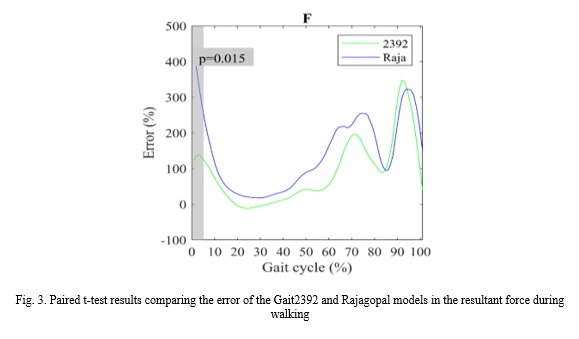
The SPM analysis revealed that during approximately the first 5% of the gait cycle, there was a significant difference between the errors of the two models (p = 0.015). This region corresponded to initial heel contact and the early stance phase, during which the Gait2392 model demonstrated lower error than the Rajagopal model in estimating knee joint reaction force. No significant differences were observed between the two models during the remaining phases of the gait cycle. Furthermore, the RMSE and coefficient of determination (R²) values indicated that the Gait2392 model showed better agreement with the measured in vivo data. The RMSE values for the Gait2392 and Rajagopal models were 0.835 and 1.486, respectively, whereas the R² values were 0.665 and 0.639, respectively.
3.2. Knee Joint Reaction Force During Squatting
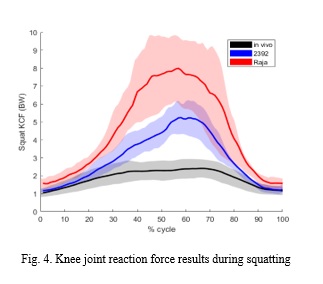
The results of knee joint reaction force modeling during the squat task are presented in Fig. 4.
3.2. Knee Joint Reaction Force During Squatting
The results of knee joint reaction force modeling during the squat task are presented in Fig. 4.
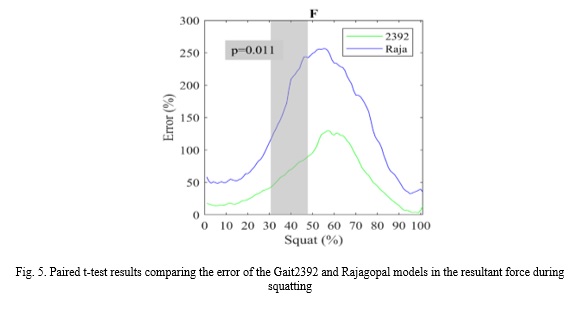
The results indicated that during squatting, the Gait2392 model also produced a pattern that was closer to the measured intra-articular force data. The discrepancy between the Rajagopal model and the measured data was greater, particularly at the end of the flexion phase and the beginning of the extension phase. To examine differences in modeling error between the two models throughout the squat cycle, a paired t-test based on Statistical Parametric Mapping (SPM) was performed, and the results are presented in Fig. 5. The SPM analysis showed that during a substantial portion of the squat cycle, particularly from the middle of the eccentric phase to the beginning of the concentric phase, there was a significant difference between the errors of the two models. In these regions, the Rajagopal model exhibited greater error than the Gait2392 model in estimating knee joint reaction force. The RMSE and coefficient of determination (R²) values also supported the better performance of the Gait2392 model. The RMSE values for the Gait2392 and Rajagopal models were 1.536 and 3.371, respectively, while the R² values were 0.767 and 0.750, respectively. Overall, the SPM results and statistical indices demonstrated that the Gait2392 model provided greater accuracy in estimating knee joint reaction forces during both walking and squatting tasks. Additionally, the modeling error of both models was greater during squatting than during walking, indicating the increased complexity of modeling movements involving larger ranges of motion.
4. Discussion
The aim of the present study was to compare the accuracy of knee joint reaction force estimation between the Gait2392 and Rajagopal musculoskeletal models during walking and squatting tasks. The results showed that the Gait2392 model demonstrated better agreement with the actual in vivo data and lower estimation error than the Rajagopal model in both activities, particularly during the stance phase of walking and throughout a substantial portion of the squat cycle. Additionally, the estimation error of both models was greater during squatting than during walking, indicating the increased complexity of modeling movements involving larger ranges of motion. These findings suggest that selecting an appropriate musculoskeletal model can substantially influence the accuracy of biomechanical analyses and knee joint loading estimations.
The findings of the present study are consistent with previous research (1, 7, 20). Imani Nejad et al. (2020) reported that the accuracy of musculoskeletal models decreases during the stance phase of gait and that estimation error is greater during squatting compared with walking (1). Similarly, Schellenberg et al. (2018) showed that movements involving large knee flexion angles and complex muscle activation patterns are associated with increased error in joint force estimation (7). Knarr and Higginson (2015) also reported that OpenSim musculoskeletal models tend to underestimate actual knee joint forces compared with data obtained from intra-articular sensors (20), which is consistent with the findings of the present study. In the current study, greater discrepancies between the measured data and predicted forces were observed particularly during the stance phase of walking and certain portions of the squat movement—regions in which rapid changes in ground reaction forces and muscle activation patterns occur, making accurate reconstruction more challenging for musculoskeletal models. One possible explanation for the difference in performance between the two models in the present study may be related to differences in model structure, muscle definitions, and knee joint mechanics (10, 11, 17). Although the Rajagopal model was developed with the goal of improving simulation accuracy using updated muscle parameters (11), the results of the present study showed that this model does not necessarily provide more accurate performance than the Gait2392 model during activities with relatively low speed and moderate ranges of motion. Differences in muscle moment arm definitions, patellar force transmission mechanisms, and muscle force distribution may all influence knee joint contact force estimation (10, 13, 15, 17). Catelli et al. (2019) also reported that the Rajagopal model may underestimate the moment arms of certain muscles during movements involving large ranges of motion (13). On the other hand, although the absence of the patella in the Gait2392 model represents an anatomical limitation, it may contribute to greater computational stability and reduced estimation error in certain functional activities. This finding suggests that greater model complexity does not necessarily translate into higher accuracy across all movement tasks, and model validation should therefore be performed in a task-specific manner.
In addition to model structure, the methods used to estimate muscle forces may also affect prediction accuracy. In the present study, static optimization was used, which is one of the most commonly applied approaches in the OpenSim platform; however, this method has limitations in accurately reconstructing real muscle activation patterns and co-contraction behaviors (1, 20). It has also been reported that improvements in knee structural modeling, particularly regarding ligaments and patellar mechanics, can enhance the accuracy of biomechanical predictions (14). Therefore, the use of more advanced models or EMG-driven models in future studies may help reduce the discrepancy between predicted forces and actual measurements.
Despite the valuable findings of the present study, several limitations should be acknowledged. The number of participants was limited, and all individuals had knee prostheses; therefore, generalization of the findings to healthy populations should be made with caution. In addition, only walking and squatting tasks were examined in this study, while other functional activities were not evaluated. Future studies are recommended to include a wider variety of functional tasks, larger sample sizes, and more advanced modeling approaches to enable more comprehensive validation of musculoskeletal models. Nevertheless, by utilizing data obtained from sensor-instrumented implants, the present study provides deeper insight into the performance of two widely used OpenSim models and may contribute to more informed selection of musculoskeletal models in biomechanical analyses and rehabilitation applications.
5. Conclusion
The findings of the present study showed that the Gait2392 model provides greater accuracy in estimating knee joint reaction forces during walking and squatting compared with the Rajagopal model. This study was one of the few investigations to directly compare the performance of two widely used OpenSim models using in vivo data obtained from sensor-instrumented implants, thereby addressing part of the existing gap in musculoskeletal model validation. The findings indicate that selecting an appropriate musculoskeletal model can significantly influence the accuracy of biomechanical analyses and the interpretation of knee joint loading. Based on these results, the Gait2392 model may be a more suitable option for analyzing activities with relatively low speed and moderate ranges of motion, such as walking and squatting. Future studies are recommended to employ more advanced modeling approaches and evaluate a wider range of functional activities to enable more comprehensive validation of musculoskeletal models.
Ethical Considerations
Compliance with ethical guidelines
This study was conducted in accordance with the ethical standards of the institutional and/or national research committee and with the principles of the Declaration of Helsinki. All participants voluntarily took part in the study and provided written informed consent prior to enrollment.
Funding
This research did not receive any specific grant from funding agencies in the public, commercial, or not-for-profit sectors.
Authors' contributions
All authors contributed to the conceptualization, data collection, analysis, and preparation of the manuscript. All authors have read and approved the final version of the manuscript.
Conflicts of interest
The authors declare that they have no conflicts of interest.
The aim of the present study was to compare the accuracy of knee joint reaction force estimation between the Gait2392 and Rajagopal musculoskeletal models during walking and squatting tasks. The results showed that the Gait2392 model demonstrated better agreement with the actual in vivo data and lower estimation error than the Rajagopal model in both activities, particularly during the stance phase of walking and throughout a substantial portion of the squat cycle. Additionally, the estimation error of both models was greater during squatting than during walking, indicating the increased complexity of modeling movements involving larger ranges of motion. These findings suggest that selecting an appropriate musculoskeletal model can substantially influence the accuracy of biomechanical analyses and knee joint loading estimations.
The findings of the present study are consistent with previous research (1, 7, 20). Imani Nejad et al. (2020) reported that the accuracy of musculoskeletal models decreases during the stance phase of gait and that estimation error is greater during squatting compared with walking (1). Similarly, Schellenberg et al. (2018) showed that movements involving large knee flexion angles and complex muscle activation patterns are associated with increased error in joint force estimation (7). Knarr and Higginson (2015) also reported that OpenSim musculoskeletal models tend to underestimate actual knee joint forces compared with data obtained from intra-articular sensors (20), which is consistent with the findings of the present study. In the current study, greater discrepancies between the measured data and predicted forces were observed particularly during the stance phase of walking and certain portions of the squat movement—regions in which rapid changes in ground reaction forces and muscle activation patterns occur, making accurate reconstruction more challenging for musculoskeletal models. One possible explanation for the difference in performance between the two models in the present study may be related to differences in model structure, muscle definitions, and knee joint mechanics (10, 11, 17). Although the Rajagopal model was developed with the goal of improving simulation accuracy using updated muscle parameters (11), the results of the present study showed that this model does not necessarily provide more accurate performance than the Gait2392 model during activities with relatively low speed and moderate ranges of motion. Differences in muscle moment arm definitions, patellar force transmission mechanisms, and muscle force distribution may all influence knee joint contact force estimation (10, 13, 15, 17). Catelli et al. (2019) also reported that the Rajagopal model may underestimate the moment arms of certain muscles during movements involving large ranges of motion (13). On the other hand, although the absence of the patella in the Gait2392 model represents an anatomical limitation, it may contribute to greater computational stability and reduced estimation error in certain functional activities. This finding suggests that greater model complexity does not necessarily translate into higher accuracy across all movement tasks, and model validation should therefore be performed in a task-specific manner.
In addition to model structure, the methods used to estimate muscle forces may also affect prediction accuracy. In the present study, static optimization was used, which is one of the most commonly applied approaches in the OpenSim platform; however, this method has limitations in accurately reconstructing real muscle activation patterns and co-contraction behaviors (1, 20). It has also been reported that improvements in knee structural modeling, particularly regarding ligaments and patellar mechanics, can enhance the accuracy of biomechanical predictions (14). Therefore, the use of more advanced models or EMG-driven models in future studies may help reduce the discrepancy between predicted forces and actual measurements.
Despite the valuable findings of the present study, several limitations should be acknowledged. The number of participants was limited, and all individuals had knee prostheses; therefore, generalization of the findings to healthy populations should be made with caution. In addition, only walking and squatting tasks were examined in this study, while other functional activities were not evaluated. Future studies are recommended to include a wider variety of functional tasks, larger sample sizes, and more advanced modeling approaches to enable more comprehensive validation of musculoskeletal models. Nevertheless, by utilizing data obtained from sensor-instrumented implants, the present study provides deeper insight into the performance of two widely used OpenSim models and may contribute to more informed selection of musculoskeletal models in biomechanical analyses and rehabilitation applications.
5. Conclusion
The findings of the present study showed that the Gait2392 model provides greater accuracy in estimating knee joint reaction forces during walking and squatting compared with the Rajagopal model. This study was one of the few investigations to directly compare the performance of two widely used OpenSim models using in vivo data obtained from sensor-instrumented implants, thereby addressing part of the existing gap in musculoskeletal model validation. The findings indicate that selecting an appropriate musculoskeletal model can significantly influence the accuracy of biomechanical analyses and the interpretation of knee joint loading. Based on these results, the Gait2392 model may be a more suitable option for analyzing activities with relatively low speed and moderate ranges of motion, such as walking and squatting. Future studies are recommended to employ more advanced modeling approaches and evaluate a wider range of functional activities to enable more comprehensive validation of musculoskeletal models.
Ethical Considerations
Compliance with ethical guidelines
This study was conducted in accordance with the ethical standards of the institutional and/or national research committee and with the principles of the Declaration of Helsinki. All participants voluntarily took part in the study and provided written informed consent prior to enrollment.
Funding
This research did not receive any specific grant from funding agencies in the public, commercial, or not-for-profit sectors.
Authors' contributions
All authors contributed to the conceptualization, data collection, analysis, and preparation of the manuscript. All authors have read and approved the final version of the manuscript.
Conflicts of interest
The authors declare that they have no conflicts of interest.
Type of Study: Applicable |
Subject:
Special
Received: 2026/05/12 | Accepted: 2026/07/30 | Published: 2026/08/14
Received: 2026/05/12 | Accepted: 2026/07/30 | Published: 2026/08/14
References
1. Imani Nejad Z, Khalili K, Hosseini Nasab SH, Schütz P, Damm P, Trepczynski A, et al. The capacity of generic musculoskeletal simulations to predict knee joint loading using the CAMS-Knee datasets. Annals of Biomedical Engineering. 2020;48(4):1430-1440. [DOI:10.1007/s10439-020-02480-6]
2. Farahmand F, Hoseini SH, Seifi MM. Determining the optimum training conditions for selective strengthening of vastus medialis oblique muscle over vastus lateralis through using musculoskeletal modeling. Journal of Sport Biomechanics. 2016;2(2):65-72.
3. Mohammad Pour Koli M, Fatahi A. Modern approaches in sport biomechanics: A review paper. Journal of Sport Biomechanics. 2024;9(4):284-300. [DOI:10.61186/JSportBiomech.9.4.284]
4. Rydell NW. Forces acting on the femoral head-prosthesis: A study on strain gauge supplied prostheses in living persons. Acta Orthopaedica Scandinavica. 1966;37(Suppl 88):1-132. [DOI:10.3109/ort.1966.37.suppl-88.01]
5. Kinney AL, Besier TF, D'Lima DD, Fregly BJ. Update on grand challenge competition to predict in vivo knee loads. Journal of Biomechanical Engineering. 2013;135(2):021012. [DOI:10.1115/1.4023255]
6. Schellenberg F, Oberhofer K, Taylor WR, Lorenzetti S. Review of modelling techniques for in vivo muscle force estimation in the lower extremities during strength training. Computational and Mathematical Methods in Medicine. 2015;2015:483921. [DOI:10.1155/2015/483921]
7. Schellenberg F, Taylor WR, Trepczynski A, List R, Kutzner I, Schütz P, et al. Evaluation of the accuracy of musculoskeletal simulation during squats by means of instrumented knee prostheses. Medical Engineering & Physics. 2018;61:95-103. [DOI:10.1016/j.medengphy.2018.09.004]
8. Hernandez V, Rezzoug N, Gorce P. Toward isometric force capabilities evaluation by using a musculoskeletal model: Comparison with direct force measurement. Journal of Biomechanics. 2015;48(12):3178-3184. [DOI:10.1016/j.jbiomech.2015.07.003]
9. Taylor WR, Schütz P, Bergmann G, List R, Postolka B, Hitz M, et al. A comprehensive assessment of the musculoskeletal system: The CAMS-Knee data set. Journal of Biomechanics. 2017;65:32-39. [DOI:10.1016/j.jbiomech.2017.09.022]
10. Delp SL, Anderson FC, Arnold AS, Loan P, Habib A, John CT, et al. OpenSim documentation: Gait 2392 and 2354 models. Stanford University; 2013.
11. Rajagopal A, Dembia CL, DeMers MS, Delp DD, Hicks JL, Delp SL. Full-body musculoskeletal model for muscle-driven simulation of human gait. IEEE Transactions on Biomedical Engineering. 2016;63(10):2068-2079. [DOI:10.1109/TBME.2016.2586891]
12. Arnold EM, Ward SR, Lieber RL, Delp SL. A model of the lower limb for analysis of human movement. Annals of Biomedical Engineering. 2010;38(2):269-279. [DOI:10.1007/s10439-009-9852-5]
13. Catelli DS, Wesseling M, Jonkers I, Lamontagne M. A musculoskeletal model customized for squatting task. Computer Methods in Biomechanics and Biomedical Engineering. 2019;22(1):21-24. [DOI:10.1080/10255842.2018.1523396]
14. Xu H, Bloswick D, Merryweather A. An improved OpenSim gait model with multiple degrees of freedom knee joint and knee ligaments. Computer Methods in Biomechanics and Biomedical Engineering. 2015;18(11):1217-1224. [DOI:10.1080/10255842.2014.889689]
15. Falisse A, Van Rossom S, Gijsbers J, Steenbrink F, van Basten BJH, Jonkers I, et al. OpenSim versus human body model: A comparison study for the lower limbs during gait. Journal of Applied Biomechanics. 2018;34(6):496-502. [DOI:10.1123/jab.2017-0156]
16. McCain EM, Dalman MJ, Berno ME, Libera TL, Lewek MD, Sawicki GS, et al. The influence of induced gait asymmetry on joint reaction forces. Journal of Biomechanics. 2023;153:111581. [DOI:10.1016/j.jbiomech.2023.111581]
17. Hicks JL, Uchida TK, Seth A, Rajagopal A, Delp SL. Is my model good enough? Best practices for verification and validation of musculoskeletal models and simulations of movement. Journal of Biomechanical Engineering. 2015;137(2):020905. [DOI:10.1115/1.4029304]
18. Sun Y, Mei Q, Kou D, Liu J, Yang Y, Duan L, et al. Biomechanical analysis of stair walking patterns and their implications for knee health in young males. Frontiers in Public Health. 2026;13:1512345. [DOI:10.3389/fpubh.2025.1725056]
19. Imani Nejad Z, Khalili K. A review of the most widely used lower limb musculoskeletal models to simulate squat motion using OpenSim (In Persian). Journal of Mechanical Engineering University of Tabriz. 2023;53(2):79-88.
20. Knarr BA, Higginson JS. Practical approach to subject-specific estimation of knee joint contact force. Journal of Biomechanics. 2015;48(11):2897-2902. [DOI:10.1016/j.jbiomech.2015.04.020]
| Rights and permissions | |
 |
This work is licensed under a Creative Commons Attribution-NonCommercial 4.0 International License. |

Journal of Sport Biomechanics
Department of Sport Biomechanics, Faculty of Humanities, Islamic Azad University, Hamedan Branch, Prof. Mousivand Blvd, Imam Khomeini Blvd, Hamedan, Iran.
Journal Tel: +98 81 34494042
Website: http://biomechanics.iauh.ac.ir
Email: sportbiomechanics@iauh.ac.ir
