

Volume 12, Issue 3 (11-2026)
J Sport Biomech 2026, 12(3): 394-414 |
Back to browse issues page




Download citation:
BibTeX | RIS | EndNote | Medlars | ProCite | Reference Manager | RefWorks
Send citation to:


BibTeX | RIS | EndNote | Medlars | ProCite | Reference Manager | RefWorks
Send citation to:
Amiri-khorasani M T, Mohammadi pour F, Shokrollahi A, Amiri khorasani A. Acute Effects of Post-Activation Performance Enhancement-Based Warm-Up Protocols on Knee Joint Kinematics and Countermovement Jump Performance in Male Physical Education Students. J Sport Biomech 2026; 12 (3) :394-414
URL: http://biomechanics.iauh.ac.ir/article-1-473-en.html
URL: http://biomechanics.iauh.ac.ir/article-1-473-en.html
MMohammadtaghiammad Taghi Amiri-khorasani *1 

 , Fariborz Mohammadi pour2 , Ahmad Shokrollahi2 , Ali Amiri khorasani2
, Fariborz Mohammadi pour2 , Ahmad Shokrollahi2 , Ali Amiri khorasani2
1- Department of Sports Biomechanics, Sport Sciences Research Institute, Tehran, Iran.
2- Department of Sports Biomechanics, Faculty of Physical Education and Sport Sciences, Shahid Bahonar University of Kerman, Kerman, Iran.
2- Department of Sports Biomechanics, Faculty of Physical Education and Sport Sciences, Shahid Bahonar University of Kerman, Kerman, Iran.
Keywords: Post-activation performance enhancement, Muscle strength, Biomechanics, Resistance exercise, Countermovement jump
Full-Text [PDF 1915 kb]
(487 Downloads)
| Abstract (HTML) (1737 Views)

Full-Text: (464 Views)
1. Introduction
Lower-extremity explosive power is a key performance component in many sports and contributes directly to jumping, landing, acceleration, cutting, and other high-intensity actions. In team and individual sports, the capacity to generate force rapidly is closely related to successful performance. For this reason, sport scientists and strength and conditioning practitioners continue to seek acute and chronic strategies that enhance neuromuscular readiness and power output (1,2).
The countermovement jump (CMJ) is one of the most frequently used tests for evaluating explosive power and stretch-shortening cycle function. The test is simple to administer, has good practical reliability, and is closely linked to performance in tasks requiring rapid lower-extremity force production. During the CMJ, the athlete first flexes the lower-extremity joints during the eccentric phase and then immediately extends them to jump vertically. Effective CMJ performance therefore depends on inter-joint coordination, force-production capacity, and efficient use of elastic energy within the muscle-tendon unit (3,4).
From a biomechanical perspective, jump performance is not defined only by the final jump height. It reflects the coordinated interaction of lower-limb joint torque, rate of force development, force-application time, and joint motion patterns during the eccentric and concentric phases. Previous work has shown meaningful associations between jump height and hip and knee flexion-extension torques in young men, suggesting that the strength of the hip and knee joints may be a determining factor in successful jumping tasks. In more complex jumping skills, variables such as jump height, vertical velocity, flight time, and hip and knee angular velocity have also been treated as key biomechanical indicators. Examining both performance and kinematic outcomes may therefore provide a more complete understanding of how neuromuscular preparation strategies affect jumping performance (5,6).
The knee joint is one of the most functionally important joints in the lower limb and contributes substantially to load bearing, stability, balance, and movement execution. During the CMJ, the knee is involved in force absorption during landing, force transfer during the propulsive phase, and elastic energy storage during the eccentric phase. Changes in knee joint angles and angular velocities may influence jump performance, mechanical load distribution, and the risk of sport-related injuries. Reduced knee flexion during landing has been associated with greater shear loading and a higher risk of anterior cruciate ligament (ACL) injury (7-9). For this reason, the kinematic response of the knee joint to warm-up interventions deserves specific attention.
The importance of knee kinematics in jump-landing tasks becomes clearer when reduced knee flexion and increased knee valgus or abduction are considered as movement patterns that may shift landing mechanics toward higher risk. Studies of jumping and landing have shown that changes in knee flexion and valgus, particularly in the dominant limb, may indicate greater mechanical joint loading and a higher likelihood of ACL injury. Research on CMJ and jump-landing tasks also suggests that lower-limb kinematic variables--especially knee range of motion during the eccentric and concentric phases, peak flexion, and the instant of landing--are sensitive to training conditions, fatigue, and corrective interventions. Assessing the effects of PAPE-based warm-up protocols on knee flexion and angular velocity is therefore valuable not only for explaining jump-performance changes but also for evaluating movement quality and landing safety (10-12). One strategy that has received growing attention for improving explosive performance is post-activation performance enhancement (PAPE). Although the term post-activation potentiation (PAP) has traditionally been used, the term PAPE is now often preferred when describing improvements in voluntary sport performance after conditioning contractions. PAPE refers to an acute enhancement of subsequent muscular performance following a preceding voluntary contraction. Proposed mechanisms include phosphorylation of myosin regulatory light chains, increased alpha-motor neuron excitability, greater motor-unit recruitment, and improved neuromuscular coordination (13-15).
Long-term training interventions are commonly used to improve jump performance, but acute preparatory strategies may also transiently increase lower-extremity power during warm-up. These short-term improvements are generally attributed to PAPE-related mechanisms and neuromuscular facilitation (16). Heavy resistance exercises, particularly squat-based conditioning activities, are frequently used to elicit PAPE responses and have been shown to improve vertical jump and explosive performance in some studies (17,18). Combined protocols that use free weights with elastic bands may provide an additional variable-resistance stimulus because external resistance increases through the range of motion as mechanical advantage improves (19).
Despite this rationale, findings regarding PAPE effects on jump performance and biomechanical variables remain inconsistent. Some studies have reported meaningful improvements in jump height and explosive power, whereas others have observed little or no change (20,21). Most previous work has focused on performance outcomes such as jump height or power, with less attention to knee joint kinematics after PAPE interventions. In addition, direct comparisons between traditional resistance warm-up and combined warm-up protocols using elastic bands are still limited, particularly in Iranian physical education students.
From an applied perspective, understanding how different PAPE protocols affect knee joint kinematics may help coaches, strength and conditioning specialists, and biomechanists design warm-ups that enhance performance without compromising movement quality. If a warm-up strategy improves explosive performance while supporting safer landing mechanics, it may be useful before training sessions and competitions. The purpose of the present study was therefore to compare the acute effects of two PAPE-based warm-up protocols--a resistance warm-up and a combined warm-up using free weights plus elastic bands--on knee joint kinematics and CMJ performance in male physical education students. We hypothesized that both PAPE protocols would improve performance and kinematic outcomes compared with a general warm-up, and that the combined protocol would produce the greatest numerical response.
2. Methods
2.1. Participants
The present study used a quasi-experimental repeated-measures crossover design. The target population consisted of male physical education students at Shahid Bahonar University of Kerman. Twenty participants (age: 21 ± 2 years; height: 176 ± 5 cm; body mass: 70 ± 5 kg; sport experience: 8 ± 2.2 years) were recruited through convenience sampling. Sample size was estimated using G*Power based on effect sizes reported in comparable studies, with statistical power set at 80% and alpha at 0.05. Inclusion criteria were male sex, enrollment in physical education, at least three years of regular sport participation, no lower-extremity injury during the previous six months, no history of orthopedic surgery, and no heavy resistance training during the previous six months. Exclusion criteria were failure to complete all testing sessions or incorrect execution of the assigned protocols.
Before testing, all participants received a full explanation of the study procedures, testing conditions, potential risks, and experimental requirements. Written informed consent was obtained from each participant. All testing sessions were conducted between 9:00 a.m. and 2:00 p.m. to reduce the influence of diurnal variation.
2.2. Training Protocols
Each participant completed three warm-up conditions--general warm-up, resistance warm-up, and combined warm-up--in three separate, non-consecutive sessions. The order of conditions was counterbalanced to reduce learning and order effects (Table 1).
Lower-extremity explosive power is a key performance component in many sports and contributes directly to jumping, landing, acceleration, cutting, and other high-intensity actions. In team and individual sports, the capacity to generate force rapidly is closely related to successful performance. For this reason, sport scientists and strength and conditioning practitioners continue to seek acute and chronic strategies that enhance neuromuscular readiness and power output (1,2).
The countermovement jump (CMJ) is one of the most frequently used tests for evaluating explosive power and stretch-shortening cycle function. The test is simple to administer, has good practical reliability, and is closely linked to performance in tasks requiring rapid lower-extremity force production. During the CMJ, the athlete first flexes the lower-extremity joints during the eccentric phase and then immediately extends them to jump vertically. Effective CMJ performance therefore depends on inter-joint coordination, force-production capacity, and efficient use of elastic energy within the muscle-tendon unit (3,4).
From a biomechanical perspective, jump performance is not defined only by the final jump height. It reflects the coordinated interaction of lower-limb joint torque, rate of force development, force-application time, and joint motion patterns during the eccentric and concentric phases. Previous work has shown meaningful associations between jump height and hip and knee flexion-extension torques in young men, suggesting that the strength of the hip and knee joints may be a determining factor in successful jumping tasks. In more complex jumping skills, variables such as jump height, vertical velocity, flight time, and hip and knee angular velocity have also been treated as key biomechanical indicators. Examining both performance and kinematic outcomes may therefore provide a more complete understanding of how neuromuscular preparation strategies affect jumping performance (5,6).
The knee joint is one of the most functionally important joints in the lower limb and contributes substantially to load bearing, stability, balance, and movement execution. During the CMJ, the knee is involved in force absorption during landing, force transfer during the propulsive phase, and elastic energy storage during the eccentric phase. Changes in knee joint angles and angular velocities may influence jump performance, mechanical load distribution, and the risk of sport-related injuries. Reduced knee flexion during landing has been associated with greater shear loading and a higher risk of anterior cruciate ligament (ACL) injury (7-9). For this reason, the kinematic response of the knee joint to warm-up interventions deserves specific attention.
The importance of knee kinematics in jump-landing tasks becomes clearer when reduced knee flexion and increased knee valgus or abduction are considered as movement patterns that may shift landing mechanics toward higher risk. Studies of jumping and landing have shown that changes in knee flexion and valgus, particularly in the dominant limb, may indicate greater mechanical joint loading and a higher likelihood of ACL injury. Research on CMJ and jump-landing tasks also suggests that lower-limb kinematic variables--especially knee range of motion during the eccentric and concentric phases, peak flexion, and the instant of landing--are sensitive to training conditions, fatigue, and corrective interventions. Assessing the effects of PAPE-based warm-up protocols on knee flexion and angular velocity is therefore valuable not only for explaining jump-performance changes but also for evaluating movement quality and landing safety (10-12). One strategy that has received growing attention for improving explosive performance is post-activation performance enhancement (PAPE). Although the term post-activation potentiation (PAP) has traditionally been used, the term PAPE is now often preferred when describing improvements in voluntary sport performance after conditioning contractions. PAPE refers to an acute enhancement of subsequent muscular performance following a preceding voluntary contraction. Proposed mechanisms include phosphorylation of myosin regulatory light chains, increased alpha-motor neuron excitability, greater motor-unit recruitment, and improved neuromuscular coordination (13-15).
Long-term training interventions are commonly used to improve jump performance, but acute preparatory strategies may also transiently increase lower-extremity power during warm-up. These short-term improvements are generally attributed to PAPE-related mechanisms and neuromuscular facilitation (16). Heavy resistance exercises, particularly squat-based conditioning activities, are frequently used to elicit PAPE responses and have been shown to improve vertical jump and explosive performance in some studies (17,18). Combined protocols that use free weights with elastic bands may provide an additional variable-resistance stimulus because external resistance increases through the range of motion as mechanical advantage improves (19).
Despite this rationale, findings regarding PAPE effects on jump performance and biomechanical variables remain inconsistent. Some studies have reported meaningful improvements in jump height and explosive power, whereas others have observed little or no change (20,21). Most previous work has focused on performance outcomes such as jump height or power, with less attention to knee joint kinematics after PAPE interventions. In addition, direct comparisons between traditional resistance warm-up and combined warm-up protocols using elastic bands are still limited, particularly in Iranian physical education students.
From an applied perspective, understanding how different PAPE protocols affect knee joint kinematics may help coaches, strength and conditioning specialists, and biomechanists design warm-ups that enhance performance without compromising movement quality. If a warm-up strategy improves explosive performance while supporting safer landing mechanics, it may be useful before training sessions and competitions. The purpose of the present study was therefore to compare the acute effects of two PAPE-based warm-up protocols--a resistance warm-up and a combined warm-up using free weights plus elastic bands--on knee joint kinematics and CMJ performance in male physical education students. We hypothesized that both PAPE protocols would improve performance and kinematic outcomes compared with a general warm-up, and that the combined protocol would produce the greatest numerical response.
2. Methods
2.1. Participants
The present study used a quasi-experimental repeated-measures crossover design. The target population consisted of male physical education students at Shahid Bahonar University of Kerman. Twenty participants (age: 21 ± 2 years; height: 176 ± 5 cm; body mass: 70 ± 5 kg; sport experience: 8 ± 2.2 years) were recruited through convenience sampling. Sample size was estimated using G*Power based on effect sizes reported in comparable studies, with statistical power set at 80% and alpha at 0.05. Inclusion criteria were male sex, enrollment in physical education, at least three years of regular sport participation, no lower-extremity injury during the previous six months, no history of orthopedic surgery, and no heavy resistance training during the previous six months. Exclusion criteria were failure to complete all testing sessions or incorrect execution of the assigned protocols.
Before testing, all participants received a full explanation of the study procedures, testing conditions, potential risks, and experimental requirements. Written informed consent was obtained from each participant. All testing sessions were conducted between 9:00 a.m. and 2:00 p.m. to reduce the influence of diurnal variation.
2.2. Training Protocols
Each participant completed three warm-up conditions--general warm-up, resistance warm-up, and combined warm-up--in three separate, non-consecutive sessions. The order of conditions was counterbalanced to reduce learning and order effects (Table 1).
Following the protocol described by Rezaei Lori et al. (1), each session included 5 min of jogging, 3 min of dynamic stretching, and the assigned warm-up condition. After the specific warm-up protocol, participants rested for 2 min before performing the CMJ test.
One week before data collection, participants completed a one-repetition maximum (1RM) assessment for the squat exercise using a trial-and-error procedure across 4-6 attempts. This assessment was used to prescribe the loading intensity for the resistance and combined warm-up protocols.
2.2.1. General Warm-Up Protocol
Participants ran on a treadmill for 5 min at 8-9 km/h, followed by 3 min of dynamic stretching targeting the quadriceps, hamstrings, calf muscles, and lumbar region. Each stretch lasted approximately 4-6 s. Participants then performed five bodyweight squats (22).
2.2.2. Resistance Warm-Up Protocol
Participants performed one set of five squat repetitions at 85-90% of 1RM.
2.2.3. Combined Warm-Up Protocol
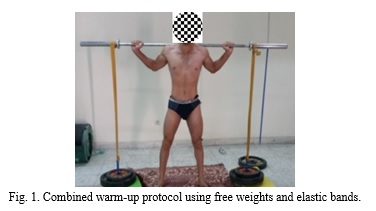
In the combined protocol, participants performed squats using both free weights and elastic bands (Fig. 1). The total exercise intensity was approximately 80% of 1RM, and participants completed three sets of three repetitions. No restriction was imposed on squat depth or knee joint angle; participants performed the movement using their natural squat pattern. Elastic bands were attached from the lower anchor point to the weight plates and from the upper end to the barbell, creating variable resistance across the movement range (14).
One week before data collection, participants completed a one-repetition maximum (1RM) assessment for the squat exercise using a trial-and-error procedure across 4-6 attempts. This assessment was used to prescribe the loading intensity for the resistance and combined warm-up protocols.
2.2.1. General Warm-Up Protocol
Participants ran on a treadmill for 5 min at 8-9 km/h, followed by 3 min of dynamic stretching targeting the quadriceps, hamstrings, calf muscles, and lumbar region. Each stretch lasted approximately 4-6 s. Participants then performed five bodyweight squats (22).
2.2.2. Resistance Warm-Up Protocol
Participants performed one set of five squat repetitions at 85-90% of 1RM.
2.2.3. Combined Warm-Up Protocol
In the combined protocol, participants performed squats using both free weights and elastic bands (Fig. 1). The total exercise intensity was approximately 80% of 1RM, and participants completed three sets of three repetitions. No restriction was imposed on squat depth or knee joint angle; participants performed the movement using their natural squat pattern. Elastic bands were attached from the lower anchor point to the weight plates and from the upper end to the barbell, creating variable resistance across the movement range (14).
2.3. Elastic Band Calibration
Elastic bands were calibrated by suspending known loads from the distal end of the band and recording the corresponding change in length. A linear regression equation was then derived from the load-elongation relationship and used to estimate elastic resistance during the movement (18).
2.4. Kinematic Data Collection
Three-dimensional kinematic data were collected using a Motion Analysis Raptor-H system with six cameras sampling at 200 Hz. Marker trajectories were recorded in Cortex software (version 2.5) and filtered using a fourth-order low-pass Butterworth filter with a 12-Hz cutoff frequency. Camera placement was arranged so that each reflective marker was visible to at least two cameras throughout the movement (23). After calibration of the capture volume, participants performed the test while wearing minimal clothing to improve marker visibility. Four reflective markers were attached to anatomical landmarks on the dominant lower limb: the anterior superior iliac spine, greater trochanter, lateral femoral epicondyle, and lateral malleolus. Dominant-limb marker placement was selected on the basis of previous CMJ biomechanical studies and was used to simplify processing and reduce tracking error (23,24). For CMJ execution, participants stood upright with their hands placed on the iliac crests to remove the contribution of the upper limbs. They then rapidly flexed the knees to initiate the eccentric phase and immediately performed a maximal vertical jump by extending the lower-extremity joints (25). Each participant completed three trials, and the best trial was selected for analysis. Jump height was calculated from the vertical displacement of the right anterior superior iliac spine marker. The difference between the initial vertical position of this marker and its highest vertical position during the jump was used as jump height (16). The dependent variables were jump height, peak knee flexion before toe-off, peak knee flexion during landing, peak knee angular velocity during the eccentric phase before take-off, peak knee angular velocity during the concentric phase, and peak knee angular velocity during landing. The eccentric phase was defined as the interval from the initiation of knee flexion to the instant of movement reversal. The concentric phase was defined as the interval from the initiation of knee extension to toe-off.
2.5. Statistical Analysis
Data normality was assessed with the Shapiro-Wilk test. A one-way repeated-measures analysis of variance was used to compare the three warm-up conditions. When a significant main effect was observed, Bonferroni post hoc tests were applied. The significance level was set at p ≤ 0.05. All analyses were conducted in SPSS version 22.
3. Results
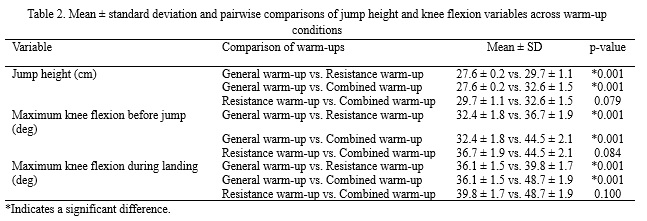
As shown in Table 2, repeated-measures ANOVA indicated significant differences among the three warm-up conditions for jump height. Bonferroni post hoc comparisons showed that jump height increased after the resistance warm-up (29.7 ± 1.1 cm) and combined warm-up (32.6 ± 1.5 cm) compared with the general warm-up (27.6 ± 0.2 cm) (p = 0.001). The difference between the resistance and combined protocols was not statistically significant (p = 0.079), although the combined condition produced the highest numerical value. Peak knee flexion before take-off also increased after the resistance warm-up (36.7 ± 1.9 degrees) and combined warm-up (44.5 ± 2.1 degrees) compared with the general warm-up (32.4 ± 1.8 degrees) (p = 0.001). The combined protocol produced a larger mean knee flexion angle than the resistance protocol, but the difference was not statistically significant (p = 0.084). Peak knee flexion during landing increased after the resistance warm-up (39.8 ± 1.7 degrees) and combined warm-up (48.7 ± 1.9 degrees) compared with the general warm-up (36.1 ± 1.5 degrees) (p = 0.001). Again, the difference between the two PAPE protocols did not reach statistical significance (p = 0.100). Overall, Table 2 indicates that PAPE-based warm-ups increased jump height and knee flexion before take-off and during landing. These changes may reflect more effective use of the stretch-shortening cycle and greater neuromuscular readiness before explosive activity.
Elastic bands were calibrated by suspending known loads from the distal end of the band and recording the corresponding change in length. A linear regression equation was then derived from the load-elongation relationship and used to estimate elastic resistance during the movement (18).
2.4. Kinematic Data Collection
Three-dimensional kinematic data were collected using a Motion Analysis Raptor-H system with six cameras sampling at 200 Hz. Marker trajectories were recorded in Cortex software (version 2.5) and filtered using a fourth-order low-pass Butterworth filter with a 12-Hz cutoff frequency. Camera placement was arranged so that each reflective marker was visible to at least two cameras throughout the movement (23). After calibration of the capture volume, participants performed the test while wearing minimal clothing to improve marker visibility. Four reflective markers were attached to anatomical landmarks on the dominant lower limb: the anterior superior iliac spine, greater trochanter, lateral femoral epicondyle, and lateral malleolus. Dominant-limb marker placement was selected on the basis of previous CMJ biomechanical studies and was used to simplify processing and reduce tracking error (23,24). For CMJ execution, participants stood upright with their hands placed on the iliac crests to remove the contribution of the upper limbs. They then rapidly flexed the knees to initiate the eccentric phase and immediately performed a maximal vertical jump by extending the lower-extremity joints (25). Each participant completed three trials, and the best trial was selected for analysis. Jump height was calculated from the vertical displacement of the right anterior superior iliac spine marker. The difference between the initial vertical position of this marker and its highest vertical position during the jump was used as jump height (16). The dependent variables were jump height, peak knee flexion before toe-off, peak knee flexion during landing, peak knee angular velocity during the eccentric phase before take-off, peak knee angular velocity during the concentric phase, and peak knee angular velocity during landing. The eccentric phase was defined as the interval from the initiation of knee flexion to the instant of movement reversal. The concentric phase was defined as the interval from the initiation of knee extension to toe-off.
2.5. Statistical Analysis
Data normality was assessed with the Shapiro-Wilk test. A one-way repeated-measures analysis of variance was used to compare the three warm-up conditions. When a significant main effect was observed, Bonferroni post hoc tests were applied. The significance level was set at p ≤ 0.05. All analyses were conducted in SPSS version 22.
3. Results
As shown in Table 2, repeated-measures ANOVA indicated significant differences among the three warm-up conditions for jump height. Bonferroni post hoc comparisons showed that jump height increased after the resistance warm-up (29.7 ± 1.1 cm) and combined warm-up (32.6 ± 1.5 cm) compared with the general warm-up (27.6 ± 0.2 cm) (p = 0.001). The difference between the resistance and combined protocols was not statistically significant (p = 0.079), although the combined condition produced the highest numerical value. Peak knee flexion before take-off also increased after the resistance warm-up (36.7 ± 1.9 degrees) and combined warm-up (44.5 ± 2.1 degrees) compared with the general warm-up (32.4 ± 1.8 degrees) (p = 0.001). The combined protocol produced a larger mean knee flexion angle than the resistance protocol, but the difference was not statistically significant (p = 0.084). Peak knee flexion during landing increased after the resistance warm-up (39.8 ± 1.7 degrees) and combined warm-up (48.7 ± 1.9 degrees) compared with the general warm-up (36.1 ± 1.5 degrees) (p = 0.001). Again, the difference between the two PAPE protocols did not reach statistical significance (p = 0.100). Overall, Table 2 indicates that PAPE-based warm-ups increased jump height and knee flexion before take-off and during landing. These changes may reflect more effective use of the stretch-shortening cycle and greater neuromuscular readiness before explosive activity.
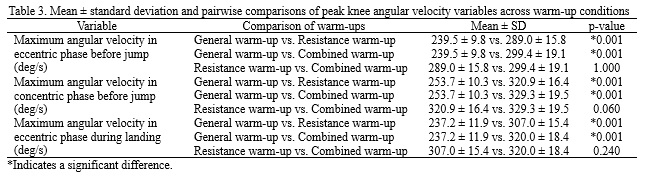
Table 3 shows that peak knee angular velocity during the eccentric phase before take-off increased after the resistance warm-up (289.0 ± 15.8 deg/s) and combined warm-up (299.4 ± 19.1 deg/s) compared with the general warm-up (239.5 ± 9.8 deg/s) (p = 0.001). The resistance and combined protocols did not differ significantly (p = 1.000).
Peak knee angular velocity during the concentric phase before take-off also increased after both PAPE protocols. Mean angular velocity increased from 253.7 ± 10.3 deg/s in the general warm-up condition to 320.9 ± 16.4 deg/s after the resistance protocol and 329.3 ± 19.5 deg/s after the combined protocol (p = 0.001). The difference between the two PAPE conditions was not significant (p = 0.060). Peak knee angular velocity during the eccentric phase of landing increased after the resistance warm-up (307.0 ± 15.4 deg/s) and combined warm-up (320.0 ± 18.4 deg/s) compared with the general warm-up (237.2 ± 11.9 deg/s) (p = 0.001). The two PAPE protocols did not differ significantly (p = 0.240). Collectively, Table 3 indicates that PAPE-based warm-ups increased knee angular velocity during different phases of the CMJ. The higher angular velocity may reflect an improved rate of force development and greater neuromuscular efficiency during explosive movement.
4. Discussion
The purpose of this study was to examine the acute effects of two PAPE-based warm-up protocols on knee joint kinematics and CMJ performance. Both the resistance and combined protocols significantly improved jump height and knee kinematic variables compared with the general warm-up condition. No statistically significant difference was observed between the two PAPE protocols. These findings suggest that high-intensity resistance activity before an explosive task can produce a short-term neuromuscular response that improves jump performance. The results are consistent with Wilson et al. (26), Gourgoulis et al. (8), and Tillin and Bishop (27), who reported that heavy resistance conditioning activities can acutely enhance explosive performance.
The improvement in jump height after the PAPE protocols may be explained by increased neuromuscular excitability and greater force-production capacity. PAPE has been linked to phosphorylation of myosin regulatory light chains, increased sensitivity of the actin-myosin complex to calcium ions, and a greater number of active cross-bridges (19,20). Increased motor-unit recruitment and higher motor-neuron discharge rates may also contribute to better explosive performance (21). These mechanisms are particularly relevant for movements such as the CMJ, which depend heavily on the stretch-shortening cycle.
The increase in jump height can also be interpreted through the role of the hip and knee joints in torque generation and force transfer along the lower-limb kinetic chain. In young men, jump height has been associated with hip and knee flexion-extension torques, indicating that improved neuromuscular readiness after PAPE protocols may enhance torque production in key lower-limb joints and allow more effective use of the eccentric phase. Findings from biomechanical analyses of more complex jumping skills also identify jump height, vertical velocity, flight time, and hip and knee angular velocity as important performance-related variables. The simultaneous increase in jump height and knee angular velocity in the present study therefore suggests that the PAPE protocols did not merely improve the final jump outcome, but may also have enhanced the mechanical quality of movement execution (5,6).
The increase in peak knee flexion before take-off has important biomechanical implications. Greater knee flexion before take-off may lengthen the time available for force application and improve the use of elastic energy stored during the eccentric phase. Previous biomechanical studies indicate that greater preparatory knee flexion can increase the contribution of the knee and hip extensors and enhance stretch-shortening cycle efficiency (22,23). Greater knee flexion during landing may also improve shock absorption and reduce knee joint loading, thereby supporting safer landing mechanics (24). The observed changes in knee flexion therefore appear to reflect a more favorable neuromuscular control strategy after the PAPE interventions.
The increase in knee flexion during landing is also relevant from a movement-safety perspective. Reduced knee flexion combined with greater knee valgus or abduction during jump-landing tasks can shift landing toward a higher-risk mechanical pattern and may increase ACL loading. Similar changes have been reported in the dominant limb after intensive training periods and during fatigued or later phases of sport activity. Corrective exercise and feedback-based interventions may increase lower-limb range of motion across the eccentric, concentric, peak-flexion, and landing phases while reducing knee valgus. On this basis, the greater knee flexion observed after the PAPE protocols in the present study may be interpreted not only as a performance-related change, but also as a softer landing strategy that supports force absorption and improves neuromuscular control of the lower limb (10-12).
Knee angular velocity during the eccentric and concentric phases also increased after the PAPE protocols. This response may indicate a higher rate of force development and improved coordination between agonist and antagonist muscle groups. In explosive tasks such as the CMJ, rapid force production is often more important than maximal force capacity alone. Consequently, higher knee angular velocity may contribute meaningfully to improved jump performance (28). The present findings are consistent with Shi et al. (29), Chen et al. (30), Beato et al. (31), and Arabatzi et al. (32), who reported improvements in explosive-force characteristics and kinematic variables after PAPE interventions.
Although the combined protocol produced higher numerical values than the resistance protocol, the differences were not statistically significant. One explanation is that the mechanical intensity of both protocols was sufficient to elicit a PAPE response, whereas the additional elastic-band stimulus was not large enough to produce a statistically superior effect. This finding is partly consistent with studies of variable resistance showing that elastic bands do not always provide additional improvements in explosive performance beyond traditional resistance exercise (33). In contrast, Sanchez-Sanchez et al. (34) and Marin et al. (35) reported positive effects of elastic-band resistance on vertical jump performance. Differences in load intensity, recovery duration, training status, or movement execution may explain the inconsistency.
From a mechanical standpoint, elastic bands may enhance explosive performance by increasing resistance through the range of motion. As resistance rises in the terminal phase of the movement, neuromuscular stimulation and recruitment of fast-twitch motor units may increase, potentially improving the rate of force development and power output. The present findings suggest, however, that this additional stimulus did not produce a statistically superior response compared with resistance warm-up alone.
Only the dominant lower limb was analyzed in this study. Although unilateral analysis limits generalization to bilateral movement patterns, it is commonly used in CMJ biomechanical studies to reduce processing complexity and marker-tracking error (36,37). Future studies should include bilateral kinematic models, electromyography, and ground reaction force data to provide a more complete explanation of the neuromuscular mechanisms underlying PAPE responses.
Several limitations should be acknowledged. First, the sample was limited to male physical education students, which restricts generalization to female participants, elite athletes, and other sport populations. Second, electromyographic activity and ground reaction forces were not recorded. Third, only acute responses were examined; long-term adaptations to repeated PAPE exposure were not assessed. Finally, complete control of neuromuscular fatigue between testing sessions was not possible.
Despite these limitations, the findings have practical value for coaches, strength and conditioning specialists, and athletes. PAPE-based warm-up strategies appear capable of increasing neuromuscular readiness and improving CMJ performance. From an applied standpoint, either a traditional resistance warm-up or a combined warm-up may be used before explosive tasks depending on available equipment, athlete familiarity, and training context.
5. Conclusion
This study showed that PAPE-based warm-up protocols acutely improved countermovement jump performance and selected knee joint kinematic variables. Both resistance and combined warm-up protocols produced significant positive effects compared with the general warm-up condition, but the combined protocol was not statistically superior to resistance warm-up alone. These findings support the use of PAPE-based strategies as part of warm-up routines before explosive athletic activity.
Acknowledgments
The authors would like to thank all participants for their valuable cooperation throughout the study.
Ethical Considerations
Compliance with ethical guidelines
All procedures involving human participants were conducted in accordance with ethical standards for human-subject research. Written informed consent was obtained from all participants before data collection.
Funding
This research received no financial support from any governmental, private, or non-profit organizations.
Authors' contributions
Conceptualization, methodology, supervision, review, and editing: all authors. Original draft preparation and reference management: Ahmad Shokrollahi and Ali Amiri Khorasani.
Conflicts of interest
The authors declare that they have no conflict of interest associated with this study.
4. Discussion
The purpose of this study was to examine the acute effects of two PAPE-based warm-up protocols on knee joint kinematics and CMJ performance. Both the resistance and combined protocols significantly improved jump height and knee kinematic variables compared with the general warm-up condition. No statistically significant difference was observed between the two PAPE protocols. These findings suggest that high-intensity resistance activity before an explosive task can produce a short-term neuromuscular response that improves jump performance. The results are consistent with Wilson et al. (26), Gourgoulis et al. (8), and Tillin and Bishop (27), who reported that heavy resistance conditioning activities can acutely enhance explosive performance.
The improvement in jump height after the PAPE protocols may be explained by increased neuromuscular excitability and greater force-production capacity. PAPE has been linked to phosphorylation of myosin regulatory light chains, increased sensitivity of the actin-myosin complex to calcium ions, and a greater number of active cross-bridges (19,20). Increased motor-unit recruitment and higher motor-neuron discharge rates may also contribute to better explosive performance (21). These mechanisms are particularly relevant for movements such as the CMJ, which depend heavily on the stretch-shortening cycle.
The increase in jump height can also be interpreted through the role of the hip and knee joints in torque generation and force transfer along the lower-limb kinetic chain. In young men, jump height has been associated with hip and knee flexion-extension torques, indicating that improved neuromuscular readiness after PAPE protocols may enhance torque production in key lower-limb joints and allow more effective use of the eccentric phase. Findings from biomechanical analyses of more complex jumping skills also identify jump height, vertical velocity, flight time, and hip and knee angular velocity as important performance-related variables. The simultaneous increase in jump height and knee angular velocity in the present study therefore suggests that the PAPE protocols did not merely improve the final jump outcome, but may also have enhanced the mechanical quality of movement execution (5,6).
The increase in peak knee flexion before take-off has important biomechanical implications. Greater knee flexion before take-off may lengthen the time available for force application and improve the use of elastic energy stored during the eccentric phase. Previous biomechanical studies indicate that greater preparatory knee flexion can increase the contribution of the knee and hip extensors and enhance stretch-shortening cycle efficiency (22,23). Greater knee flexion during landing may also improve shock absorption and reduce knee joint loading, thereby supporting safer landing mechanics (24). The observed changes in knee flexion therefore appear to reflect a more favorable neuromuscular control strategy after the PAPE interventions.
The increase in knee flexion during landing is also relevant from a movement-safety perspective. Reduced knee flexion combined with greater knee valgus or abduction during jump-landing tasks can shift landing toward a higher-risk mechanical pattern and may increase ACL loading. Similar changes have been reported in the dominant limb after intensive training periods and during fatigued or later phases of sport activity. Corrective exercise and feedback-based interventions may increase lower-limb range of motion across the eccentric, concentric, peak-flexion, and landing phases while reducing knee valgus. On this basis, the greater knee flexion observed after the PAPE protocols in the present study may be interpreted not only as a performance-related change, but also as a softer landing strategy that supports force absorption and improves neuromuscular control of the lower limb (10-12).
Knee angular velocity during the eccentric and concentric phases also increased after the PAPE protocols. This response may indicate a higher rate of force development and improved coordination between agonist and antagonist muscle groups. In explosive tasks such as the CMJ, rapid force production is often more important than maximal force capacity alone. Consequently, higher knee angular velocity may contribute meaningfully to improved jump performance (28). The present findings are consistent with Shi et al. (29), Chen et al. (30), Beato et al. (31), and Arabatzi et al. (32), who reported improvements in explosive-force characteristics and kinematic variables after PAPE interventions.
Although the combined protocol produced higher numerical values than the resistance protocol, the differences were not statistically significant. One explanation is that the mechanical intensity of both protocols was sufficient to elicit a PAPE response, whereas the additional elastic-band stimulus was not large enough to produce a statistically superior effect. This finding is partly consistent with studies of variable resistance showing that elastic bands do not always provide additional improvements in explosive performance beyond traditional resistance exercise (33). In contrast, Sanchez-Sanchez et al. (34) and Marin et al. (35) reported positive effects of elastic-band resistance on vertical jump performance. Differences in load intensity, recovery duration, training status, or movement execution may explain the inconsistency.
From a mechanical standpoint, elastic bands may enhance explosive performance by increasing resistance through the range of motion. As resistance rises in the terminal phase of the movement, neuromuscular stimulation and recruitment of fast-twitch motor units may increase, potentially improving the rate of force development and power output. The present findings suggest, however, that this additional stimulus did not produce a statistically superior response compared with resistance warm-up alone.
Only the dominant lower limb was analyzed in this study. Although unilateral analysis limits generalization to bilateral movement patterns, it is commonly used in CMJ biomechanical studies to reduce processing complexity and marker-tracking error (36,37). Future studies should include bilateral kinematic models, electromyography, and ground reaction force data to provide a more complete explanation of the neuromuscular mechanisms underlying PAPE responses.
Several limitations should be acknowledged. First, the sample was limited to male physical education students, which restricts generalization to female participants, elite athletes, and other sport populations. Second, electromyographic activity and ground reaction forces were not recorded. Third, only acute responses were examined; long-term adaptations to repeated PAPE exposure were not assessed. Finally, complete control of neuromuscular fatigue between testing sessions was not possible.
Despite these limitations, the findings have practical value for coaches, strength and conditioning specialists, and athletes. PAPE-based warm-up strategies appear capable of increasing neuromuscular readiness and improving CMJ performance. From an applied standpoint, either a traditional resistance warm-up or a combined warm-up may be used before explosive tasks depending on available equipment, athlete familiarity, and training context.
5. Conclusion
This study showed that PAPE-based warm-up protocols acutely improved countermovement jump performance and selected knee joint kinematic variables. Both resistance and combined warm-up protocols produced significant positive effects compared with the general warm-up condition, but the combined protocol was not statistically superior to resistance warm-up alone. These findings support the use of PAPE-based strategies as part of warm-up routines before explosive athletic activity.
Acknowledgments
The authors would like to thank all participants for their valuable cooperation throughout the study.
Ethical Considerations
Compliance with ethical guidelines
All procedures involving human participants were conducted in accordance with ethical standards for human-subject research. Written informed consent was obtained from all participants before data collection.
Funding
This research received no financial support from any governmental, private, or non-profit organizations.
Authors' contributions
Conceptualization, methodology, supervision, review, and editing: all authors. Original draft preparation and reference management: Ahmad Shokrollahi and Ali Amiri Khorasani.
Conflicts of interest
The authors declare that they have no conflict of interest associated with this study.
Type of Study: Research |
Subject:
Special
Received: 2025/11/28 | Accepted: 2026/06/15 | Published: 2026/06/18
Received: 2025/11/28 | Accepted: 2026/06/15 | Published: 2026/06/18
References
1. Rezaei Lori F, Amiri-Khorasani M, Mohammadipour F. Acute effect of postactivation potentiation after a plyometric stimulator and heavy resistance combination with elastic band on kinematic features of countermovement jump in male physical education students of Shahid Bahonar University of Kerman. Journal for Research in Sport Rehabilitation. 2022;9(18):127-137.
2. Hormozi K. Comparison of the effect of TRT and TRX resistance training on strength, power, and sports performance of young karate athletes. Research in Physical Education and Sports Sciences. 2022;11(2):29-48.
3. da Silva LO, Puggina EF, Pithon-Curi TC, Hirabara SM. Acute effects of drop jump potentiation protocol on sprint and countermovement vertical jump performance. Human Movement. 2011;12(4):324-330. [DOI:10.2478/v10038-011-0036-4]
4. Miller MG, Herniman JJ, Ricard MD, Cheatham CC, Michael TJ. The effects of a 6-week plyometric training program on agility. Journal of Sports Science and Medicine. 2006;5(3):459-465.
5. Nikoukheslat S, Yazdani S, Hosseini Houri Pasand E. The relationship between isokinetic relative torque of hip, knee, and ankle joints and the height of guide leg jump in young men. Journal of Sport Biomechanics. 2016;2(1):49-56.
6. Tahan MJ, Zandi S, Mousavi SH. Prediction of gymnastics back salto biomechanics by anthropometric characteristics. Journal of Sport Biomechanics. 2025;11(2):114-130. [DOI:10.61186/JSportBiomech.11.2.114]
7. Mahdavi Mohtasham H, Shahrbanian S. An investigation of knee injury prevalence and its mechanism among Premier League soccer referees in Iran. Journal of Sport Biomechanics. 2017;2(4):29-39.
8. Gourgoulis V, Aggeloussis N, Kasimatis P, Mavromatis G, Garas A. Effect of a submaximal half-squats warm-up program on vertical jumping ability. Journal of Strength and Conditioning Research. 2003;17(2):342-344. [DOI:10.1519/1533-4287(2003)0172.0.CO;2]
9. Satavand S, Nikbakt M, Habibi A. Effect of post-activation potentiation in different time intervals on the explosive power of athlete girls. Journal of Practical Studies of Biosciences in Sport. 2021;9(17):46-57.
10. Omidi H, Sabzevari Rad R, Ghorbani M. Biomechanical changes of the knee during jump-landing tasks: A longitudinal study of military cadets at Imam Ali (AS) University. Journal of Sport Biomechanics. 2026;11(4):424-437. [DOI:10.61882/JSportBiomech.11.4.424]
11. Daneshjoo A, Mohseni M. Comparing the knee joint kinematic parameters during landing at different minutes of soccer game. Journal of Sport Biomechanics. 2019;5(1):2-13. [DOI:10.32598/biomechanics.5.1.1]
12. Ashrafizadeh M, Norasteh A. Comparison of the effects of exercises with and without feedback on lower extremity kinematics during jump landing tasks in men with selected motor control defects: A randomized clinical trial. Journal of Sport Biomechanics. 2024;9(4):302-319. [DOI:10.61186/JSportBiomech.9.4.302]
13. Hedayati Y, Amirseyfaddini MR, Amiri Khorasani M. The effect of post-activation performance enhancement using ballistic movements, heavy resistance, and dynamic stretching on barbell balance during the bench press. Journal of Sport Biomechanics. 2026;11(4):360-376. [DOI:10.61882/JSportBiomech.11.4.360]
14. Chmielewski TL, Myer GD, Kauffman D, Tillman SM. Plyometric exercise in the rehabilitation of athletes: Physiological responses and clinical application. Journal of Orthopaedic and Sports Physical Therapy. 2006;36(5):308-319. [DOI:10.2519/jospt.2006.2013]
15. Shahabpour E, Agaali Nejad H. The effect of warming intensity on oxygen dynamics response to recovery period after continuous maximum activity in basketball women. Journal of Motor Behavior Sciences. 2018;1(3):254-261.
16. Amiri-Khorasani M, Ferdinands RE, Amiri-Khorasani A. Effect of eccentric and concentric overload bouts as post-activation performance enhancement on knee biomechanics of soccer heading. Sport Sciences for Health. 2024;20(2):585-592. [DOI:10.1007/s11332-023-01120-5]
17. Khodaei B, Sari Sarraf V, Amirsasan R. The study of positive and negative impact of post-activation potentiation (PAP) on male taekwondo athletes. Research on Biosciences and Physical Activity. 2016;3(5):37-43.
18. Anderson CE, Sforzo GA, Sigg JA. The effects of combining elastic and free weight resistance on strength and power in athletes. Journal of Strength and Conditioning Research. 2008;22(2):567-574. [DOI:10.1519/JSC.0b013e3181634d1e]
19. Baker DG, Newton RU. Effect of kinetically altering a repetition via the use of chain resistance on velocity during the bench press. Journal of Strength and Conditioning Research. 2009;23(7):1941-1946. [DOI:10.1519/JSC.0b013e3181b3dd09]
20. Cronin J, McNair PJ, Marshall RN. Velocity specificity, combination training and sport specific tasks. Journal of Science and Medicine in Sport. 2001;4(2):168-178. [DOI:10.1016/S1440-2440(01)80027-X]
21. Markovic G. Does plyometric training improve vertical jump height? A meta-analytical review. British Journal of Sports Medicine. 2007;41(6):349-355. [DOI:10.1136/bjsm.2007.035113]
22. Chatzopoulos DE, Michailidis CJ, Giannakos AK, Alexiou KC, Patikas DA, Antonopoulos CB, et al. Postactivation potentiation effects after heavy resistance exercise on running speed. Journal of Strength and Conditioning Research. 2007;21(4):1278-1281. [DOI:10.1519/00124278-200711000-00051]
23. Winter DA. Biomechanics and Motor Control of Human Movement. 4th ed. Hoboken: John Wiley & Sons; 2009. [DOI:10.1002/9780470549148]
24. Kovacevic E, Klino A, Babajic F, Bradic A. Effects of maximum isometric contraction on explosive power of lower limbs (jump performance). Sport Scientific and Practical Aspects. 2010;7(1):69-75.
25. Daneshjoo A, Hosseini E, Heshmati S, Sahebozamani M, Behm DG. Effects of slow dynamic, fast dynamic, and static stretching on recovery of performance, range of motion, balance, and joint position sense in healthy adults. BMC Sports Science, Medicine and Rehabilitation. 2024;16(1):167. [DOI:10.1186/s13102-024-00841-5]
26. Wilson JM, Duncan NM, Marin PJ, Brown LE, Loenneke JP, Wilson SM, et al. Meta-analysis of postactivation potentiation and power: Effects of conditioning activity, volume, gender, rest periods, and training status. Journal of Strength and Conditioning Research. 2013;27(3):854-859. [DOI:10.1519/JSC.0b013e31825c2bdb]
27. Tillin NA, Bishop D. Factors modulating post-activation potentiation and its effect on performance of subsequent explosive activities. Sports Medicine. 2009;39(2):147-166. [DOI:10.2165/00007256-200939020-00004]
28. Avazzadeh Samani A, Anbarian M, Ghasemi MH. The effects of two traditional and post-activation potentiation warm-up methods on ground reaction forces during squat-jump. Scientific Journal of Kurdistan University of Medical Sciences. 2018;23(1):84-92.
29. Shi L, Ye X, Han D, Yang C, Tu Y. Acute effects of back squat combined with different elastic band resistance on vertical jump performance in collegiate basketball players. Journal of Sports Science and Medicine. 2023;22(3):502-510. [DOI:10.52082/jssm.2023.502]
30. Chen CF, Wang SF, Shen XX, Liu L, Wu HJ. Kinematic analysis of countermovement jump performance in response to immediate neuromuscular electrical stimulation. Mathematical Biosciences and Engineering. 2023;20(9):16031-16042. [DOI:10.3934/mbe.2023715]
31. Beato M, Stiff A, Coratella G. Effects of postactivation potentiation after an eccentric overload bout on countermovement jump and lower-limb muscle strength. Journal of Strength and Conditioning Research. 2021;35(7):1825-1832. [DOI:10.1519/JSC.0000000000003005]
32. Arabatzi F, Patikas D, Zafeiridis A, Giavroudis K, Kannas T, Gourgoulis V, et al. The post-activation potentiation effect on squat jump performance: Age and sex effect. Pediatric Exercise Science. 2014;26(2):187-194. [DOI:10.1123/pes.2013-0052]
33. Nickerson BS, Williams TD, Snarr RL, Park KS. Individual and combined effect of inter-repetition rest and elastic bands on jumping potentiation in resistance-trained men. Journal of Strength and Conditioning Research. 2019;33(8):2087-2093. [DOI:10.1519/JSC.0000000000002593]
34. Sanchez-Sanchez J, Clemente FM, Ramirez-Campillo R, Rodriguez-Fernandez A. Elastic bands during half-squats as a re-warm-up strategy for youth soccer players' performance. Journal of Sports Science and Medicine. 2024;23(4):843-852. [DOI:10.52082/jssm.2024.843]
35. Marin DP, Astorino TA, Serafim AIS, Urtado CB, Prestes J, Polito LFT, et al. Comparison between traditional resistance exercise and variable resistance with elastic bands in acute vertical jump performance. Human Movement. 2021;22(4):28-35. [DOI:10.5114/hm.2021.103287]
36. Koklu O, Alptekin A. Acute effects of FIFA 11+, PEP, HarmoKnee, and dynamic warm-up protocols on phase-specific countermovement jump performance and neuromuscular activation in elite youth soccer players. BMC Sports Science, Medicine and Rehabilitation. 2026;18:147. [DOI:10.1186/s13102-026-01599-8]
37. Seki K, Nagano T, Aoyama K, Morioka Y. Squat and countermovement vertical jump dynamics using knee dominant or hip dominant strategies. Journal of Human Kinetics. 2023;86:63-74. [DOI:10.5114/jhk/159285]
| Rights and permissions | |
 |
This work is licensed under a Creative Commons Attribution-NonCommercial 4.0 International License. |

Journal of Sport Biomechanics
Department of Sport Biomechanics, Faculty of Humanities, Islamic Azad University, Hamedan Branch, Prof. Mousivand Blvd, Imam Khomeini Blvd, Hamedan, Iran.
Journal Tel: +98 81 34494042
Website: http://biomechanics.iauh.ac.ir
Email: sportbiomechanics@iauh.ac.ir
