

Volume 12, Issue 4 (2-2027)
J Sport Biomech 2027, 12(4): 690-708 |
Back to browse issues page




Download citation:
BibTeX | RIS | EndNote | Medlars | ProCite | Reference Manager | RefWorks
Send citation to:


BibTeX | RIS | EndNote | Medlars | ProCite | Reference Manager | RefWorks
Send citation to:
Barghamadi M, Barzehgarfar L, Piri E, Barghamadi S. Effect of Using Carbon Shoes on Ground Reaction Forces Components in Runners with Pronated Feet During Walking. J Sport Biomech 2027; 12 (4) :690-708
URL: http://biomechanics.iauh.ac.ir/article-1-534-en.html
URL: http://biomechanics.iauh.ac.ir/article-1-534-en.html


1- Department of Sports Biomechanics, Faculty of Educational Sciences and Psychology, University of Mohaghegh Ardabili, Ardabil, Iran.
2- Department of Polymer Engineering, Faculty of Engineering, University of Tehran, Tehran, Iran.
2- Department of Polymer Engineering, Faculty of Engineering, University of Tehran, Tehran, Iran.
Full-Text [PDF 1407 kb]
(17 Downloads)
| Abstract (HTML) (48 Views)
Full-Text: (19 Views)
Introduction
In recent years, the increasing popularity and specialization of running have drawn growing attention to sports footwear as a key interface between the body and the ground (1). These shoes typically combine a highly stiff carbon-fiber plate with lightweight, elastic foams that provide high energy return. This structure may increase the longitudinal stiffness of the foot–shoe system, improve energy storage and return, and reduce mechanical energy losses, potentially enhancing running economy and performance (2, 3). The widespread use of carbon-plated footwear began around 2016 with the introduction of energy-return technologies, which manufacturers claimed could reduce energy consumption, increase speed, and improve running performance (4). Subsequent notable records in endurance races and marathons further stimulated research interest in the mechanisms underlying their performance effects (5). However, findings regarding the effects of footwear characteristics on ground reaction forces (GRFs) have been inconsistent. GRF responses may depend on footwear features such as bending stiffness, rocker geometry, midsole construction, and plate placement (6-8). In individuals with pronated feet, footwear modifications and anti-pronation interventions have also been associated with changes in GRF characteristics during walking (9-12). Foot pronation is a common biomechanical condition, with a reported prevalence of 10–25% in the general population (13). It is characterized by a reduced medial longitudinal arch, excessive rearfoot eversion, and changes in lower-limb alignment (10, 14, 15). These characteristics may be associated with changes in lower-limb kinematics and kinetics, redistribution of GRFs, and altered joint loading patterns (10, 16-18). Previous studies have demonstrated that footwear characteristics can modify lower-limb mechanical behavior, although the magnitude and direction of these responses may vary according to shoe design and movement conditions (2, 19-23). Pronated foot posture has also been associated with an increased risk of lower-limb injuries, including patellofemoral pain, dynamic knee valgus, and plantar fasciitis (12, 24, 25). Furthermore, increased longitudinal stiffness of the foot–shoe system, a key feature of carbon-plated footwear, may modify force transmission and mechanical loading by changing the moment arms of the ankle and metatarsophalangeal joints (2). Therefore, the biomechanical responses of runners with pronated feet to carbon-plated footwear may differ from those of individuals with normal foot structure. Although several studies have reported positive effects of carbon-plated footwear on running economy and athletic performance (16, 17), other studies have reported nonsignificant effects or findings that depend on individual characteristics (6, 26, 27). Evidence on the effects of carbon-plated footwear on GRFs in runners with pronated feet remains limited. Because walking and running differ in loading patterns and foot–ankle mechanics, footwear responses may vary between activities. As most studies have focused on running, investigating walking may provide complementary insights into footwear–foot interactions in runners with pronated feet. The present study aimed to compare ground reaction force (GRF) components and their temporal characteristics during walking between recreational runners with pronated feet wearing carbon-plated and conventional footwear. It was hypothesized that GRF components and their temporal characteristics would differ significantly between the two footwear conditions.
Methods
This quasi-experimental laboratory study included 30 recreational runners with pronated feet. An a priori sample-size calculation using G*Power 3.1 indicated that at least 23 participants were required, based on an effect size of 0.621 for time to peak mediolateral ground reaction force during heel contact (TTPFXHC), a statistical power of 80%, and an alpha level of 0.05 (17). The final sample consisted of 30 participants recruited from the local running community. Participants were required to be 18–35 years old, have at least three years of regular running experience, run at least three times per week, and cover a minimum of 20 km per week. Foot posture was assessed using the Foot Posture Index-6 (FPI-6), with a score of ≥+6 indicating pronated foot posture (19, 28). All participants met this criterion. The dominant limb was identified using the preferred kicking leg (29). Participants were randomly allocated to either the carbon-plated footwear group (n = 15) or the conventional footwear group (n = 15), and the same experimental procedure was applied to both groups. Exclusion criteria included a history of lower-limb musculoskeletal injury during the previous year that required medical care or restricted physical activity for more than one week; previous orthopedic surgery or major trauma involving the lower limbs, pelvis, or spine; severe trunk or spinal deformities; a structural leg-length discrepancy greater than 1 cm; and neurological, vestibular, or systemic conditions that could affect balance, gait, or motor control. Participants were also excluded if they sustained an acute musculoskeletal injury during the study or voluntarily withdrew (27, 30). All procedures were conducted under the supervision of a medical specialist in accordance with the Declaration of Helsinki. Written informed consent was obtained from all participants, and participant confidentiality was maintained. All participants familiarized themselves with each shoe by walking for five minutes (31). All participants were familiarized with the testing procedures before the assessment (32). To improve measurement reliability, each participant completed three walking trials, and the mean values were used for statistical analysis (33). All force data were normalized to body weight to account for differences in participants’ body mass (34). Participants were assigned to the carbon-plated or conventional shoe group. Between-group differences were analyzed using independent-samples t-tests in SPSS version 26, with statistical significance set at p < 0.05. Effect sizes were calculated using Cohen’s d (35).
Results
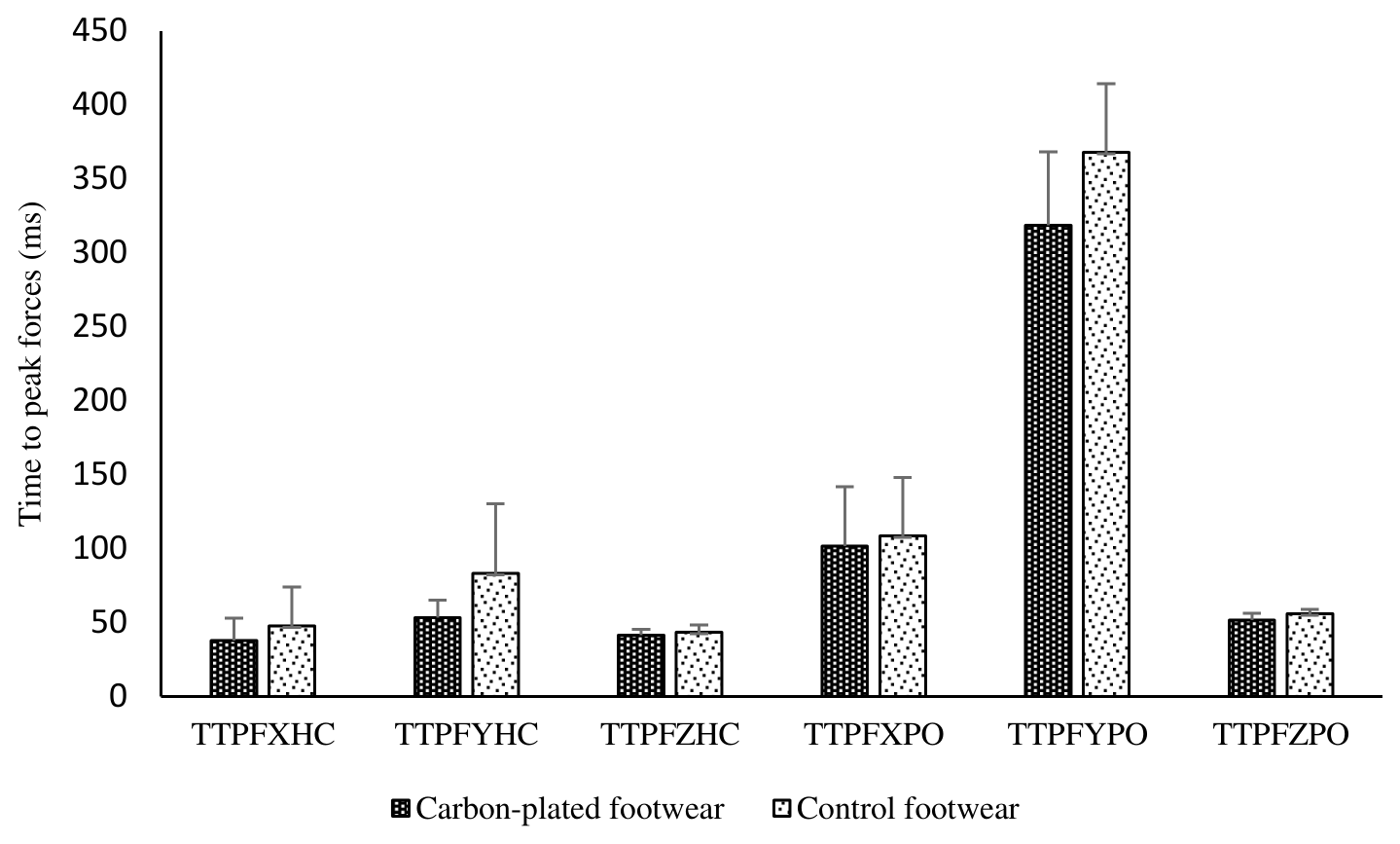
The results showed no significant differences in the demographic characteristics of the two groups (Table 1). As shown in Table 2, significant between-group differences were observed in peak medial-lateral force (p =0.04, d = 1.16) and anterior–posterior force (p=0.01, d = 0.99) during heel contact. Additionally, the time to peak anterior–posterior force during heel contact was significantly greater in the carbon-plated footwear group than in the conventional footwear group (p = 0.02, d = 0.872). In contrast, statistical analyses during push-off revealed significant increases in peak vertical force (p = 0.02, d = 0.906), time to peak anterior–posterior force (p = 0.009, d = 1.027), and time to peak vertical force (p = 0.006, d = 1.098) in the carbon-plated footwear group compared with the conventional footwear group (Fig. 1).
Discussion
The aim of the present study was to investigate the effects of carbon-plated footwear on GRF components in runners with pronation abnormalities. The findings showed that carbon-plated footwear was associated with differences in selected kinetic patterns during walking, particularly in variables related to loading and push-off. The main findings included a longer time to peak anterior–posterior force during heel contact, differences in medial-lateral and anterior-posterior forces, and, during push-off, a greater vertical force and longer times to peak anterior–posterior and vertical forces. One of the main findings was the longer time to peak anterior–posterior force during heel contact. This variable provides information about the temporal development of force during foot contact with the ground. A longer time to peak force may indicate that the force reaches its maximum later during the contact phase; however, this finding alone does not establish that loading occurs more gradually or that mechanical stress on the lower extremity is reduced (36). The longer time to peak anterior–posterior force during the heel contact phase observed in the present study is consistent with the broader literature examining the effects of footwear design on force transmission and lower-limb biomechanics (37). Because runners with pronation abnormalities may demonstrate differences in lower-limb mechanics, the temporal changes observed with carbon-plated footwear may be relevant to understanding footwear-related loading patterns. Nevertheless, further research is needed to determine whether these changes are associated with reductions in mechanical stress
Fig. 1. Comparison of time to peak ground reaction force components (ms) between carbon plate footwear and control footwear.
on lower-extremity tissues (38). The results also showed that carbon-plated footwear was associated with a lower absolute anterior–posterior force during heel contact. This component represents the braking force applied to the body when the foot contacts the ground. The less negative values observed with carbon-plated footwear indicate a reduction in the magnitude of this braking force. Such a difference may reflect a change in the interaction between the foot, shoe, and ground during initial contact. However, the present study did not directly assess movement efficiency or energy expenditure. Therefore, it cannot be concluded that the lower braking-force magnitude improved movement efficiency or reduced energy loss. Previous research has examined relationships between footwear characteristics, mechanical loading, and running economy, although the implications of these findings for walking remain uncertain (2, 27). Another finding was the difference in vertical force during heel contact. Although the mean vertical force was numerically higher in the carbon-plated footwear group, the difference did not reach statistical significance (p = 0.05). Therefore, this result should not be interpreted as evidence of a significant increase in vertical force during heel contact. More broadly, force magnitude and time to peak force represent different aspects of GRF behavior, and neither measure alone is sufficient to determine the mechanical loading experienced by specific tissues. Consequently, conclusions about force absorption, redistribution, or injury risk require additional biomechanical evidence (2, 6). The findings during push-off showed that the times to peak anterior–posterior and vertical forces were significantly longer with carbon-plated footwear. These differences suggest that the timing of force development during this phase varied between the footwear conditions. This may be related to differences in the mechanical properties of the shoes, including longitudinal bending stiffness and midsole construction. Previous research has investigated how carbon-plated footwear affects running biomechanics and the mechanical characteristics of the foot–shoe system (39). However, the present study did not directly measure energy storage or return; therefore, the longer times to peak force cannot be taken as direct evidence of more effective energy utilization or improved movement performance. Further research incorporating direct measurements of energy expenditure and foot–shoe mechanics is needed to clarify the mechanisms underlying these differences. Peak vertical force during push-off was also significantly greater in the carbon-plated footwear group. This finding may indicate that the footwear conditions were associated with differences in vertical force production during the push-off phase. Increased longitudinal bending stiffness and changes in the lever function of the foot have been proposed as potential mechanisms through which carbon-plated footwear may influence lower-limb mechanics (7). Nevertheless, a greater peak vertical force does not necessarily indicate improved propulsion or increased injury risk. Moreover, previous studies have reported inconsistent findings concerning peak vertical force and other biomechanical outcomes in carbon-plated footwear (6, 7, 26). These differences may be related to variations in movement speed, footwear design, participant characteristics, and foot structure. Because all participants in the present study had pronation abnormalities, the findings should be interpreted within the characteristics of this specific population. The present study also identified a significant difference in peak mediolateral force during heel contact. This finding indicates that the mediolateral component of the GRF differed between the footwear groups at initial contact. However, the clinical significance of this difference remains uncertain. Previous studies have examined the relationships between foot posture, lower-limb mechanics, and GRF characteristics during walking, as well as the effects of interventions targeting foot mechanics (40, 41). Differences in participant characteristics and experimental protocols may contribute to variation across studies. Pronation-related biomechanical characteristics may be relevant to the interpretation of footwear responses, but the present study did not include participants with normal foot posture. Therefore, it cannot establish whether these findings are specific to runners with pronated feet or whether foot posture modifies the response to footwear design. This study had several limitations. First, the participants were recreational runners with pronation abnormalities; therefore, the findings should be generalized cautiously to competitive runners, individuals without pronation, and other populations. Second, only one carbon-plated shoe model and one conventional shoe model without a plate were examined. Consequently, the findings cannot be generalized to all carbon-plated footwear, and the observed differences cannot be attributed exclusively to the carbon-fiber plate because shoe geometry, midsole construction, bending stiffness, and other design characteristics may also affect biomechanical responses. Third, the assessment was conducted under laboratory conditions during walking; therefore, the findings may not represent biomechanical responses during natural running or prolonged activity. In addition, the study examined acute responses to footwear and did not evaluate the effects of long-term adaptation.
Conclusion
Overall, carbon-fiber plated footwear was associated with changes in GRF patterns in runners with pronated feet. Longer time to peak force during heel contact may indicate more gradual loading, whereas increased shear and vertical forces during push-off may increase mechanical demands on foot and ankle stabilizing structures. These findings highlight the importance of considering individual foot biomechanics when prescribing carbon-fiber plated footwear.
Ethical Considerations
Compliance with ethical guidelines
This study was approved by the Ethics Committee of the University of Mohaghegh Ardabili, Ardabil, Iran (IR.UMA.REC.1401.081). Written informed consent was obtained from all participants prior to participation.
Funding
This research received no specific grant from any funding agency in the public, commercial, or not-for-profit sectors.
Authors' contributions
Mohsen Barghamadi: Conceptualization, Methodology, Formal analysis, Supervision, Writing – original draft, Writing – review & editing. Ladan Barzegarfar and Ebrahim Piri: Conceptualization, Methodology, Writing – original draft, Writing – review & editing. Saleh Barghamadi: Investigation, Project administration, Writing – review & editing. All authors read and approved the final version of the manuscript.
Conflicts of interest
The authors declare no conflict of interest.
Type of Study: Research |
Subject:
Special
Received: 2026/06/30 | Accepted: 2026/10/1 | Published: 2026/10/10
Received: 2026/06/30 | Accepted: 2026/10/1 | Published: 2026/10/10
References
1. Xiao X, Lian A, Li Z, Fan Y. Trends and hotspots in running shoe research: a bibliometric study from 2005 to 2024. Frontiers in Sports and Active Living. 2025;7:1609141. [DOI:10.3389/fspor.2025.1609141]
2. Ortega JA, Healey LA, Swinnen W, Hoogkamer W. Energetics and biomechanics of running footwear with increased longitudinal bending stiffness: a narrative review. Sports Medicine. 2021;51(5):873-894. [DOI:10.1007/s40279-020-01406-5]
3. Xu Y, Zhu C, Fang Y, Lu Z, Song Y, Hu C, et al. The effects of different carbon-fiber plate shapes in shoes on lower limb biomechanics following running-induced fatigue. Frontiers in Bioengineering and Biotechnology. 2025;13:1539976. [DOI:10.3389/fbioe.2025.1539976]
4. Bruvere DD, Bernans E. Mechanisms, economy, and performance of advanced footwear technology in endurance running: a review. Muscles. 2025;5(1):2. [DOI:10.3390/muscles5010002]
5. Guinness J, Bhattacharya D, Chen J, Chen M, Loh A. An observational study of the effect of Nike Vaporfly shoes on marathon performance. arXiv. 2020;2002.06105.
6. Madden R, Sakaguchi M, Tomaras EK, Wannop JW, Stefanyshyn D. Forefoot bending stiffness, running economy and kinematics during overground running. Footwear Science. 2016;8(2):91-98. [DOI:10.1080/19424280.2015.1130754]
7. Flores N, Rao G, Berton E, Delattre N. The stiff plate location into the shoe influences the running biomechanics. Sports Biomechanics. 2021;20(7):815-830. [DOI:10.1080/14763141.2019.1607541]
8. Healey LA, Hoogkamer W. Longitudinal bending stiffness does not affect running economy in Nike Vaporfly shoes. Journal of Sport and Health Science. 2022;11(3):285-292. [DOI:10.1016/j.jshs.2021.07.002]
9. Hsu CY, Wang CS, Lin KW, Chien MJ, Wei SH, Chen CS. Biomechanical analysis of the flatfoot with different 3D-printed insoles on the lower extremities. Bioengineering. 2022;9(10):563. [DOI:10.3390/bioengineering9100563]
10. Menz HB, Dufour AB, Riskowski JL, Hillstrom HJ, Hannan MT. Association of planus foot posture and pronated foot function with foot pain: the Framingham Foot Study. Arthritis Care & Research. 2013;65(12):1991-1999. [DOI:10.1002/acr.22079]
11. Kruger KM, Graf A, Flanagan A, McHenry BD, Altiok H, Smith PA, et al. Segmental foot and ankle kinematic differences between rectus, planus, and cavus foot types. Journal of Biomechanics. 2019;94:180-186. [DOI:10.1016/j.jbiomech.2019.07.032]
12. Tong JW, Kong PW. Association between foot type and lower extremity injuries: systematic literature review with meta-analysis. Journal of Orthopaedic & Sports Physical Therapy. 2013;43(10):700-714. [DOI:10.2519/jospt.2013.4225]
13. Piri E, Jafarnezhadgero A, Stålman A, Alihosseini S, Panahighaffarkandi Y. Comparison of the ground reaction force frequency spectrum during walking with and without anti-pronation insoles in individuals with pronated feet. Journal of Sport Biomechanics. 2025;11(1):20-33. [DOI:10.61186/JSportBiomech.11.1.20]
14. Sabouri L, Piri E, Jafarnezhadgero AA. Biomechanics of transitional movements in individuals with pronated feet: a review study. Journal of Sport Biomechanics. 2025;11(3):270-287. [DOI:10.61882/JSportBiomech.11.3.270]
15. Sabouri L, Piri E. Effects of training interventions on walking and running mechanics in individuals with pronated feet: a systematic review. Journal of Sport Biomechanics. 2026;12(2):242-263. [DOI:10.66224/JSportBiomech.12.2.242]
16. Keenan M, Peabody T, Gronley J, Perry J. Valgus deformities of the feet and characteristics of gait in patients who have rheumatoid arthritis. The Journal of Bone and Joint Surgery. American Volume. 1991;73(2):237-247. [DOI:10.2106/00004623-199173020-00012]
17. Piri E, Sobhani V, Jafarnezhadgero AA, Shamsoddini A, Arabzadeh E, Alihosseini S. Double-density foot orthoses altered ground reaction force characteristics and the lower limb muscular activities in adults with pronated feet during walking: a clinical trial study. Trauma Monthly. 2026;31(1):1666-1675. [DOI:10.1186/s13102-025-01095-5]
18. Terada M, Wittwer AM, Gribble PA. Intra-rater and inter-rater reliability of the five image-based criteria of the Foot Posture Index-6. International Journal of Sports Physical Therapy. 2014;9(2):187-194.
19. McFadden C, Daniels KA, Strike S. Six methods for classifying lower-limb dominance are not associated with asymmetries during a change of direction task. Scandinavian Journal of Medicine & Science in Sports. 2022;32(1):106-115. [DOI:10.1111/sms.14054]
20. Yang J, Ou Z, Mao Z, Wang Y, Zhong Y, Dong W, et al. Reliability and validity of Foot Posture Index (FPI-6) for evaluating foot posture in participants with low back pain. Scientific Reports. 2022;12(1):21168. [DOI:10.1038/s41598-022-22220-1]
21. Farahpour N, Jafarnezhadgero A, Allard P, Majlesi M. Muscle activity and kinetics of lower limbs during walking in pronated feet individuals with and without low back pain. Journal of Electromyography and Kinesiology. 2018;39:35-41. [DOI:10.1016/j.jelekin.2018.01.006]
22. Song Q, Sun M, Lewis K, Choi JH, Manor B, Li L. Hoffmann reflex measured from lateral gastrocnemius is more reliable than from soleus among elderly with peripheral neuropathy. Frontiers in Aging Neuroscience. 2022;14:800698. [DOI:10.3389/fnagi.2022.800698]
23. Veras L, Oliveira D, Diniz-Sousa F, Boppre G, Resende-Coelho A, Oliveira J, et al. External validation of accelerometry-based mechanical loading prediction equations. Applied Sciences. 2024;14(22):10292. [DOI:10.3390/app142210292]
24. Valizadeorang A, Ghorbanlou F, Jafarnezhadgero A, Alipoor Sarinasilou M. Effect of knee brace on frequency spectrum of ground reaction forces during landing from two heights of 30 and 50 cm in athletes with anterior cruciate ligament injury. The Scientific Journal of Rehabilitation Medicine. 2019;8(2):159-168.
25. Di Nardo F, Romanato M, Spolaor F, Volpe D, Fioretti S, Sawacha Z. Simplified muscle-recruitment strategy during walking in Parkinson's disease people: a time-frequency analysis of EMG signal. IRBM. 2023;44(6):100798. [DOI:10.1016/j.irbm.2023.100798]
26. Merletti R, Vieira TM, Farina D. Techniques for information extraction from the surface EMG signal: high-density surface EMG. In: Merletti R, Farina D, editors. Surface Electromyography: Physiology, Engineering, and Applications. Hoboken, NJ: Wiley; 2016. p. 126-157. [DOI:10.1002/9781119082934.ch05]
27. Souza TR, Pinto RZ, Trede RG, Kirkwood RN, Fonseca ST. Temporal couplings between rearfoot-shank complex and hip joint during walking. Clinical Biomechanics. 2010;25(7):745-748. [DOI:10.1016/j.clinbiomech.2010.04.012]
28. Neal BS, Griffiths IB, Dowling GJ, Murley GS, Munteanu SE, Franettovich Smith MM, et al. Foot posture as a risk factor for lower limb overuse injury: a systematic review and meta-analysis. Journal of Foot and Ankle Research. 2014;7(1):55. [DOI:10.1186/s13047-014-0055-4]
29. Dowling GJ, Murley GS, Munteanu SE, Smith MMF, Neal BS, Griffiths IB, et al. Dynamic foot function as a risk factor for lower limb overuse injury: a systematic review. Journal of Foot and Ankle Research. 2014;7(1):53. [DOI:10.1186/s13047-014-0053-6]
30. Day E, Hahn M. Optimal footwear longitudinal bending stiffness to improve running economy is speed dependent. Footwear Science. 2020;12(1):3-13. [DOI:10.1080/19424280.2019.1696897]
31. McLeod AR, Bruening D, Johnson AW, Ward J, Hunter I. Improving running economy through altered shoe bending stiffness across speeds. Footwear Science. 2020;12(2):79-89. [DOI:10.1080/19424280.2020.1734870]
32. Shih YF, Chen CY, Chen WY, Lin HC. Lower extremity kinematics in children with and without flexible flatfoot: a comparative study. BMC Musculoskeletal Disorders. 2012;13:31. [DOI:10.1186/1471-2474-13-31]
33. Lavcanska V, Taylor NF, Schache AG. Familiarization to treadmill running in young unimpaired adults. Human Movement Science. 2005;24(4):544-557. [DOI:10.1016/j.humov.2005.08.001]
34. McWalter EJ, Cibere J, MacIntyre NJ, Nicolaou S, Schulzer M, Wilson DR. Relationship between varus-valgus alignment and patellar kinematics in individuals with knee osteoarthritis. The Journal of Bone and Joint Surgery. American Volume. 2007;89(12):2723-2731. [DOI:10.2106/JBJS.F.01016]
35. Howard CK, Rhea CK, Moxey JR, Langerhans K, Prupetkaew P, Samulski BS. How many trials are needed for consistent clinical gait assessment? Applied Sciences. 2025;15(23):12740. [DOI:10.3390/app152312740]
36. Barghamadi M, Shokrzadehsarebanlar M, Nosratihashi A, Piri E, Imani F. Effects of arch support insole on vertical GRF variables and time to peak among handball players with pronated foot during jump and landing three-step shot technique. Journal of Paramedical Sciences & Rehabilitation. 2023;12(1):53-62.
37. Cohen J. A power primer. Psychological Bulletin. 1992;112(1):155-159. [DOI:10.1037/0033-2909.112.1.155]
38. Winter DA. Biomechanics and Motor Control of Human Movement. 4th ed. Hoboken, NJ: Wiley; 2009. [DOI:10.1002/9780470549148]
39. Hunter I, Bradshaw C, McLeod A, Ward J, Standifird T. Energetics and biomechanics of uphill, downhill and level running in highly-cushioned carbon fiber midsole plated shoes. Journal of Sports Science & Medicine. 2022;21(1):127-130. [DOI:10.52082/jssm.2022.127]
40. Nigg BM, Mohr M, Nigg SR. Muscle tuning and preferred movement path: a paradigm shift. Current Issues in Sport Science. 2017;2:007. [DOI:10.15203/CISS_2017.007]
41. Hoogkamer W, Kipp S, Kram R. The biomechanics of competitive male runners in three marathon racing shoes: a randomized crossover study. Sports Medicine. 2019;49(1):133-143. [DOI:10.1007/s40279-018-1024-z]
| Rights and permissions | |
 |
This work is licensed under a Creative Commons Attribution-NonCommercial 4.0 International License. |

Journal of Sport Biomechanics
Department of Sport Biomechanics, Faculty of Humanities, Islamic Azad University, Hamedan Branch, Prof. Mousivand Blvd, Imam Khomeini Blvd, Hamedan, Iran.
Journal Tel: +98 81 34494042
Website: http://biomechanics.iauh.ac.ir
Email: sportbiomechanics@iauh.ac.ir
