

Volume 12, Issue 4 (2-2027)
J Sport Biomech 2027, 12(4): 732-755 |
Back to browse issues page




Download citation:
BibTeX | RIS | EndNote | Medlars | ProCite | Reference Manager | RefWorks
Send citation to:


BibTeX | RIS | EndNote | Medlars | ProCite | Reference Manager | RefWorks
Send citation to:
Ali Hassan M F, Abdulkareem O W, Ali L S. Effects of High-Intensity Plyometric Training on Force-Time Characteristics During Volleyball Spike and Block Jumps. J Sport Biomech 2027; 12 (4) :732-755
URL: http://biomechanics.iauh.ac.ir/article-1-547-en.html
URL: http://biomechanics.iauh.ac.ir/article-1-547-en.html


1- Physical Education and Sports Sciences College, Baghdad University, Baghdad, Iraq.
Full-Text [PDF 1887 kb]
(12 Downloads)
| Abstract (HTML) (43 Views)

Full-Text: (11 Views)
Introduction
The performance of volleyball athletes depends greatly on their ability to perform explosive actions such as spike and block jumps, which require rapid force production and effective application of vertical ground reaction forces (vGRFs). From a biomechanical perspective, the analysis of force-time characteristics provides information about both the magnitude and timing of force application during explosive movements. In volleyball, these characteristics are particularly relevant because spike and block jumps require athletes to generate substantial force within a limited time period (1). Previous research has demonstrated the importance of lower-limb force production and jumping biomechanics for volleyball performance, including the contribution of lower-limb kinetics to spike-jump performance (2–4).
Plyometric training has been widely used to improve jump performance, reactive strength, and the effectiveness of the stretch-shortening cycle in volleyball athletes (5–7). Previous studies have reported improvements in jumping ability and physical performance following plyometric interventions; however, many investigations have emphasized outcome measures such as jump height, power, or peak force rather than the temporal characteristics of force production (8,9). Rate of force development (RFD) provides information about how rapidly force is generated, whereas time to peak force (TPF) reflects the time required to reach peak force. These force-time variables may therefore provide additional information about explosive force-production characteristics that cannot be captured by jump height or peak force alone. Although plyometric training has been shown to improve general jumping performance in volleyball players (10–12), limited evidence is available regarding changes in force-time characteristics during volleyball-specific spike and block jumps following high-intensity plyometric training (HPT).
Recent advances in sports biomechanics have emphasized the value of force-time analysis for examining the magnitude and temporal characteristics of force application during explosive movements (13,14). Spike and block jumps also differ in their initial movement configurations. A spike jump typically involves an approach phase before take-off, whereas a block jump is performed from a stationary bilateral stance. These differences provide distinct movement contexts in which force-time characteristics can be examined. The extent to which a structured HPT program influences peak force (PF), RFD, and TPF during these two volleyball-specific jumping tasks remains insufficiently documented.
The present study examined the effects of an 8-week HPT program on the force-time characteristics of vGRFs during volleyball spike and block jumps. The primary novelty of the study was the simultaneous assessment of three complementary force-time variables—PF, RFD, and TPF—during two sport-specific volleyball jumping tasks following a standardized HPT intervention. This approach provides a more detailed characterization of changes in force-production characteristics than assessments based solely on jump height or peak force (15,16). Based on these objectives, it was hypothesized that HPT would significantly increase PF and RFD while concurrently decreasing TPF during both volleyball spike and block jumps.
The scientific significance of this study lies in its contribution to sport biomechanics and strength and conditioning research by providing detailed information about HPT-related changes in force-time characteristics during volleyball-specific jumping tasks. Examining both the magnitude and timing of force production may provide additional information for evidence-based training design and task-specific programming in volleyball players (8,13).
Methods
Research Design
A randomized controlled pretest-posttest design was used to examine the effects of an 8-week HPT program on the force-time characteristics of vGRFs. Participants were randomly allocated to either the EG, which received the HPT intervention in addition to regular volleyball training, or the CG, which maintained its regular training regimen. The independent variable was the training protocol (HPT plus regular training vs. regular training), whereas the dependent variables were PF, RFD, and TPF during volleyball spike and block jumps. Following eligibility screening and baseline assessments, the 40 participants were randomly assigned in equal proportions to either the EG (n = 20) or the CG (n = 20) using a simple lottery-based allocation procedure. Each participant had an equal probability of allocation to either study group. The assessor conducting the baseline and post-intervention assessments was unaware of the participants’ group assignments at the time of testing, thereby minimizing the possibility of assessment bias. The study included 40 eligible participants, with 20 allocated to each group. An a priori power analysis was not performed before data collection. The sample size was based on the number of eligible participants available during the recruitment period and the predefined inclusion and exclusion criteria. All 40 participants completed the 8-week intervention and post-test assessments, with no dropout or loss to follow-up.
Participants
Forty physically active male undergraduate students from the College of Physical Education and Sport Sciences, University of Baghdad, participated in the study. Participants were classified as recreational volleyball players because they were not professional or elite athletes, although they were members of a university volleyball team and participated in formal volleyball competitions. Their ages ranged from 19 to 22 years. The inclusion criteria were at least one year of regular volleyball participation and the absence of a lower-extremity injury during the previous six months. Participants were excluded if they had a chronic musculoskeletal condition or were unable to safely perform the spike and block jump tasks. All participants provided informed consent before participation. The study protocol was approved by the Institutional Review Board (IRB) of the College of Physical Education and Sport Sciences, University of Baghdad (Approval Code: IRB-PESS-2026-05). The sample included five volleyball playing positions: setters, middle blockers, outside hitters, opposites, and liberos. Each position was equally represented, with eight players in each position across the total sample. Following random allocation, each study group included four setters, four middle blockers, four outside hitters, four opposites, and four liberos. The EG and CG were therefore balanced with respect to playing position, with each group comprising 20 participants. Participants had approximately two years of volleyball experience and regularly participated in volleyball training and formal university-level competitions. They also had experience with resistance/weight training as part of their usual physical preparation before and during the study period. The resistance training component was not part of the experimental intervention and was maintained as part of their usual training activities. Throughout the 8-week intervention, both groups maintained their standard volleyball training schedule, consisting of three sessions per week of approximately 90 minutes each, with an emphasis on technical and tactical volleyball skills. The EG supplemented this routine with the HPT program, whereas the CG followed the same regular volleyball training schedule without receiving the additional plyometric intervention. After eligibility screening and completion of the baseline procedures, participants were assigned equally to the EG (n = 20) and the CG (n = 20) using a simple lottery-based randomization procedure. The assessor responsible for conducting the baseline and post-intervention assessments remained blinded to the participants’ group allocation before each assessment. All 40 participants completed the 8-week intervention and post-test assessments, with no dropout or loss to follow-up. Participants were randomly assigned to two groups: an EG (n = 20) that underwent HPT and a CG (n = 20) that continued their regular volleyball training. No significant differences were found between groups in baseline characteristics (p > 0.05), as shown in Table 1.
Equipment and Measurement Tools
vGRFs were collected using a calibrated force platform (model OR6-7, AMTI, Watertown, MA, USA) securely embedded in and flush with the laboratory floor. Analog signals from the platform were sampled at a frequency of 1000 Hz using a data acquisition system and stored for subsequent offline analysis. Before each testing session, the force platform was calibrated according to the
Table 1. Baseline Characteristics (Mean ± SD) of the Experimental and Control Groups (n = 40)
Note. * = non-significant at p< 0.05
manufacturer's instructions to ensure signal accuracy and linearity.Participants performed two distinct volleyball-specific jumping tasks: the spike jump (with a three-step approach) and the block jump (from a stationary bilateral position). For the spike jump, participants were instructed to use a standard three-step approach, plant both feet simultaneously on the center of the force platform to ensure accurate force capture, and execute a maximal vertical jump simulating an attack hit while swinging both arms vigorously upward (17). For the block jump, participants started in an athletic stance with their feet shoulder-width apart on the platform, performed a rapid self-selected countermovement, and executed a maximal vertical jump with both arms reaching upward to simulate a defensive block (17).
The sequence of the two jumping tasks was randomized to reduce potential effects related to test order and fatigue. Participants performed three maximal-effort trials. A standardized rest interval was provided between trials to limit fatigue and maintain maximal neuromuscular performance during the explosive efforts (18). If a participant stepped off the platform during the jump or demonstrated improper technique, the trial was discarded and immediately repeated. The mean value of the three successful trials was calculated and used for subsequent statistical analysis. Before data collection, all participants completed a standardized 10-minute dynamic warm-up consisting of light jogging, lower-limb dynamic stretching, and familiarization jumps performed at submaximal intensity. For the analysis of force-time characteristics, force onset was identified manually from the vertical ground reaction force-time curve using the participant's baseline standing force as the reference. Baseline force was determined from the quiet-standing period recorded before each jumping task. The same manual identification procedure was applied consistently across all participants, jumping tasks, and measurement occasions. The analyst responsible for extracting the force-time variables was blinded to the participants’ group allocation and measurement time (pretest or posttest) to minimize potential measurement bias.
Procedures
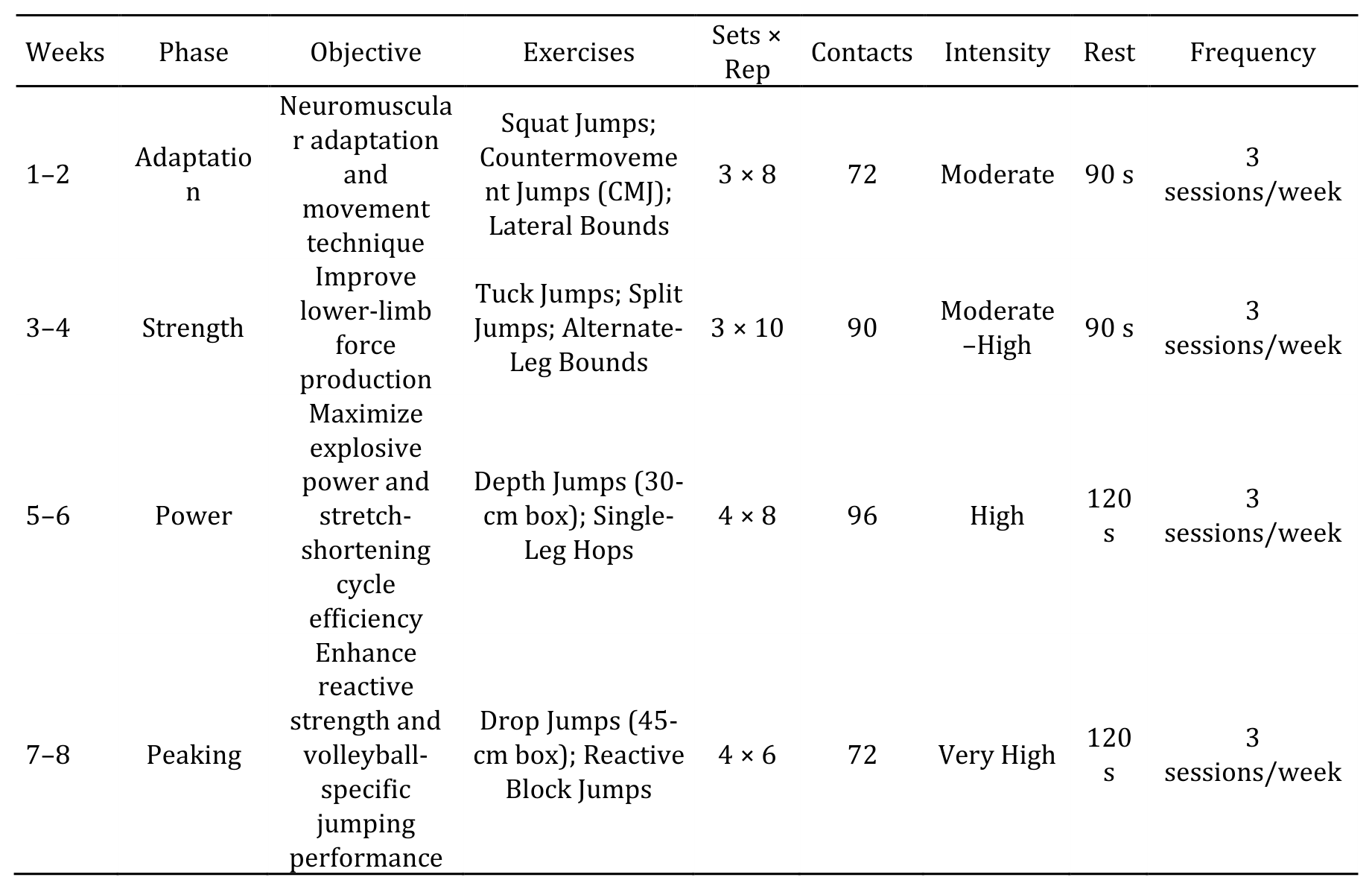
Throughout the 8-week intervention, the EG maintained its regular volleyball training schedule, which comprised three weekly sessions focused on technical and tactical development, while additionally completing the HPT program. Each regular volleyball session lasted approximately 90 minutes. The CG continued with its usual volleyball training without receiving the supplementary HPT intervention. Plyometric sessions were scheduled on nonconsecutive days (Monday, Wednesday, and Friday) to provide sufficient recovery between training sessions and were conducted under the supervision of qualified strength and conditioning staff. Each HPT session began with a 10-minute dynamic warm-up involving light jogging, dynamic stretching, and submaximal jumps, followed by approximately 35–40 minutes of plyometric training, and concluded with a 10-minute static-stretching cool-down. The HPT program was structured into four progressive two-week phases, as presented in Table 2. Progression was achieved by increasing the mechanical and neuromuscular demands of the exercises through changes in exercise complexity, jump height, unilateral loading demands, and reactive requirements. Rest intervals between sets were controlled at 90–120 seconds according to the training phase to provide adequate recovery between explosive sets. Adequate recovery between sets was maintained to support high-quality explosive performance throughout the training sessions (18). Phase 1 (Weeks 1–2; Adaptation) focused on neuromuscular adaptation, movement familiarization, and safe landing techniques. The exercises included basic bilateral movements such as squat jumps and countermovement jumps
Table 2. 8-Week HPT Program
Note. CMJ = countermovement jump. Training intensity was progressively increased according to the mechanical and neuromuscular demands of the exercises, including exercise complexity, jump height, unilateral loading demands, and reactive requirements. Ground-contact values represent the HPT component only and do not include contacts generated during regular volleyball training.
(CMJ), performed with an emphasis on controlled landing mechanics and maximal vertical effort. Lateral bounds were also included to introduce multidirectional lower-limb loading. Phase 2 (Weeks 3–4; Strength) focused on increasing lower-limb force-production demands through more challenging plyometric exercises. The training included tuck jumps, split jumps, and alternate-leg bounds, with an emphasis on forceful take-off and controlled landing. Phase 3 (Weeks 5–6; Power) introduced higher-intensity stretch-shortening-cycle exercises. Depth jumps from a 30-cm box and single-leg hops were performed to increase the explosive and reactive demands of the training. For the depth jumps, participants stepped down from the box rather than jumping from it, landed bilaterally, and immediately performed a maximal vertical response with a rapid transition from landing to take-off. The use of depth-jump exercises was consistent with previously reported approaches for developing reactive and explosive lower-limb performance (19). Phase 4 (Weeks 7–8; Peaking) emphasized reactive strength and volleyball-specific jumping demands. Drop jumps from a 45-cm box and reactive block jumps were performed. Reactive block jumps involved a rapid maximal vertical jump following the preceding landing action, providing a task-specific stimulus related to the rapid jumping demands encountered during volleyball blocking (20).
The HPT volume ranged from approximately 216 to 288 ground contacts per week across the four phases. These values represented the HPT component only and did not include ground contacts generated during the participants’ regular volleyball training. The selected progression in plyometric volume was consistent with previously reported training approaches for developing explosive performance in trained athletes (21). All 20 participants assigned to the EG completed the prescribed 24 HPT sessions over the 8-week intervention, corresponding to a 100% adherence rate. No training-related adverse events or injuries were reported during the intervention, and no participant was lost to follow-up.
Data Analysis
All vGRF signals were filtered using a fourth-order, zero-phase Butterworth low-pass filter with a cutoff frequency of 20 Hz (22). From the filtered force-time curves, three primary dependent variables were extracted for both spike and block jumps: PF, defined as the maximum vertical force value during the propulsive phase; RFD, calculated as the average slope of the force-time curve from force onset to peak force (N/s); and TPF, representing the time elapsed from force onset to the achievement of PF (ms). Force onset was defined as the instant at which the vertical ground reaction force exceeded the baseline standing body weight by 5 standard deviations (SD) for at least 30 milliseconds, ensuring that the detected onset represented an actual change in force production rather than signal noise. Descriptive statistics (mean ± SD) were calculated for all variables. Data normality was assessed using the Shapiro-Wilk test, and homogeneity of variances was verified using Levene's test. To evaluate the effects of the intervention, a two-way mixed-design repeated-measures ANOVA (2 Groups [EG, CG] × 2 Times [Pretest, Posttest]) was conducted for each dependent variable. If a significant Time × Group interaction was found, post hoc pairwise comparisons with Bonferroni correction were performed. Effect sizes were calculated using ηp² and interpreted as small (0.01), medium (0.06), and large (0.14). Statistical significance was set at p < 0.05. All analyses were performed using SPSS (version 25.0, IBM Corp., USA).
Results
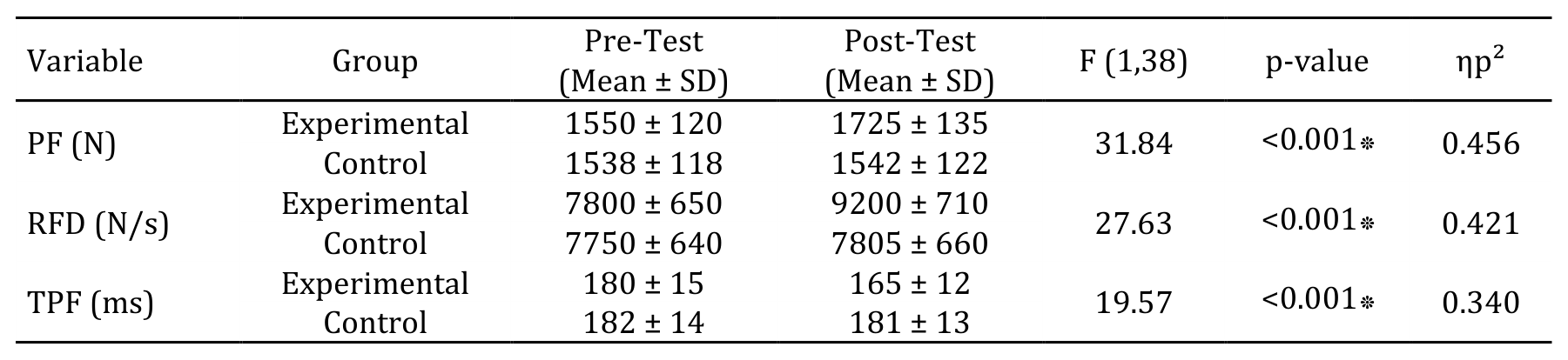
The effects of the 8-week HPT program on vGRF variables during the spike and block jump tests were analyzed using a two-way mixed-design repeated-measures analysis of variance (ANOVA), with Time as the within-subjects factor and Group as the between-subjects factor. The ANOVA revealed significant Time × Group interactions for all three variables in both jumping tasks. For the spike jump task (Table 3), significant Time × Group interactions were observed for PF, RFD, and TPF (p < 0.001). PF increased significantly in the EG following the intervention, whereas no significant change was observed in the CG (F(1,38) = 31.84, p < 0.001, ηp² = 0.456). RFD increased significantly in the EG, while no significant change was observed in the CG (F(1,38) = 27.63, p < 0.001, ηp² = 0.421). TPF decreased significantly in the EG, whereas no significant change was observed in the CG (F(1,38) = 19.57, p < 0.001, ηp² = 0.340).
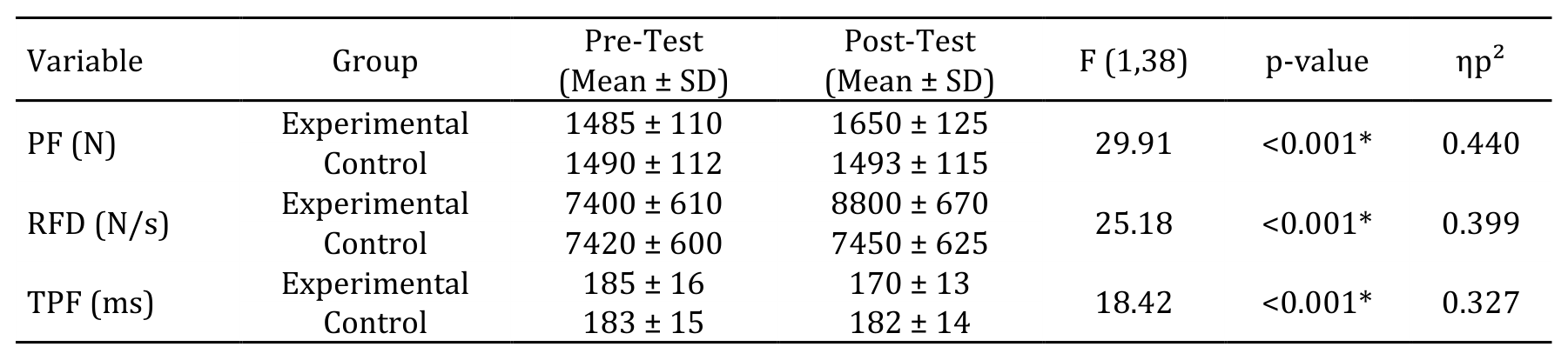
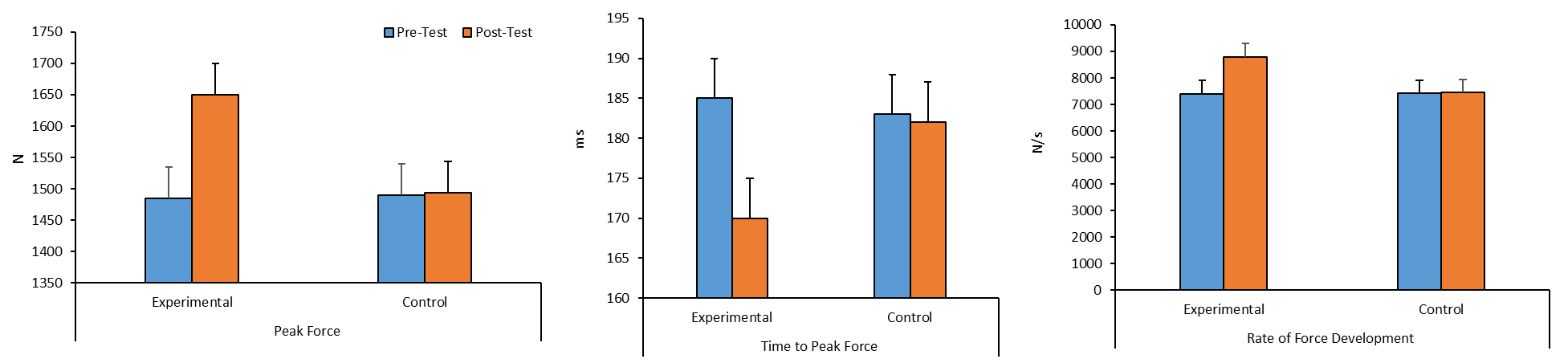
For the block jump task (Table 4), significant Time × Group interactions were also observed for PF, RFD, and TPF (p < 0.001). PF increased significantly in the EG following the intervention, whereas no significant change was observed in the CG (F(1,38) = 29.91, p < 0.001, ηp² = 0.440). RFD increased significantly in the EG, while no significant change was observed in the CG (F(1,38) = 25.18, p < 0.001, ηp² = 0.399). TPF decreased significantly in the EG, whereas no significant change was observed in the CG (F(1,38) = 18.42, p < 0.001, ηp² = 0.327). Fig. 1 presents the pretest and posttest values of PF, RFD, and TPF for the spike jump task in the EG and CG. In the EG, PF and RFD were higher at posttest than at pretest, whereas TPF was lower. The corresponding values in the CG remained relatively stable. Fig. 2 presents the same variables for the block jump task. In the EG, PF and RFD were higher at posttest than at pretest, whereas TPF was lower. The CG showed relatively stable values between the two measurement occasions.
Table 3. Two-Way Repeated-Measures ANOVA Results for Vertical Ground Reaction Force Variables in the Spike Jump Task
Note. * = significant at p<0.05.
Table 4. Two-Way Repeated-Measures ANOVA Results for Vertical Ground Reaction Force Variables in the Block Jump Task
Note. * = significant at p<0.05.
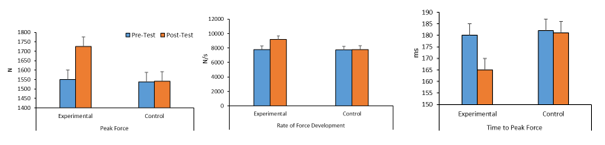
Fig. 1. Pre- and post-test comparisons of PF, RFD, and TPF during spike jumps for the EG and CG.
Fig. 2. Pre- and post-test comparisons of PF, RFD, and TPF during block jumps for the EG and CG.
Discussion
The main finding of this study was that the 8-week HPT intervention was associated with significant changes in the magnitude and temporal characteristics of vGRFs during volleyball-specific spike and block jumps. Consistent with the first hypothesis, participants in the EG demonstrated significant increases in PF and RFD, together with a significant reduction in TPF. Participants in the CG, who continued their regular volleyball training, did not demonstrate statistically significant changes in the examined variables. These findings suggest that the addition of HPT to regular volleyball training contributed to the observed changes in force-time characteristics in the present sample.
The higher PF recorded during both spike and block jumps suggests an enhanced ability to generate force during the jumping movement. Previous studies have indicated that plyometric training may influence neuromuscular properties, including motor unit recruitment, neural activation, and muscle-tendon stiffness (4,7). However, these mechanisms were not directly measured in the present study and should therefore be considered possible explanations rather than demonstrated adaptations. From a mechanical perspective, greater muscle-tendon stiffness has been associated
with more effective energy storage and return during the stretch-shortening cycle. The large effect sizes observed for PF (ηp² > 0.44) indicate substantial Time × Group interaction effects in the present sample. These findings suggest that the addition of HPT may produce changes in force-production characteristics beyond those observed during regular volleyball training (6).
The increased force production observed during the jumping tasks is also relevant to the biomechanical demands of volleyball spike and block movements. Although the present study focused on the propulsive phase, previous research has shown that landing characteristics and vGRFs can be influenced by neuromuscular fatigue in trained athletes (23,24). The present findings demonstrate improvements in force-production characteristics during the measured jumping tasks, but they do not establish whether these adaptations would improve landing mechanics or reduce the effects of fatigue. Future studies incorporating both take-off and landing kinetics could provide a more comprehensive assessment of the effects of HPT on the complete jump cycle.
From a temporal perspective, the increase in RFD observed in the EG is particularly relevant to volleyball because spike and block jumps require rapid force production. RFD describes the rate at which force is developed and is considered an important characteristic of explosive movements (25,26). Because force production during jumping occurs over a relatively short time interval, improvements in RFD may be functionally relevant to the rapid force-generation demands of volleyball movements. The increases in RFD observed in the present study are also consistent with previous evidence suggesting that plyometric training can improve explosive force-production characteristics and the utilization of the stretch-shortening cycle (8,14).
The decrease in TPF after the training period provides additional information regarding the temporal characteristics of force production during explosive jumping. This reduction indicates a shorter time required to reach PF during the jumping movement (27). From a mechanical perspective, the ability to generate high levels of force within a shorter period may be relevant to the development of take-off velocity (V₀), which is an important determinant of vertical displacement during jumping. However, take-off velocity and jump height were not directly assessed in the present study. Therefore, the findings should be interpreted as evidence of changes in force-time characteristics rather than direct evidence of improvements in jump height or flight time.
Changes in force-time characteristics were observed during both spike and block jumps despite differences in their initial movement configurations. In the spike jump, the approach phase involves horizontal movement before take-off, whereas the block jump begins from a stationary bilateral stance and emphasizes vertical force production. The significant changes in PF, RFD, and TPF in both tasks suggest that the HPT intervention was associated with improvements in force-time characteristics across these two volleyball-specific jumping conditions. However, because the statistical analysis did not include a direct Task × Time × Group interaction, it cannot be concluded that the magnitude of adaptation differed between spike and block jumps. The findings should therefore be interpreted as evidence of improvements across both tested tasks rather than differential task-specific adaptations.
This pattern is generally consistent with previous research indicating that plyometric training can produce broader neuromuscular adaptations (28). The present findings also complement studies examining both acute and chronic applications of plyometric and neuromuscular training approaches. For example, previous research has investigated acute interventions, such as PAP-based warm-ups, to influence upper-body striking velocity in combat sports (29), as well as longer-term training approaches targeting technical and kinematic performance in volleyball players (30). The present study extends this literature by examining changes in force-time characteristics during volleyball-specific spike and block jumps following an 8-week HPT intervention. However, the findings should be interpreted within the characteristics of the present sample and study design and should not be taken as evidence that HPT is superior to other training approaches or necessary for producing long-term kinetic adaptations.
Several limitations should be considered when interpreting the findings of this study. First, the study focused exclusively on kinetic variables derived from vGRF measurements and did not incorporate additional biomechanical variables, such as lower-limb joint angles, angular velocities, or joint moments. Therefore, the specific biomechanical mechanisms underlying the observed changes cannot be determined. Future studies should combine force-platform analysis with three-dimensional motion capture to provide a more comprehensive assessment of how HPT influences joint-level biomechanics during spike and block jumps. Second, the study did not directly measure maximal strength or neuromuscular mechanisms such as muscle activation. Consequently, conclusions regarding the relative importance of RFD versus maximal strength or changes in neuromuscular coordination cannot be established from the current data. Future research incorporating maximal-strength testing, electromyography, and other neuromuscular assessments may help clarify the mechanisms associated with changes in force-time characteristics. Third, although the study included an EG and a CG, it did not compare HPT with an alternative structured training program. Thus, the findings do not establish that HPT is superior to other forms of training or that conventional volleyball training is insufficient to produce similar adaptations. Comparative studies involving different training modalities would be valuable for determining the relative effects of HPT. Fourth, the findings are primarily applicable to the recreationally active male volleyball players included in this study and cannot necessarily be generalized to professional athletes, female players, or other populations. Future research should include larger and more heterogeneous samples, including female and professional volleyball players, to determine whether comparable force-time adaptations occur across different athlete populations. Finally, the present analysis was based on absolute kinetic values. Normalizing these variables to body mass could facilitate comparisons between athletes with different anthropometric characteristics. Future studies should consider reporting both absolute and body-mass-normalized force-time measures.
Based on the findings of this study, strength and conditioning coaches working with volleyball athletes may incorporate HPT programs to enhance rapid force-production characteristics. Exercises such as drop jumps and bounding can be introduced progressively according to athletes’ training status and the specific goals of the program. However, because the present study did not compare HPT with other training modalities or directly assess maximal strength, RFD should not be considered a substitute for maximal-strength development. Rapid force-production capacity may be developed alongside other relevant physical qualities. Practitioners may also consider using force-platform measurements, when available, to complement conventional performance assessments such as jump height. Force-time variables, including PF, RFD, and TPF, can provide additional information about force-production characteristics during jumping and may help practitioners monitor changes in explosive performance. These measures should be interpreted alongside other performance and training indicators rather than used as the sole indicators of athletic performance.
Conclusion
The 8-week HPT program was associated with significant changes in the kinetic and temporal characteristics of vGRFs during volleyball-specific spike and block jumps in the present sample. PF and RFD increased, whereas TPF decreased in the EG, with significant Time × Group interactions observed for all examined variables. These findings indicate improved force-time characteristics during the tested jumping tasks following the HPT intervention. However, the study did not directly assess maximal strength, neuromuscular mechanisms, or alternative training programs. Therefore, the findings do not establish that HPT is superior to other training approaches or that conventional volleyball training is insufficient to produce similar adaptations. The results provide biomechanical evidence supporting the consideration of HPT as a component of volleyball training programs aimed at developing explosive force-production characteristics.
Acknowledgements
The authors gratefully acknowledge all those who contributed to the successful completion of this study. Special thanks are extended to all participants for their valuable participation. The authors also sincerely thank the staff of the College of Physical Education and Sport Sciences at the University of Baghdad for their assistance and support throughout the study.
Ethical Considerations
Compliance with ethical guidelines
The study received ethical approval from the Institutional Review Board (IRB) of the College of Physical Education and Sport Sciences, University of Baghdad (Approval Code: IRB-PESS-2026-05). Written informed consent was obtained from all participants before their participation in the study. All study procedures were conducted in accordance with the principles of the Declaration of Helsinki, with appropriate measures taken to protect participants’ confidentiality and anonymity.
Funding
This research received no specific grant from any funding agency in the public, commercial, or not-for-profit sectors.
Authors' contributions
Moneer Fadel Ali Hassan: Conceived and designed the study, collected and statistically analyzed the data, and prepared the initial draft of the manuscript.
Omar Waleed Abdulkareem: Contributed to the study design, supervised data collection, reviewed the manuscript, and participated in its revision.
Linha Safaa Ali: Collected references, formatted the manuscript according to the journal's requirements, and assisted with manuscript editing.
All authors read and approved the final version of the manuscript.
Conflicts of interest
The authors declare no conflict of interest.
Use of Artificial Intelligence
No artificial intelligence was employed in preparing this manuscript.
Type of Study: Research |
Subject:
General
Received: 2026/07/15 | Accepted: 2026/10/12 | Published: 2026/10/15
Received: 2026/07/15 | Accepted: 2026/10/12 | Published: 2026/10/15
References
1. Hassan MFA, Abdulkareem OW. The effect of mental training on psychological hardiness and selected personality traits among adolescent male volleyball players. International Journal of Exercise Science. 2025;18(4):1186-1198. [DOI:10.70252/MQUH7716]
2. Ramachandran AK, Pedley JS, Moeskops S, Oliver JL, Myer GD, Hsiao HI, et al. Influence of neuromuscular training interventions on jump-landing biomechanics and implications for ACL injuries in youth females: a systematic review and meta-analysis. Sports Medicine. 2025;55(5):1265-1292. [DOI:10.1007/s40279-025-02190-w]
3. Ramirez-Campillo R, Sortwell A, Moran J, Afonso J, Clemente FM, Lloyd RS, et al. Plyometric-jump training effects on physical fitness and sport-specific performance according to maturity: a systematic review with meta-analysis. Sports Medicine - Open. 2023;9(1):23. [DOI:10.1186/s40798-023-00568-6]
4. Ramirez-Campillo R, García-de-Alcaraz A, Chaabene H, Moran J, Negra Y, Granacher U. Effects of plyometric jump training on physical fitness in amateur and professional volleyball: a meta-analysis. Frontiers in Physiology. 2021;12:636140. [DOI:10.3389/fphys.2021.636140]
5. Özdemir M, Kayantaş İ. Effect of plyometric training on vertical jump performance (a meta-analysis study). International Journal of Applied Exercise Physiology. 2020;9(7):90-100.
6. Weldon A, Duncan MJ, Turner A, Lockie RG, Loturco I. Practices of strength and conditioning coaches in professional sports: a systematic review. Biology of Sport. 2022;39(3):715-726. [DOI:10.5114/biolsport.2022.107480]
7. Silva AF, Clemente FM, Lima R, Nikolaidis PT, Rosemann T, Knechtle B. The effect of plyometric training in volleyball players: a systematic review. International Journal of Environmental Research and Public Health. 2019;16(16):2960. [DOI:10.3390/ijerph16162960]
8. Radnor JM, Oliver JL, Waugh CM, Myer GD, Moore IS, Lloyd RS. The influence of growth and maturation on stretch-shortening cycle function in youth. Sports Medicine. 2018;48(1):57-71. [DOI:10.1007/s40279-017-0785-0]
9. Gabbett TJ. The training-injury prevention paradox: should athletes be training smarter and harder? British Journal of Sports Medicine. 2016;50(5):273-280. [DOI:10.1136/bjsports-2015-095788]
10. James LP, Talpey SW, Stutter LR, Häkkinen K, Huynh M. The sensitivity of isometric versus ballistic measures of rapid force production following ballistic speed-strength training: a systematic review and meta-analysis. International Journal of Sports Physiology and Performance. 2025;20(12):1625-1635. [DOI:10.1123/ijspp.2025-0297]
11. Negra Y, Chaabene H, Sammoud S, Bouguezzi R, Mkaouer B, Hachana Y, et al. Effects of plyometric training on components of physical fitness in prepuberal male soccer athletes: the role of surface instability. Journal of Strength and Conditioning Research. 2017;31(12):3295-3304. [DOI:10.1519/JSC.0000000000002262]
12. Sun J, Sun J, Shaharudin S, Zhang Q. Effects of plyometrics training on lower limb strength, power, agility, and body composition in athletically trained adults: systematic review and meta-analysis. Scientific Reports. 2025;15(1):34146. [DOI:10.1038/s41598-025-10652-4]
13. Souaifi M, Dhahbi W, Jebabli N, Ceylan Hİ, Boujabli M, Muntean RI, et al. Artificial intelligence in sports biomechanics: a scoping review on wearable technology, motion analysis, and injury prevention. Bioengineering. 2025;12(8):887. [DOI:10.3390/bioengineering12080887]
14. Martín-Miguel I, Moreno-Martín A, Torrontegi-Ronco E, Montalvo-Zenarruzabeitia Z, de Rozas-Galán A. Principal component analysis of countermovement jump force-time variables for sex- and sport-specific profiling in elite athletes. International Journal of Sports Science & Coaching. 2026;0(0). [DOI:10.1177/17479541261459967]
15. Barrio ED, Thapa RK, Villanueva-Flores F, Garcia-Atutxa I, Santibañez-Gutierrez A, Fernández-Landa J, et al. Plyometric jump training exercise optimization for maximizing human performance: a systematic scoping review and identification of gaps in the existing literature. Sports. 2023;11(8):150. [DOI:10.3390/sports11080150]
16. Kons RL, Orssatto LBR, Ache-Dias J, De Pauw K, Meeusen R, Trajano GS, et al. Effects of plyometric training on physical performance: an umbrella review. Sports Medicine - Open. 2023;9(1):4. [DOI:10.1186/s40798-022-00550-8]
17. Makino M, Nakahara T, Nagakubo K, Ando Y, Tauchi K. Relationship between volleyball spike jump height and lower limb kinetics is stronger for orientation leg than rear leg. Sports Biomechanics. 2025;24(8):2406-2416. [DOI:10.1080/14763141.2025.2458491]
18. Haff GG, Nimphius S. Training principles for power. Strength & Conditioning Journal. 2012;34(6):2-12. [DOI:10.1519/SSC.0b013e31826db467]
19. Lin Y, Lu Z, Cen X, Thirupathi A, Sun D, Gu Y. The influence of different rope jumping methods on adolescents' lower limb biomechanics during the ground-contact phase. Children. 2022;9(5):721. [DOI:10.3390/children9050721]
20. Bobbert MF. Drop jumping as a training method for jumping ability. Sports Medicine. 1990;9(1):7-22. [DOI:10.2165/00007256-199009010-00002]
21. Radcliffe J. High-Powered Plyometrics. Champaign, IL: Human Kinetics; 2024.
22. Winter DA. Biomechanics and Motor Control of Human Movement. 4th ed. Hoboken, NJ: John Wiley & Sons; 2009. [DOI:10.1002/9780470549148]
23. Mohammad Zaheri R, Majlesi M, Fatahi A. Assessing the effects of fatigue on ground reaction force variations during landing after a spike in professional volleyball players. Journal of Sport Biomechanics. 2024;10(1):54-68. [DOI:10.61186/JSportBiomech.10.1.54]
24. Abdulkareem OW, Sattar Jabbar H. Comparative biomechanical analysis of three-point shooting between elite Iraqi basketball players and international counterparts. Journal of Sport Biomechanics. 2025;11(3):326-342. [DOI:10.61882/JSportBiomech.11.3.326]
25. Suchomel TJ, Nimphius S, Stone MH. The importance of muscular strength in athletic performance. Sports Medicine. 2016;46(10):1419-1449. [DOI:10.1007/s40279-016-0486-0]
26. Cormie P, McGuigan MR, Newton RU. Developing maximal neuromuscular power. Sports Medicine. 2011;41(2):125-146. [DOI:10.2165/11538500-000000000-00000]
27. Mohammed HM, Majed OM, Abdulkareem OW, Abdulhussein AA, Shehab GM, Kadhim MJ. Effects of an augmented motor reality-based training program on spatial awareness and skill-based decision making in youth basketball players. AIP Conference Proceedings. 2026:020019. [DOI:10.1063/12.0046265]
28. Atıcı M, Bayrakdar A. Effects of plyometric and agility-based training on physical performance in adolescent male volleyball players: a controlled experimental study. Pedagogy of Physical Culture and Sports. 2025;29(4):297-307. [DOI:10.15561/26649837.2025.0407]
29. Najafpour S, Fadaei H, Adigozali H, Rad AG. Effect of a post-activation potentiation-based plyometric warm-up on hand and pelvis linear velocity during the Gyaku-Zuki punch: a quasi-experimental study. Journal of Sport Biomechanics. 2026;12(3):372-382. [DOI:10.66224/JSportBiomech.12.3.372]
30. Hassan MFA, Abdulkareem OW. Effects of an integrated balance and muscle tension control training program on kinematic variables and defensive accuracy in volleyball players. Journal of Sport Biomechanics. 2026;11(4):438-464. [DOI:10.61882/JSportBiomech.11.4.438]
| Rights and permissions | |
 |
This work is licensed under a Creative Commons Attribution-NonCommercial 4.0 International License. |

Journal of Sport Biomechanics
Department of Sport Biomechanics, Faculty of Humanities, Islamic Azad University, Hamedan Branch, Prof. Mousivand Blvd, Imam Khomeini Blvd, Hamedan, Iran.
Journal Tel: +98 81 34494042
Website: http://biomechanics.iauh.ac.ir
Email: sportbiomechanics@iauh.ac.ir
