

Volume 12, Issue 3 (11-2026)
J Sport Biomech 2026, 12(3): 642-660 |
Back to browse issues page




Download citation:
BibTeX | RIS | EndNote | Medlars | ProCite | Reference Manager | RefWorks
Send citation to:


BibTeX | RIS | EndNote | Medlars | ProCite | Reference Manager | RefWorks
Send citation to:
Barghamadi M, Jabbar Ali M. The Effect of American Academy of Sports Medicine Exercises on Ground Reaction Forces During Walking in Individuals with Hamstring Tightness and Low Back Pain. J Sport Biomech 2026; 12 (3) :642-660
URL: http://biomechanics.iauh.ac.ir/article-1-555-en.html
URL: http://biomechanics.iauh.ac.ir/article-1-555-en.html


1- Department of Sports Biomechanics, Faculty of Educational Sciences and Psychology, University of Mohaghegh Ardabili, Ardabil, Iran.
Keywords: Walking, Ground reaction force, Hamstring tightness, Low back pain, Corrective exercise, Gait biomechanics
Full-Text [PDF 1796 kb]
(6 Downloads)
| Abstract (HTML) (16 Views)
Full-Text: (6 Views)
Extended Abstract
1. Introduction
Low back pain (LBP) is one of the most prevalent musculoskeletal disorders worldwide and is associated with disability, psychological consequences, and substantial socioeconomic costs (1–4). Individuals with LBP often demonstrate altered movement strategies, including impaired trunk motor control, changes in lower-limb kinematics, increased postural sway, altered center of pressure displacement, and reduced trunk muscle performance (5). These biomechanical adaptations may influence the distribution and regulation of external forces during functional activities such as walking. Walking requires coordinated interaction between the lower limbs and the trunk to effectively control external loads, including tensile, shear, and rotational forces (6, 7). Alterations in lower-limb mechanics and hip muscle function have been associated with low back disorders and may contribute to abnormal gait patterns in individuals with LBP (8–10). Previous studies have reported differences in ground reaction force characteristics, including force peaks, impulse, loading rate, and time to peak force, among individuals with LBP compared with healthy populations (11). Various exercise-based interventions, including general exercise programs, the McKenzie method, Pilates, core stabilization, and motor control exercises, have been investigated for improving movement impairments associated with LBP (12–15). Recently, corrective exercise approaches based on the National Academy of Sports Medicine (NASM) model have gained attention due to their emphasis on flexibility, muscle activation, and neuromuscular control. However, the effects of NASM-based corrective exercises on gait-related biomechanical variables, particularly ground reaction forces, remain unclear. Therefore, the present study aimed to investigate the effects of a NASM-based corrective exercise program on ground reaction forces during walking in individuals with hamstring tightness and low back pain.
2. Methods
This quasi-experimental laboratory study employed a pretest–posttest design with a control group. Based on previous studies and an a priori sample size estimation using G*Power software, 15 participants per group were considered sufficient to achieve a statistical power of 0.80 at a significance level of 0.05. Accordingly, 30 men aged 20–30 years were recruited through purposive sampling from patients with hamstring tightness and low back pain who were referred to public clinics and private centers in Ardabil, Iran. Participants were evaluated and diagnosed by an orthopedic specialist according to the inclusion and exclusion criteria. The participants were assigned to two groups: an experimental group consisting of individuals with hamstring tightness and low back pain, and a control group consisting of healthy individuals without low back pain or hamstring tightness. Inclusion criteria for both groups included male sex, age between 20 and 30 years, no participation in regular exercise programs during the previous six months, no involvement in competitive or professional sports, the ability to sit, stand, and walk independently without assistive devices, no history of musculoskeletal surgery in the trunk or lower extremities, and absence of neurological, musculoskeletal, or orthopedic disorders that could limit physical activity. Specific inclusion criteria for the experimental group included hamstring tightness confirmed by the Active Knee Extension (AKE) test and a history of low back pain lasting at least three months. The control group was required to have no history of low back pain and no hamstring tightness based on the AKE test. Participants were excluded if they had previously participated in structured rehabilitation programs for low back pain, used analgesic or anti-inflammatory medications during the intervention period, experienced injury, withdrew consent, or missed more than two consecutive training sessions. The study protocol was approved by the Ethics Committee of Mohaghegh Ardabili University (IR.UMA.REC.1403.090), and all participants provided written informed consent after receiving a complete explanation of the study procedures.
Hamstring tightness was assessed using the AKE test. Participants were positioned supine, and the examiner placed the hip in 90° flexion. Participants were instructed to actively extend the knee, and the knee extension angle was measured using a goniometer. The axis of the goniometer was aligned with the lateral femoral condyle, with the stationary arm aligned with the femur and the movable arm aligned with the lateral malleolus. The test was considered positive when participants reported a strong stretching sensation in the posterior thigh or knee before reaching the final 25° of knee extension.
The experimental group participated in an eight-week NASM corrective exercise program consisting of 24 training sessions (three sessions per week, 60 minutes per session), whereas the control group did not participate in any structured exercise program and maintained their usual daily activities. Participants in both groups were instructed to avoid additional exercise programs during the study period. The NASM program included diaphragmatic breathing, baby rock, prone on elbows, rolling, side lying and oblique sit exercises, tripod position, kneeling to squat, and Czech get-up exercises, which were progressively introduced according to the stages of the program.
Ground reaction force data were collected in the biomechanics laboratory of Ardabil using a Bertec force plate (40 × 60 cm). Participants walked along a 20-m walkway at a controlled speed of 2.3 m/s, with the force plate positioned in the middle of the walkway. Walking speed was monitored using a stopwatch to ensure consistency among trials. Ground reaction force signals were filtered using a fourth-order Butterworth low-pass filter with a cutoff frequency of 20 Hz. The analyzed variables included peak three-dimensional ground reaction forces, peak positive free moment, and time to peak values for the mediolateral (Fx), anteroposterior (Fy), and vertical (Fz) components. All force variables were normalized to body mass and expressed as a percentage of body weight. Data normality was assessed using the Shapiro–Wilk test, and homogeneity of variances was examined using Levene’s test. A two-way repeated-measures analysis of variance was used to evaluate the effects of time (pretest and posttest), group (experimental and control), and the time × group interaction. Bonferroni post hoc tests were performed when significant interactions were observed. Statistical significance was set at α < 0.05, and all analyses were conducted using SPSS version 26.
3. Results
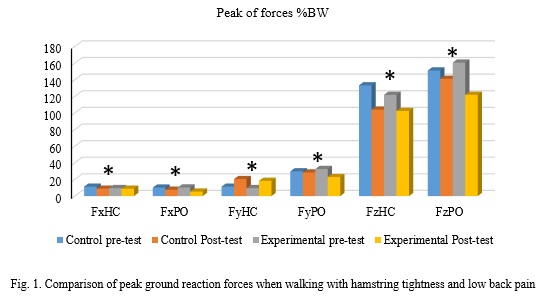
The results indicated a significant main effect of time on peak mediolateral ground-reaction forces at heel contact (p=0.024, d=0.201) and during the push-off phase (p=0.001, d=0.633). A significant main effect of time was also observed for peak anteroposterior ground-reaction forces at heel contact (p=0.011, d=0.249) and during push-off (p=0.001, d=0.533). Likewise, peak vertical ground-reaction forces showed a significant main effect of time at heel contact (p=0.001, d=0.459) and during push-off (p=0.002, d=0.496) (Fig. 1). A significant time × group interaction was found for peak anteroposterior ground-reaction force at heel contact (p=0.001, d=0.399) and for peak vertical ground-reaction force during push-off (p=0.010, d=0.254). Significant time × group interactions were also detected for time-to-peak of the anteroposterior ground-reaction force at heel contact (p=0.006, d=0.276) and for time-to-peak of the vertical ground-reaction force during push-off (p=0.016, d=0.224).
1. Introduction
Low back pain (LBP) is one of the most prevalent musculoskeletal disorders worldwide and is associated with disability, psychological consequences, and substantial socioeconomic costs (1–4). Individuals with LBP often demonstrate altered movement strategies, including impaired trunk motor control, changes in lower-limb kinematics, increased postural sway, altered center of pressure displacement, and reduced trunk muscle performance (5). These biomechanical adaptations may influence the distribution and regulation of external forces during functional activities such as walking. Walking requires coordinated interaction between the lower limbs and the trunk to effectively control external loads, including tensile, shear, and rotational forces (6, 7). Alterations in lower-limb mechanics and hip muscle function have been associated with low back disorders and may contribute to abnormal gait patterns in individuals with LBP (8–10). Previous studies have reported differences in ground reaction force characteristics, including force peaks, impulse, loading rate, and time to peak force, among individuals with LBP compared with healthy populations (11). Various exercise-based interventions, including general exercise programs, the McKenzie method, Pilates, core stabilization, and motor control exercises, have been investigated for improving movement impairments associated with LBP (12–15). Recently, corrective exercise approaches based on the National Academy of Sports Medicine (NASM) model have gained attention due to their emphasis on flexibility, muscle activation, and neuromuscular control. However, the effects of NASM-based corrective exercises on gait-related biomechanical variables, particularly ground reaction forces, remain unclear. Therefore, the present study aimed to investigate the effects of a NASM-based corrective exercise program on ground reaction forces during walking in individuals with hamstring tightness and low back pain.
2. Methods
This quasi-experimental laboratory study employed a pretest–posttest design with a control group. Based on previous studies and an a priori sample size estimation using G*Power software, 15 participants per group were considered sufficient to achieve a statistical power of 0.80 at a significance level of 0.05. Accordingly, 30 men aged 20–30 years were recruited through purposive sampling from patients with hamstring tightness and low back pain who were referred to public clinics and private centers in Ardabil, Iran. Participants were evaluated and diagnosed by an orthopedic specialist according to the inclusion and exclusion criteria. The participants were assigned to two groups: an experimental group consisting of individuals with hamstring tightness and low back pain, and a control group consisting of healthy individuals without low back pain or hamstring tightness. Inclusion criteria for both groups included male sex, age between 20 and 30 years, no participation in regular exercise programs during the previous six months, no involvement in competitive or professional sports, the ability to sit, stand, and walk independently without assistive devices, no history of musculoskeletal surgery in the trunk or lower extremities, and absence of neurological, musculoskeletal, or orthopedic disorders that could limit physical activity. Specific inclusion criteria for the experimental group included hamstring tightness confirmed by the Active Knee Extension (AKE) test and a history of low back pain lasting at least three months. The control group was required to have no history of low back pain and no hamstring tightness based on the AKE test. Participants were excluded if they had previously participated in structured rehabilitation programs for low back pain, used analgesic or anti-inflammatory medications during the intervention period, experienced injury, withdrew consent, or missed more than two consecutive training sessions. The study protocol was approved by the Ethics Committee of Mohaghegh Ardabili University (IR.UMA.REC.1403.090), and all participants provided written informed consent after receiving a complete explanation of the study procedures.
Hamstring tightness was assessed using the AKE test. Participants were positioned supine, and the examiner placed the hip in 90° flexion. Participants were instructed to actively extend the knee, and the knee extension angle was measured using a goniometer. The axis of the goniometer was aligned with the lateral femoral condyle, with the stationary arm aligned with the femur and the movable arm aligned with the lateral malleolus. The test was considered positive when participants reported a strong stretching sensation in the posterior thigh or knee before reaching the final 25° of knee extension.
The experimental group participated in an eight-week NASM corrective exercise program consisting of 24 training sessions (three sessions per week, 60 minutes per session), whereas the control group did not participate in any structured exercise program and maintained their usual daily activities. Participants in both groups were instructed to avoid additional exercise programs during the study period. The NASM program included diaphragmatic breathing, baby rock, prone on elbows, rolling, side lying and oblique sit exercises, tripod position, kneeling to squat, and Czech get-up exercises, which were progressively introduced according to the stages of the program.
Ground reaction force data were collected in the biomechanics laboratory of Ardabil using a Bertec force plate (40 × 60 cm). Participants walked along a 20-m walkway at a controlled speed of 2.3 m/s, with the force plate positioned in the middle of the walkway. Walking speed was monitored using a stopwatch to ensure consistency among trials. Ground reaction force signals were filtered using a fourth-order Butterworth low-pass filter with a cutoff frequency of 20 Hz. The analyzed variables included peak three-dimensional ground reaction forces, peak positive free moment, and time to peak values for the mediolateral (Fx), anteroposterior (Fy), and vertical (Fz) components. All force variables were normalized to body mass and expressed as a percentage of body weight. Data normality was assessed using the Shapiro–Wilk test, and homogeneity of variances was examined using Levene’s test. A two-way repeated-measures analysis of variance was used to evaluate the effects of time (pretest and posttest), group (experimental and control), and the time × group interaction. Bonferroni post hoc tests were performed when significant interactions were observed. Statistical significance was set at α < 0.05, and all analyses were conducted using SPSS version 26.
3. Results
The results indicated a significant main effect of time on peak mediolateral ground-reaction forces at heel contact (p=0.024, d=0.201) and during the push-off phase (p=0.001, d=0.633). A significant main effect of time was also observed for peak anteroposterior ground-reaction forces at heel contact (p=0.011, d=0.249) and during push-off (p=0.001, d=0.533). Likewise, peak vertical ground-reaction forces showed a significant main effect of time at heel contact (p=0.001, d=0.459) and during push-off (p=0.002, d=0.496) (Fig. 1). A significant time × group interaction was found for peak anteroposterior ground-reaction force at heel contact (p=0.001, d=0.399) and for peak vertical ground-reaction force during push-off (p=0.010, d=0.254). Significant time × group interactions were also detected for time-to-peak of the anteroposterior ground-reaction force at heel contact (p=0.006, d=0.276) and for time-to-peak of the vertical ground-reaction force during push-off (p=0.016, d=0.224).
4. Discussion
This study investigated the effects of NASM-based corrective exercise training on ground reaction forces during walking in individuals with hamstring tightness and low back pain. The findings demonstrated significant changes over time in peak ground reaction forces across the mediolateral, anteroposterior, and vertical directions at both heel contact and push-off phases. These findings suggest that lower-limb loading patterns changed during the intervention period; however, the specific contribution of NASM training should be interpreted based on the observed time × group interactions. Alterations in the anteroposterior and vertical components may reflect modifications in force absorption and generation strategies throughout the gait cycle, as these components play important roles in controlling forward progression and managing external mechanical loads.
The mediolateral component of ground reaction force represents an important aspect of frontal-plane loading during locomotion and may influence lower-limb joint loading patterns (26). In the present study, significant changes in peak mediolateral ground reaction forces were observed at heel contact and push-off, indicating alterations in mediolateral loading strategies following the intervention period. These findings are partially consistent with previous research by Jafarnezhadgero et al., who reported reductions in peak mediolateral forces following sand-surface training in individuals with foot pronation (31). Together, these findings suggest that corrective exercise interventions may contribute to modifications in lower-limb force distribution and gait-related loading patterns. Vertical ground reaction force is one of the primary external forces acting on the body during locomotion and contributes to mechanical loading of the ankle, knee, hip, and spine (27, 28). In this study, peak vertical ground reaction forces showed significant reductions at both heel contact and push-off phases. These changes may indicate alterations in impact absorption and force-generation strategies during walking. However, reductions in vertical ground reaction force alone cannot directly confirm improvements in tissue tolerance or reductions in injury risk.
The anteroposterior component of ground reaction force, particularly its braking phase during early stance, reflects the interaction between the foot and ground and contributes to deceleration control following foot contact (32). The present findings demonstrated significant changes in peak anteroposterior force and time-to-peak values. Previous studies have suggested that alterations in the timing of force development may affect lower-limb loading characteristics (33–35). Nevertheless, anteroposterior force characteristics are influenced by several factors, including walking speed, step length, and confidence during walking (36). Therefore, these factors should be considered when interpreting changes in this variable. The propulsive phase during push-off is primarily influenced by plantarflexor muscle function and contributes to forward progression (6, 32). Accordingly, the observed changes may reflect adaptations in gait mechanics and force-generation strategies following the training program. The current study also demonstrated a significant effect of time on vertical loading rate. Loading rate represents the speed at which external forces are transmitted to the musculoskeletal system and has been considered an important biomechanical parameter related to repetitive loading conditions (35). The observed reduction in loading rate may indicate changes in impact absorption strategies during walking. This finding is consistent with previous studies reporting that gait characteristics, including stance duration and walking speed, can influence loading rate values (38, 39). However, further investigations using additional biomechanical variables are required to clarify the mechanisms responsible for these changes.
Regarding the free moment, a significant time × group interaction was observed for peak positive values. The free moment provides information about rotational control during locomotion and has been associated with transverse-plane loading of the lower limb and joints (41–44). The observed changes may indicate modifications in rotational control strategies following NASM training. Previous studies have demonstrated that corrective exercise programs can improve balance, lower-limb strength, and movement patterns (46, 47). Additionally, comprehensive corrective training has been shown to improve balance and plantar pressure distribution in individuals with lower-limb abnormalities (48). Therefore, improvements in neuromuscular coordination, muscle function, and movement strategies may represent possible explanations for the observed changes in free moment and loading characteristics. Nevertheless, these mechanisms require confirmation through direct assessments such as kinematic or electromyographic analyses. Overall, the findings suggest that NASM-based corrective exercise training may influence specific ground reaction force characteristics during walking in individuals with hamstring tightness and low back pain. These changes may reflect adaptations in lower-limb loading strategies and movement control. Future studies with larger sample sizes and comprehensive biomechanical assessments are recommended to further investigate the mechanisms underlying these adaptations.
5. Conclusion
The findings of this study suggest that NASM-based corrective exercises may influence specific biomechanical characteristics of walking in individuals with hamstring tightness and low back pain. The intervention was associated with changes in ground reaction force components in the mediolateral, anteroposterior, and vertical directions, as well as alterations in vertical loading rate and peak positive free moment. These changes may reflect adaptations in lower-limb loading strategies and movement control during walking. Although the findings indicate potential benefits of NASM exercises as a non-invasive approach for improving gait-related biomechanical characteristics, further studies with larger sample sizes, longer follow-up periods, and additional biomechanical assessments are required to confirm the underlying mechanisms and clinical effectiveness.
Ethical Considerations
Compliance with ethical guidelines
This study was approved by the Ethics Committee of Mohaghegh Ardabili University (IR.UMA.REC.1403.090). Written informed consent was obtained from all participants prior to participation.
Funding
This research received no specific grant from any funding agency in the public, commercial, or not-for-profit sectors.
Authors' contributions
Makwan Jabbar Ali and Mohsen Barghamdi contributed to the conception and design of the study, methodology development, and interpretation of findings. Makwan Jabbar Ali was responsible for data collection and project management. Mohsen Barghamdi performed the data analysis and supervised the research process. Both authors contributed to manuscript preparation, critical revision, and editing of the manuscript. All authors reviewed and approved the final version of the manuscript.
Conflicts of interest
The authors declare that there is no conflict of interest regarding the publication of this article.
This study investigated the effects of NASM-based corrective exercise training on ground reaction forces during walking in individuals with hamstring tightness and low back pain. The findings demonstrated significant changes over time in peak ground reaction forces across the mediolateral, anteroposterior, and vertical directions at both heel contact and push-off phases. These findings suggest that lower-limb loading patterns changed during the intervention period; however, the specific contribution of NASM training should be interpreted based on the observed time × group interactions. Alterations in the anteroposterior and vertical components may reflect modifications in force absorption and generation strategies throughout the gait cycle, as these components play important roles in controlling forward progression and managing external mechanical loads.
The mediolateral component of ground reaction force represents an important aspect of frontal-plane loading during locomotion and may influence lower-limb joint loading patterns (26). In the present study, significant changes in peak mediolateral ground reaction forces were observed at heel contact and push-off, indicating alterations in mediolateral loading strategies following the intervention period. These findings are partially consistent with previous research by Jafarnezhadgero et al., who reported reductions in peak mediolateral forces following sand-surface training in individuals with foot pronation (31). Together, these findings suggest that corrective exercise interventions may contribute to modifications in lower-limb force distribution and gait-related loading patterns. Vertical ground reaction force is one of the primary external forces acting on the body during locomotion and contributes to mechanical loading of the ankle, knee, hip, and spine (27, 28). In this study, peak vertical ground reaction forces showed significant reductions at both heel contact and push-off phases. These changes may indicate alterations in impact absorption and force-generation strategies during walking. However, reductions in vertical ground reaction force alone cannot directly confirm improvements in tissue tolerance or reductions in injury risk.
The anteroposterior component of ground reaction force, particularly its braking phase during early stance, reflects the interaction between the foot and ground and contributes to deceleration control following foot contact (32). The present findings demonstrated significant changes in peak anteroposterior force and time-to-peak values. Previous studies have suggested that alterations in the timing of force development may affect lower-limb loading characteristics (33–35). Nevertheless, anteroposterior force characteristics are influenced by several factors, including walking speed, step length, and confidence during walking (36). Therefore, these factors should be considered when interpreting changes in this variable. The propulsive phase during push-off is primarily influenced by plantarflexor muscle function and contributes to forward progression (6, 32). Accordingly, the observed changes may reflect adaptations in gait mechanics and force-generation strategies following the training program. The current study also demonstrated a significant effect of time on vertical loading rate. Loading rate represents the speed at which external forces are transmitted to the musculoskeletal system and has been considered an important biomechanical parameter related to repetitive loading conditions (35). The observed reduction in loading rate may indicate changes in impact absorption strategies during walking. This finding is consistent with previous studies reporting that gait characteristics, including stance duration and walking speed, can influence loading rate values (38, 39). However, further investigations using additional biomechanical variables are required to clarify the mechanisms responsible for these changes.
Regarding the free moment, a significant time × group interaction was observed for peak positive values. The free moment provides information about rotational control during locomotion and has been associated with transverse-plane loading of the lower limb and joints (41–44). The observed changes may indicate modifications in rotational control strategies following NASM training. Previous studies have demonstrated that corrective exercise programs can improve balance, lower-limb strength, and movement patterns (46, 47). Additionally, comprehensive corrective training has been shown to improve balance and plantar pressure distribution in individuals with lower-limb abnormalities (48). Therefore, improvements in neuromuscular coordination, muscle function, and movement strategies may represent possible explanations for the observed changes in free moment and loading characteristics. Nevertheless, these mechanisms require confirmation through direct assessments such as kinematic or electromyographic analyses. Overall, the findings suggest that NASM-based corrective exercise training may influence specific ground reaction force characteristics during walking in individuals with hamstring tightness and low back pain. These changes may reflect adaptations in lower-limb loading strategies and movement control. Future studies with larger sample sizes and comprehensive biomechanical assessments are recommended to further investigate the mechanisms underlying these adaptations.
5. Conclusion
The findings of this study suggest that NASM-based corrective exercises may influence specific biomechanical characteristics of walking in individuals with hamstring tightness and low back pain. The intervention was associated with changes in ground reaction force components in the mediolateral, anteroposterior, and vertical directions, as well as alterations in vertical loading rate and peak positive free moment. These changes may reflect adaptations in lower-limb loading strategies and movement control during walking. Although the findings indicate potential benefits of NASM exercises as a non-invasive approach for improving gait-related biomechanical characteristics, further studies with larger sample sizes, longer follow-up periods, and additional biomechanical assessments are required to confirm the underlying mechanisms and clinical effectiveness.
Ethical Considerations
Compliance with ethical guidelines
This study was approved by the Ethics Committee of Mohaghegh Ardabili University (IR.UMA.REC.1403.090). Written informed consent was obtained from all participants prior to participation.
Funding
This research received no specific grant from any funding agency in the public, commercial, or not-for-profit sectors.
Authors' contributions
Makwan Jabbar Ali and Mohsen Barghamdi contributed to the conception and design of the study, methodology development, and interpretation of findings. Makwan Jabbar Ali was responsible for data collection and project management. Mohsen Barghamdi performed the data analysis and supervised the research process. Both authors contributed to manuscript preparation, critical revision, and editing of the manuscript. All authors reviewed and approved the final version of the manuscript.
Conflicts of interest
The authors declare that there is no conflict of interest regarding the publication of this article.
Type of Study: Research |
Subject:
General
Received: 2026/08/2 | Accepted: 2026/08/24 | Published: 2026/08/25
Received: 2026/08/2 | Accepted: 2026/08/24 | Published: 2026/08/25
References
1. Maher C, Underwood M, Buchbinder R. Non-specific low back pain. The Lancet. 2017;389(10070):736-747. [DOI:10.1016/S0140-6736(16)30970-9]
2. Wilson E, Payton O, Donegan-Shoaf L, Dec K. Muscle energy technique in patients with acute low back pain: a pilot clinical trial. Journal of Orthopaedic & Sports Physical Therapy. 2003;33(9):502-512. [DOI:10.2519/jospt.2003.33.9.502]
3. Mohseni-Bandpei MA, Fakhri M, Ahmad-Shirvani M, Bagheri-Nessami M, Khalilian AR, Shayesteh-Azar M, et al. Low back pain in 1,100 Iranian pregnant women: prevalence and risk factors. The Spine Journal. 2009;9(10):795-801. [DOI:10.1016/j.spinee.2009.05.012]
4. Katz JN. Lumbar disc disorders and low-back pain: socioeconomic factors and consequences. The Journal of Bone and Joint Surgery. 2006;88(Suppl 2):21-24. [DOI:10.2106/JBJS.E.01273]
5. Leo Rathinaraj A, Sreeja M, Arun B, Sundar KS, Premlal R. A surface electromyographic study to assess the effect of spinal segmental stabilization (multifidus) exercise program in chronic mechanical low back pain patients. European Orthopaedics and Traumatology. 2012;3:161-168. [DOI:10.1007/s12570-012-0113-y]
6. Hamill J, Knutzen KM. Biomechanical Basis of Human Movement. Philadelphia: Lippincott Williams & Wilkins; 2006.
7. Monteiro M, Gabriel R, Aranha J, e Castro MN, Sousa M, Moreira M. Influence of obesity and sarcopenic obesity on plantar pressure of postmenopausal women. Clinical Biomechanics. 2010;25(5):461-467. [DOI:10.1016/j.clinbiomech.2010.01.017]
8. Ackland TR, Elliott B, Bloomfield J. Applied Anatomy and Biomechanics in Sport. Champaign: Human Kinetics; 2009.
9. Haddas R, Sawyer SF, Sizer PS Jr, Brooks T, Chyu MC, James CR. Effects of volitional spine stabilization and lower extremity fatigue on trunk control during landing in individuals with recurrent low back pain. Journal of Orthopaedic & Sports Physical Therapy. 2016;46(2):71-78. [DOI:10.2519/jospt.2016.6048]
10. Harris-Hayes M, Czuppon S, Van Dillen LR, Steger-May K, Sahrmann S, Schootman M, et al. Movement-pattern training to improve function in people with chronic hip joint pain: a feasibility randomized clinical trial. Journal of Orthopaedic & Sports Physical Therapy. 2016;46(6):452-461. [DOI:10.2519/jospt.2016.6279]
11. Hildebrandt M, Fankhauser G, Meichtry A, Luomajoki H. Correlation between lumbar dysfunction and fat infiltration in lumbar multifidus muscles in patients with low back pain. BMC Musculoskeletal Disorders. 2017;18(1):1-9. [DOI:10.1186/s12891-016-1376-1]
12. Müller R, Ertelt T, Blickhan R. Low back pain affects trunk as well as lower limb movements during walking and running. Journal of Biomechanics. 2015;48(6):1009-1014. [DOI:10.1016/j.jbiomech.2015.01.042]
13. Hanada EY, Johnson M, Hubley-Kozey C. A comparison of trunk muscle activation amplitudes during gait in older adults with and without chronic low back pain. PM&R. 2011;3(10):920-928. [DOI:10.1016/j.pmrj.2011.06.002]
14. Vogt L, Pfeifer K, Banzer W. Neuromuscular control of walking with chronic low-back pain. Manual Therapy. 2003;8(1):21-28. [DOI:10.1054/math.2002.0476]
15. Ogon M, Aleksiev AR, Pope MH, Wimmer C, Saltzman CL. Does arch height affect impact loading at the lower back level in running? Foot & Ankle International. 1999;20(4):263-266. [DOI:10.1177/107110079902000410]
16. Betsch M, Schneppendahl J, Dor L, Jungbluth P, Grassmann JP, Windolf J, et al. Influence of foot positions on the spine and pelvis. Arthritis Care & Research. 2011;63(12):1758-1765. [DOI:10.1002/acr.20601]
17. Farahpour N, Jafarnezhad A, Damavandi M, Bakhtiari A, Allard P. Gait ground reaction force characteristics of low back pain patients with pronated foot and able-bodied individuals with and without foot pronation. Journal of Biomechanics. 2016;49(9):1705-1710. [DOI:10.1016/j.jbiomech.2016.03.056]
18. da Fonseca JL, Magini M, de Freitas TH. Laboratory gait analysis in patients with low back pain before and after a Pilates intervention. Journal of Sport Rehabilitation. 2009;18(2):269-282. [DOI:10.1123/jsr.18.2.269]
19. Papuga MO, Cambron J. Foot orthotics for low back pain: the state of our understanding and recommendations for future research. The Foot. 2016;26:53-57. [DOI:10.1016/j.foot.2015.12.002]
20. Hsu WH, Lewis CL, Monaghan GM, Saltzman E, Hamill J, Holt KG. Orthoses posted in both the forefoot and rearfoot reduce moments and angular impulses on lower extremity joints during walking. Journal of Biomechanics. 2014;47(11):2618-2625. [DOI:10.1016/j.jbiomech.2014.05.021]
21. Farahpour N, Jafarnezhadgero A, Allard P, Majlesi M. Muscle activity and kinetics of lower limbs during walking in pronated feet individuals with and without low back pain. Journal of Electromyography and Kinesiology. 2018;39:35-41. [DOI:10.1016/j.jelekin.2018.01.006]
22. Zandi F, Khodaveisi H. Comparison of electromyography activity of abdominal muscles and hamstrings in women with low back pain during different lifting positions. Journal of Sport Biomechanics. 2021;7(3):226-237. [DOI:10.32598/biomechanics.7.3.328.1]
23. Edsfeldt S, Rempel D, Kursa K, Diao E, Lattanza L. In vivo flexor tendon forces generated during different rehabilitation exercises. Journal of Hand Surgery (European Volume). 2015;40(7):705-710. [DOI:10.1177/1753193415591491]
24. Sertpoyraz F, Eyigor S, Karapolat H, Capaci K, Kirazli Y. Comparison of isokinetic exercise versus standard exercise training in patients with chronic low back pain: a randomized controlled study. Clinical Rehabilitation. 2009;23(3):238-247. [DOI:10.1177/0269215508099862]
25. Noori S, Ghasemi G, Khayambashi K, Karimi A, Minasian V, Alizamani S. Effect of exercise therapy and physiotherapy on patients with chronic low back pain. Journal of Isfahan Medical School. 2011;29(151):1-9.
26. Fong SS, Tam Y, Macfarlane DJ, Ng SS, Bae YH, Chan EW, et al. Core muscle activity during TRX suspension exercises with and without kinesiology taping in adults with chronic low back pain: implications for rehabilitation. Evidence-Based Complementary and Alternative Medicine. 2015;2015:910168. [DOI:10.1155/2015/910168]
27. Javadian Y, Akbari M, Talebi G, Taghipour-Darzi M, Janmohammadi N. Influence of core stability exercise on lumbar vertebral instability in patients presented with chronic low back pain: a randomized clinical trial. Caspian Journal of Internal Medicine. 2015;6(2):98-102.
28. Macedo LG, Maher CG, Latimer J, McAuley JH. Motor control exercise for persistent, nonspecific low back pain: a systematic review. Physical Therapy. 2009;89(1):9-25. [DOI:10.2522/ptj.20080103]
29. Miyamoto GC, Moura KF, Franco YRdS, de Oliveira NTB, Amaral DDV, Branco ANC, et al. Effectiveness and cost-effectiveness of different weekly frequencies of Pilates for chronic low back pain: randomized controlled trial. Physical Therapy. 2016;96(3):382-389. [DOI:10.2522/ptj.20150404]
30. Seify M, Letafatkar A. Comparing the effect of stabilization exercises with and without dry needling on pain and performance of patients with chronic low back pain. Journal of Sport Biomechanics. 2023;8(4):304-315. [DOI:10.61186/JSportBiomech.8.4.304]
31. Hou CR, Tsai LC, Cheng KF, Chung KC, Hong CZ. Immediate effects of various physical therapeutic modalities on cervical myofascial pain and trigger-point sensitivity. Archives of Physical Medicine and Rehabilitation. 2002;83(10):1406-1414. [DOI:10.1053/apmr.2002.34834]
32. Idan Almasoodi MC, Mahdavinejad R, Ghasmi G. The effect of 8 weeks National Academy of Sports Medicine exercises training on posture, shoulder pain, and functional disability in male with upper cross syndrome. Systematic Reviews in Pharmacy. 2020;11(11):100-108.
33. Huang H, Xie H, Zhang G, Xiao W, Ge L, Chen S, et al. Effects of dynamic neuromuscular stabilization training on the core muscle contractility and standing postural control in patients with chronic low back pain: a randomized controlled trial. BMC Musculoskeletal Disorders. 2025;26(1):213. [DOI:10.1186/s12891-025-08417-1]
34. Scherier I, Gossal K. Myths and truths of stretching for improved physical performance and prevention of sport related injuries. Journal of Sports Medicine. 1985;2(4):267-287. [DOI:10.2165/00007256-198502040-00004]
35. Williams JR. The Declaration of Helsinki and public health. Bulletin of the World Health Organization. 2008;86(8):650-652. [DOI:10.2471/BLT.08.050955]
36. Damavandi M, Dixon PC, Pearsall DJ. Ground reaction force adaptations during cross-slope walking and running. Journal of Human Movement Studies. 2012;31(1):182-189. [DOI:10.1016/j.humov.2011.06.004]
37. McLean SG, Su A, van den Bogert AJ. Development and validation of a 3-D model to predict knee joint loading during dynamic movement. Journal of Biomechanical Engineering. 2003;125(6):864-874. [DOI:10.1115/1.1634282]
38. Leuty PM. Understanding the Effects of Progressive Fatigue on Impact Landing Force and Knee Joint Mechanics, During the Landing Phase of Continuous Maximal Vertical Jumps [dissertation]. Windsor: University of Windsor; 2016.
39. Kijowski R, Sanogo ML, Lee KS, Muñoz del Río A, McGuine TA, Baer GS, et al. Short-term clinical importance of osseous injuries diagnosed at MR imaging in patients with anterior cruciate ligament tear. Radiology. 2012;264(2):531-541. [DOI:10.1148/radiol.12112171]
40. Frobell R, Le Graverand MP, Buck R, Roos E, Roos H, Tamez-Pena J, et al. The acutely ACL injured knee assessed by MRI: changes in joint fluid, bone marrow lesions, and cartilage during the first year. Osteoarthritis and Cartilage. 2009;17(2):161-167. [DOI:10.1016/j.joca.2008.06.020]
41. Quatman CE, Ford KR, Myer GD, Hewett TE. Maturation leads to gender differences in landing force and vertical jump performance: a longitudinal study. The American Journal of Sports Medicine. 2006;34(5):806-813. [DOI:10.1177/0363546505281916]
42. Jafarnezhadgero AA, Fatollahi A, Granacher U. Eight weeks of exercising on sand has positive effects on biomechanics of walking and muscle activities in individuals with pronated feet: a randomized double-blinded controlled trial. Sports. 2022;10(5):70. [DOI:10.3390/sports10050070]
43. Kakavandi HT, Sadeghi H, Abbasi A. The effects of genu varum deformity on the pattern and amount of electromyography muscle activity lower extremity during the stance phase of walking. Journal of Clinical Physiotherapy Research. 2017;2(3):110-118.
44. Khazaei G, Ilbeigi S, Saghebjoo M, Farjad Pezeshk A. Effects of a 6-week TRX training program with and without curcumin supplementation on ground reaction forces and center of pressure in overweight women with nonspecific chronic low back pain. Journal of Sport Biomechanics. 2026;12(2):264-285. [DOI:10.66224/JSportBiomech.12.2.264]
45. Irandoust K, Taheri M. The effect of aquatic training on kinematic walking patterns of elderly women. International Archives of Health Sciences. 2019;6(1):1-5. [DOI:10.4103/iahs.iahs_1_19]
46. Schaffler M, Radin E, Burr D. Mechanical and morphological effects of strain rate on fatigue of compact bone. Bone. 1989;10(3):207-214. [DOI:10.1016/8756-3282(89)90055-0]
47. Kulin RM, Jiang F, Vecchio KS. Effects of age and loading rate on equine cortical bone failure. Journal of the Mechanical Behavior of Biomedical Materials. 2011;4(1):57-75. [DOI:10.1016/j.jmbbm.2010.09.006]
48. Keenan GS, Franz JR, Dicharry J, Della Croce U, Kerrigan DC. Lower limb joint kinetics in walking: the role of industry recommended footwear. Gait & Posture. 2011;33(3):350-355. [DOI:10.1016/j.gaitpost.2010.09.019]
49. Stergiou N, Giakas G, Byrne JE, Pomeroy V. Frequency domain characteristics of ground reaction forces during walking of young and elderly females. Clinical Biomechanics. 2002;17(8):615-617. [DOI:10.1016/S0268-0033(02)00072-4]
50. Hallemans A, Ortibus E, Meire F, Aerts P. Low vision affects dynamic stability of gait. Gait & Posture. 2010;32(4):547-551. [DOI:10.1016/j.gaitpost.2010.07.018]
51. Patla AE, Davies TC, Niechwiej E. Obstacle avoidance during locomotion using haptic information in normally sighted humans. Experimental Brain Research. 2004;155(2):173-185. [DOI:10.1007/s00221-003-1714-z]
52. Hallemans A, Ortibus A, Truijen S, Meire F. Development of independent locomotion in children with a severe visual impairment. Research in Developmental Disabilities. 2011;32(6):2069-2074. [DOI:10.1016/j.ridd.2011.08.017]
53. Willwacher S, Eglitis S, Heinrich K, Sanno M, Brüggemann GP. Transversal plane whole body angular momentum control in straight running. In: Proceedings of the International Calgary Running Symposium; 2014.
54. Herr H, Popovic M. Angular momentum in human walking. Journal of Experimental Biology. 2008;211(4):467-481. [DOI:10.1242/jeb.008573]
55. Kakavandi HT, Sadeghi H, Abbasi A. The effects of genu varum deformity on the pattern and amount of electromyography muscle activity lower extremity during the stance phase of walking. Journal of Clinical Physiotherapy Research. 2017;2(3):110-118.
56. Ghorbanloo F, Jafarnezhadgero A. The effect of corrective exercises using Thera-Band on components of ground reaction force in boy students with genu valgum during running: a clinical trial study. Journal of Rafsanjan University of Medical Sciences. 2020;19(7):661-676. [DOI:10.29252/jrums.19.7.661]
57. Kim JS, Lee MY. The effect of short foot exercise using visual feedback on the balance and accuracy of knee joint movement in subjects with flexible flatfoot. Medicine. 2020;99(13):e19578. [DOI:10.1097/MD.0000000000019260]
58. Mulligan EP, Cook PG. Effect of plantar intrinsic muscle training on medial longitudinal arch morphology and dynamic function. Manual Therapy. 2013;18(5):425-430. [DOI:10.1016/j.math.2013.02.007]
| Rights and permissions | |
 |
This work is licensed under a Creative Commons Attribution-NonCommercial 4.0 International License. |

Journal of Sport Biomechanics
Department of Sport Biomechanics, Faculty of Humanities, Islamic Azad University, Hamedan Branch, Prof. Mousivand Blvd, Imam Khomeini Blvd, Hamedan, Iran.
Journal Tel: +98 81 34494042
Website: http://biomechanics.iauh.ac.ir
Email: sportbiomechanics@iauh.ac.ir
